Blog

Taking advantage of quarterly results

T

We are deep into the quarterly result season and most of the channels and papers are talking about the X% growth or drop in the profits of companies. It almost feels like a fashion parade J
A few years back, the stock market reaction to quarterly numbers was not too high and stocks would rarely move by a few percentage points. Now a days, it is quite common to see a 5-10% swing in the stock price, based on whether the company has beaten or fallen short of expectations. Most of the times, the expectation is around the net profit with minimal analysis beyond the reported numbers.
If you can keep your emotions in check and look beyond the headlines, you can make some sensible investments during such emotional reactions

Homework

For starters, one needs to have done his or her homework before hand. You have to constantly look for new ideas and analyze them in detail on a regular basis. A lot of times, the company could be performing well, but priced for perfection (high valuations).
In other cases, the company could be going through a cyclical downturn and the stock price would be reflecting the near term bleak prospects (though the long term could still be good)
In all such cases, one should do a detailed analysis before hand and have a trigger price in mind. If you are lucky, a excessive reaction to the result could give you an opportunity to act.

Digging through the results

Once the annual / quarterly results are announced, it is important to analyze the results in detail and look beyond the obvious numbers.
For starters, look at the lead indicators. For example, in case of banks and financial institutions, disbursements / approvals start rising before the topline and profits pick up. If you keep a track of this indicator and see it rising, it is a good indicator that the performance of the company is likely to turn around soon.
If the price is right and the lead indicators point in the right direction, it may make sense to start a new position in the stock.

Have a sense of the business cycle

In addition to the obvious indicators, one needs to have sense of the business cycle too. You don’t have to predict the exact timing of the turn, but a general sense will help. This is relevant for the cyclical industries such as capital goods or materials (cement, steel etc) and banking too.
The quarterly results could give you a sense of the drop from peak to trough (drop from the peak profit levels) and can be used as a rough guide to plan your purchase.

Read /listen to the conference call
The conference call is unique source of information which is not available through any other channel. One should read the transcript or better yet, listen to the conference to gauge the thought process of the management and the direction of the business.
All the above suggestions may sound fuzzy to you and do not provide a clear buy signal at any point of time. The problem is that by the time the signals are clear and loud, it obvious to everyone that the company is doing well and the price starts reflecting the same.

If one wants to generate above average returns, then it is crucial to keep your emotions in check and look for the faint signal in all the noise. One needs to look at the results holistically and digest both the quantitative and qualitative information to arrive at a conclusion (which often means doing nothing). It is not as difficult as it sounds, but requires a different mindset and practice to have some success at it.

Stocks discussed in this post are for educational purpose only and not recommendations to buy or sell. Please contact a certified investment adviser for your investment decisions. Please read disclaimer towards the end of blog.

Falling off the cliff

F

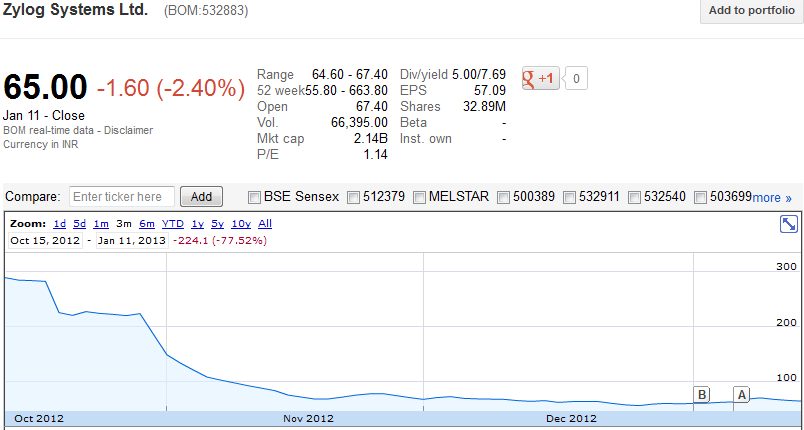
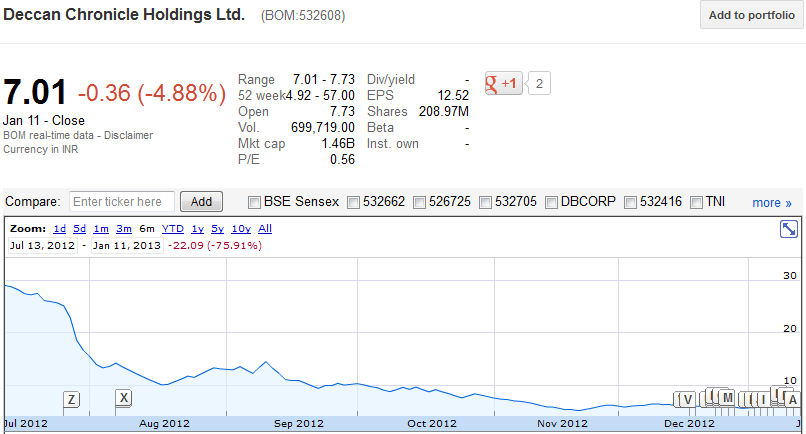
You may have heard about the fiscal cliff drama in the US. We have some companies which have already gone through their own version of the cliff

Look at some of the price action below


As you can see in  these two cases, the price has dropped by 75% or more in the last 6-12 months. I normally ignore fluctuations in stock price, as most of it is noise. However a drop of 75% or higher is a signal that something fundamental is happening.
Why analyze failure

The question is why bother to analyze such cases? I subscribe to the philosophy that if one wants to be a good investor, then one should study and learn from exceptional success and failure. One should not only analyze companies which have done well in the past (such as Hawkins or titan), but also look at the companies which have destroyed a large amount of shareholder wealth.

The best reason for analyzing failure is illustrated by the phrase – invert, always invert, by Carl Jacobi who said that one of best ways to solve some problems is by inverting them.
As Charlie munger has said, if you want to succeed, learn to avoid failure. If one can identify why the above companies dropped off a cliff, one can use that learning to avoid such cases in the future.

Is it all fraud?
It is easy to ascribe the drop to some kind of fraud (as it happened in the case of satyam) and avoid any further analysis. I think that is intellectual laziness and will not help us learn anything.
I would like to put the above examples in two buckets

  1. Attractive core business, with management diversifying into poor businesses with heavy leverage
  2. Mediocre core business with poor cash flow resulting in high debt

Poor diversification and failure of corporate governance
You can read the story of Deccan chronicle here. In a nutshell, the company had a very profitable core business – newspapers and diversified into loss making ventures such as Deccan charges, retail ventures etc.

Over time these cash guzzling businesses consumed the entire cash flow of the core business and more , resulting in high levels of debt on the company. The management on its part, hid the problems and the extent of the debt from the shareholders. When the same was disclosed, the stock price collapsed.

It was not easy to see this problem coming (atleast to me) as the annual report as late as 2011 did not display any kind of serious problem. We had a failure of corporate governance and lack of appropriate disclosures (fraud or not, I am not sure).

Weak core business

The case of zylog systems is different. If you read the past annual reports, you will be able to see that the company has not been generating adequate free cash flows and has funded the high levels of growth via debt. The ‘cliff’ seems to have happened due to the following events

  1. poor operating performance resulting in cash flow problems (in addition to commoditization of the core business)
  2. Cash flow problems resulting in higher debt which was taken to fund the growth
  3. higher debt resulting in promoter pledges to get the funds
  4.  Point a. causing the stock to drop, resulting in margin calls and forced sale of the pledged stock.
  5. The forced sale, causing further steep drop in the stock price

Difference between the cases
Although the end result is the same (as of today), the underlying cause is different. In addition, it is easier to identify companies with a weak core business (and high debt and promoter pledge).

In comparison, companies like Deccan chronicle had a healthy amount of cash on the balance sheet until it suddenly became known that there were a lot of hidden issues (and debt). Such companies are more difficult to identify and one is likely to only get some faint signals that there is something out of place.
Learnings

So what can one learn from the above cases ? Let me share mine

  1. Follow the cash flow, ahead of the profits. If the company is showing a high level of growth, which is increasingly funded by debt, one should get cautious. It is a time bomb, which can blow up if things don’t play out as planned.
  2. Poor Capital allocation – if the management is investing in all kinds of ventures with a history of poor profitability, then one should avoid such companies . These kinds of decisions eventually catch-up with the company.

Disclosure : Have invested a tiny amount  zylog from a tracking perspective.  Please make your own decisions and read the disclaimer

Trading on noise

T

Mid-caps and small cap stocks have an average standard deviation of around 18-20% per annum. The implication of this factoid is that these stocks can drop or rise by 15%+ over a year for no fundamental reason at all.

Anecdotally most of us have seen a drop or rise in the stock price by 15% or more within a quarter, even in absence of any stock specific news. One can say that the stock price in such cases is being driven by noise.

What is noise?

In layman’s term, noise is variation without any underlying cause. In other words, the probability of the upside or downside is around 50%, which is the equivalent of a coin toss (random event). So if you expect a 15% variation due to noise, the probability of increase or decrease is the same with the expected value being zero ( expected value = 0.5*upside+0.5*downside)

Trading on noise

If your trading or investing strategy involves a 15-18% upside on the current price within a year, it is quite likely that the stock price may rise for no reason other than random fluctuations. In such a scenario, you may end up making money for no specific reason – though you may think that it was the result of your accurate analysis.

The risk of making money in such a way is that one ends up with the wrong conclusions, even though the real  cause of success was sheer luck (for further understanding of this phenomenon , you should read the book – fooled by randomness).

In addition to a faulty understanding, the long term returns can turn out to be sub par as the expected value for a series of such trades is essentially zero (upside and downside being equally likely).

Financial news is all noise

I am sure most of you have watched the financial news channels. Almost 90% of the time is spent on explaining the fluctuations during the day, which for the predominant part is just noise. Ofcourse you will get some information or insight if you spent the entire day watching this circus, but it is like chewing a ton of grass to get a litre of milk.

There are far more efficient and easier ways to get the required information – annual reports or magazine articles being some of them. One should watch these channels for entertainment and not for information.

Noise trading quite pervasive

If you think that trading or investing on noise is a rare occurrence, you may be mistaken. I am sure most of you would have seen analyst reports or talking heads recommend some stock with a 10-15% upside in the short to medium term.

If the random fluctuation of stocks is 15% or more, then some of the recommendations will achieve this upside for no reason at all. The unsophisticated investor would erroneously consider the analyst to be skilled at picking stocks and may start following such people or worse, even pay for such advise.

How to see through such tricks?

I will suggest a simple set of rules to ignore analysts and their stock picks if the following is true

          A price target with a 15-20% upside within the year

          A success rate of 55% or less in terms of success rate (preferably over a year)

          Completely confident and sure of the picks (no allowance or probability of error)

Now, you may be thinking that the above is an unrealistic and harsh set of expectations. Let me ask you this – In your job or business, does your boss or customer give you a raise or money for being wrong more than 50% of the times?

As far as I know, if someone goofed up 20% of the times or more, he or she will be out of a job or business. Why should the expectations from an analyst be any lower?

Vote on an article topic

V

update: 23-12
A lot of readers have responded to the survey. My personal thanks to all of you, who have responded.

The topic which got the maximum vote is – How to search for and analyse investment ideas ?

The balance questions were ordered in the following manner with the second and third place a close tie
How to read and analyse an annual report – second place 
Discounted cash flow analysis – third place
My goofups and learnings of 2012 – fourth place
Portfolio management for professionals – fifth place

I will be putting together a post over next month, for the topic which got the highest ranking  I will take up the next two topics too in due course of time.

The topic which was my favorite – about my magnetic personality 🙂 got 15% votes. atleast 15% of you like my magnetic personality !!! 🙂

—————————————————————————————————————–
I get emails from a lot of readers to write about various topics. The topics requested are important for most investors and I think a majority of the readers of the blog would benefit from them. 

I have put a poll on the list of topics which have been requested in the past (except point 6) and would write on the topic which gets the most votes. If you want a different topic to be written about and is not on the list, please leave a comment and i will take it up in a future poll. 

I am sure you can guess, which topic will get my vote 🙂

Triveni turbines limited – Waiting for growth

T

About
Triveni turbine is a Bangalore based company in the business of manufacturing and servicing steam turbines upto 30 Mw. In addition the company has a JV with GE (general electric) for turbines in the range of 30-100 Mw.

The company has around 2500 turbine installations globally and is a market leader in India in the sub 30 Mw range with a market share of around 55%.

Steam turbines have multiple applications such as co-generation, captive power plants, and Industrial drives and in ships. The company supplies industry specific turbines to multiple industry segments such as sugar, cement, steel, chemicals, municipal solid waste and textiles.

Financials

The company was spun off from triveni engineering in 2011, which also has a sugar, water management and gears business. The turbines business has grown from around 280 crs in 2006 to around 670 Crs in the current year at a CAGR of around 13%. PBT has risen from around 37 Crs to 140 crs in the current year at a CAGR of 20%+.

The company has been able to maintain an operating margin of roughly 25% during this period and a return on capital in excess of 100%. The company is able to earn such a high return on capital due to negative working capital and high operating margins.

Positives

The company earns a very high return on capital which points to the presence of a sustainable competitive advantage. It enjoys a very high market share in India and is now expanding into export markets too

The company also has the following four growth engines working for it

      Industrial demand for power via captive power plants. Additional demand from co-gen opportunities
      Service demand from the install base and for turbines of other manufacturers.
      Demand from the JV with GE in India and abroad for the 30-100 Mw range
      Export demand for sub 30 Mw product range

In addition to the above growth opportunities, the company is currently running at around 40-50% of capacity and can expand sales with minimal capex.

Risks

The key risk for the company is a delay in the revival of the capex cycle. The investment cycle has slowed down in India and in the export markets. As a result the company has struggled to grow the topline and profits in the last 2 years. If the capex does not revive, the company could face stagnant profits for some more time.

Competitive analysis

The key competitor for the company in India is Siemens. However companies like Siemens and BHEL have a very wide range of products and are not as focused on a single product in a narrow range (below 30 Mw). Most companies in this sector enjoy a decent return on capital and hence triveni turbine should continue to earn a high return in the foreseeable future.

Management quality checklist

          Management compensation : reasonable at around 1-2% of profit
          Capital allocation record : In the short operating period as an independent company, management has used the free cash to pay down the debt and the company should be debt free by the end of the year
          Shareholder communication – fairly good. The company shares adequate details via the annual report and quarterly investor updates and conference calls.
          Accounting practice – appear conservative
          Conflict of interest – none

Valuation

The company is currently selling at around 20 times earnings. On the face of it, this does not appear to be cheap. At the same time one has to look beyond the raw numbers. The topline and profits for the company have stagnated in the last 2 years with a complete collapse of investment demand.

During this period, several capital goods companies have made losses and have seen their working capitals blow up. During one of the worst downturns in the sector, the company has remained solidly profitable and continues to operate with a negative working capital.

In addition the company expanding its export business has a thriving and growing turbine services business and should see additional revenue from the JV with GE. We may not see a PE expansion as the company is already operating very efficiently, however as the topline and profits start expanding, we should get a return commensurate with the growth.

Conclusion

The company operates in a niche and has a sustainable competitive advantage due to its customer relationships and service network. In addition the company has formed a JV for the 30-100 Mw range which should enable it to expand the target market for its products.

The company’s performance has stagnated in the last 2years due to the macro economic conditions. However the long term prospects remain intact and the company and its stock should do well in the long run.

Disclosure: No position in the stock as of writing this post

Stocks discussed in this post are for educational purpose only and not recommendations to buy or sell. Please read disclaimer towards the end of blog. 

2013 market predictions

2

We are approaching the year end and soon the experts will start coming out with their predictions for next year. As there is a lot of competition to be the first one, I decided to get ahead in the line by kicking it off in November itself

So here goes
1.    Barring any macro-economic shocks and if sensex earnings exceed 15%, the stock market should be up next year. If however we have a crisis in Europe or we get an oil shock then the index could even touch 10000 levels.

2.    Gold could be up by 10%, if we get a major recession in US due to the fiscal cliff and it could surprise us on the upside if it coincides with the further instability in Greece and Spain. Over the long term, the macro-economic and supply-demand drivers point to a continued increase in gold prices.

3.    Capital good stocks in India could surprise on the upside if the current momentum on the reforms continue. One needs to focus on high quality names in the sector

4.    The consumption story continues to play out and high quality names should outperform the market in 2013, barring any sudden depreciation of the rupee. Demand from consumption centers, such as India and China largely seem to be on a firm footing

5.    The real estate market will continue to face headwinds of high interest rates in the initial part of the year, but if  RBI starts cutting rates in the second half, we could see higher activity in certain pockets of the market

6.    Rohit Chauhan will become the smartest and richest investor in the Indian stock markets.  President Obama and other world leaders will seek his counsel on how to fix the developed economies J

Did I get you? Do you realize how absurd these predictions are?
There is a consistent pattern in all these predictions. They are not predicting anything and are simply stating that a market will go up if all conditions are right, otherwise it will go down (if the conditions go bad). This is similar to what you would hear from an astrologer if you were to ask him about your future.
One more point – I did not make up all these predictions. I just googled some sites and cut and paste what I found for 2012 (yes for the current year !!).
If you really feel the urge to get some predictions for 2013 on the cheap, please email me and send me 10 Rs. I know a guy on the street with a parrot, who for 10 bucks , will ask his bird to pick a card and will use the card to tell you the future. The parrot is a better fortune teller (50% accuracy), is crisp and short (no beating round the bush) and much cheaper.

For the patient investor: ILFS investment managers

F

About
IL&FS investment managers is a private equity/ fund management company promoted by ILFS (50.5% ownership). The company is in the business of raising funds from investors (institutional – both in India and abroad) in the form of individual fund offerings.

These funds have their individual mandates such private equity investments, infrastructure or real estate type investments. The company is responsible for investing the funds, managing the risks of individual investments and then finally working out exits from these investments. The company has been fairly successfull in managing the funds, generating 20%+ returns on most of the funds in the past for the fund investors.

The main source of revenue for the company is the fixed 2% management fee on these funds and an override on the returns over a threshold (a percentage of the gains made, above a threshold)

Financials

The company has delivered a 35% growth per annum over the last 8 years. The company earned around 225 Crs in 2012.

The company has grown the net profits at around 40% over the same period and made around 74 Crs in 2012. The main cost for the company is compensation for the employees and overhead expenses incurred on launching and operating the funds. The company has been able to maintain net margins in excess of 30% in the last 10 years.

Finally, the company has been able to maintain a high ROE of 30%+ and if one excludes the excess cash on the balance sheet, the ROE would be in excess of 50%.

Positives

The business requires minimal incremental capital to grow. The main assets of the company are the brand, its relationships with clients and the skills/knowledge of its employees.

The company needs very little capital to grow (some extra office space and maybe a few computers) and hence the entire profit is truly free cash flow. The company has consistently maintained a high dividend payout ratio in the past (over 50%) and used the excess capital to acquire a new fund (saffron) in 2010.

The company has a long operating history in raising and investing funds in various opportunities in India with good results (returns in excess of 20%). As a result the company has a good reputation with current and potential investors which should help the company raise additional funds from the clients in the future.

Risks

The company operates in a very competitive environment with minimal entry barriers. The company now faces stiff competition from a large number of Indian and international competitors such as hedge funds and other private equity funds. This has resulted in higher competition for raising India specific funds and investing the same in attractive opportunities (businesses) in India. This could result in lower returns for the fund investors and hence lower income for the company in the future.

The slowdown in the investment cycle, recent actions by the government such as the GAAR fiasco and other global macro-economic factors have made it difficult for the company to raise new funds. In addition the exit timelines for the fund investments have increased due to weak stock markets, resulting in lower returns for the fund investors. All this has impacted the revenue of the company which depends on the volume of funds managed (AUM) and the carry (excess returns over a threshold). It is unlikely that the investment cycle will turn around quickly, due to which the company may face a longer period of low revenue growth or even de-growth over the next few quarters.

Management quality checklist

Management compensation: fairly high at 25% of revenue. However this kind of compensation is typical of the industry.
Capital allocation record: extremely good. The company has maintained a very high dividend payout ratio and has indicated that they will dividend out almost the entire profits to the shareholders.
Shareholder communication: Quite good. The company provides adequate details of the business in its annual reports and conducts quarterly conference calls to keep the shareholders updated on progress.
Accounting practice: conservative
Conflict of interest: none

Valuation

The company is currently selling at a PE of around 7 which is on the lower side of the past PE range of the company (6-23). A company earning an ROE of around 30% and with a 15%+ growth prospects can easily support a PE of 15 or more. The company thus appears undervalued by most objective measures.

Conclusion

The company has performed extremely well in the past and has rewarded the shareholders well. The period from 2003-2008 was a bull market for private equity and stock markets resulting in high returns for the company’s funds. This resulted in good profits and high growth for the company.

The markets have slowed down considerably since the 2008 financial crisis and the Indian government has made it worse in the last few years. As a result, the company has struggled to raise new funds which is needed to drive the topline and profits for the company. It is likely that the company will take a few more quarters before it can raise and deploy new funds and a result the topline and profits could stagnate for some time.

The long term prospects of the company are good, though it will take time for the company to start growing again. This would test the patience of most investors.

Disclosure: No position in the stock as of writing this post
Stocks discussed in this post are for educational purpose only and not recommendations to buy or sell. Please read disclaimer towards the end of blog

Investing to be rich

I

If one wants to be rich, one should learn how to invest on your own…right ? that way you can compound your capital and retire rich ! Isnt that obvious ?

If I am asking this question, you can guess I don’t believe it to be the case.
I get asked this question in different shapes and forms and a typical email goes like this

Rohit – I am currently X years old and want to become financially independent in the next 10 years so that I can purse XYZ (insert a dream here). Can you suggest how to become a better investor so that I can have enough money in a decade to pursue my dream ?
What does it take to be an active investor ?
It takes a  few hours a week for a year or so to become financially literate, which involves having a reasonable understanding of various investment options such as fixed deposits, mutual funds, stocks, and insurance etc. Once you reach this level of understanding, you can with a moderate amount of effort,  identify a mix of assets which will help you earn around 12-14% return per annum (depending on the mix of debt and equity)

In effect, you can spend a few hours a month and earn 12-14% on your assets over the long term. We can call this a baseline level  of effort.

Now lets assume that you are not satisfied with the above returns and would not settle for anything less than 20%+ levels (around 10 times in the 10 years). If you wish to achieve these level of returns, then you  need to invest atleast 15+ hours a week on learning various aspects of investing and in finding new opportunities on a regular basis.

What is the return on time in case of active investing?
So what do I mean by the term – Return on time ? Let me illustrate with an example.

Let’s look at a typical case of a young professional who has a full time job. Let’s assume the following

Annual salary in year 1 = 10 lacs
Annual savings  in year 1 = 5 lacs (I know this is too high, but we are considering an optimistic scenario)

Salary increases each year by 10% and so does the savings. This individual has two options for his/ her savings. They can be financially literate and spend minimal time (a few hours a month) and earn around 12-14% per annum or spend 15 hrs or more on investing and earn a much higher return.
Lets also assume the individual works around 40 hrs each week in his / her job  (would be higher in reality)
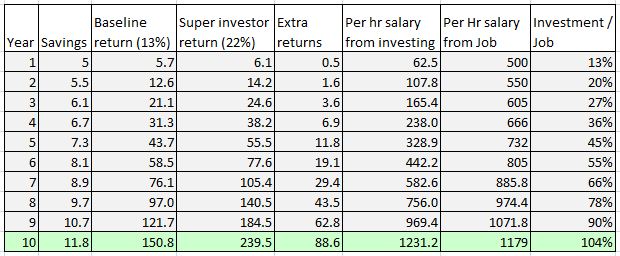
So whats does the return on time (money earned per hour spent) look like for the person in terms of active investing ?
 Lets look at the table below
I have plotted the savings, the extra returns earned by putting in  extra hours each week (15 hrs per week) and the per hour return
A few things standout,

In the initial years when one has a small level of savings and is just starting out, the per hour ‘salary’ from investing  is way below the per hour salary from a job. The higher your education or skill, the larger the gap.

This is the best case scenario. The above picture worsens if one gets hit by a bear (a certainity in a 10 year period). The last column shows that this ratio becomes favorable only after  8-9 years

Implications of the analysis

The above analysis though silly,  lead us to a fairly important conclusion. If the only reason you want to become an active investor is to make more money, then it is not a very smart way to do it.

For starters, all the time spent in the initial years will appear to be a complete waste of time. Most of the people soon realize that the extra returns are really not worth the time.
In addition, if you start late in a bull cycle (as most individuals do), the quick and easy returns are soon lost in the subsequent bear market. In most cases, such individuals throw in the towel and move on to other pursuits in life.
Finally, the additional hours spent on investing means that one does not have time for any other pursuits like having girlfriends or other hobbies  at the prime time of their life (early to late 20s).
My personal story
The above table and discussion is not theoretical. I have personally lived it for the last 15 years. I started investing in the late 90s (around 1997). I think I was financially literate by around 1998 and around that time came across the book – The warren buffett way. I read about this person who had become the second richest person by investing in stocks and was completely mesmerized by it.
I read the biography of warren buffett (Making of an American capitalist) and his letter to sharehlolders and anything else I could find about him. It was in late 1999 , early 2000 that I finally turned to active investing.
As you can see, my timing was perfect. I made some money for around 3-4 months of 2000 and then lost all the gains by the end of year – some on paper and some of it was a permanent loss as I had put money in IT/ Internet oriented mutual funds (don’t ask what I was thinking).
The years from 2000-2003 was one long bear market, where the market slowly went down from 4000 levels to around 3000 in a period of three years. If I put the numbers in the earlier table, my ‘salary’ from investing was negative, whereas I was making a good income from my full time job.
Any rational person after three year of losing money, would have given up investing and move onto something else in life. I did not even think of it as I was extremely passionate about it and inspite of mediocre absolute returns, I was still beating the market by a large margin.
The market turned in mid 2003 and as it took off for the next 5 years, so did my portfolio.
Better way to well
As you can see from my personal experience and from the analysis, that investing is definitely not a quick or easy way to becoming rich.
Let me suggest an alternative – If you are really passionate about something or good at your full time job, focus on it and get better at it. You will have fun doing it and over a decade you will make a decent amount of money out of it. Invest the money saved, sensibly by becoming financially literate and you will realize that not only is your life more pleasant , but  that you also have enough tucked away for a rainy day.
I know this is not the conventional wisdom and we have a cottage industry of people  encouraging others to invest on their own. I would rather follow my interest/ passions and become good at it (the money usually follows then), than do something just for the sake of a little extra money.
 
In case you wondering about the life I had outside work and investing early on …I am not going to disclose than on my blog and get in trouble with my wife J

Value trading

V

I am going to discuss a new term –value trading in this post. It is a very interesting concept and it was first mentioned by my good friend – arpit ranka.  I cannot claim any originality on this concept, but once it was mentioned  by arpit, I started thinking about it and found a lot of validity and relevance to my style of investing.
What is value trading? (my definition)
Value trading is best described as buying a stock with the expectation of selling the same (hopefully with a gain) in a short period of time based on the realization of a single or multiple triggers. This trigger can be fundamental in nature such as normalization of sales/ profit margins (from a temporary low), business event such as launch of a new product or new capacity or change in the business environment for the better such as moving from extreme  to moderate pessimism .
In addition to the fundamental issues, the trigger could be technical in nature such as short term overselling of a stock due to unexpectedly poor results or some temporary event such as elections which do not really impact the fundamentals of the business
In all these cases, one is expecting that the trigger will occur in the short term and the stock price will get a quick bounce (10%+) and one would be able to exit with a nice little profit
How does it differ from value investing
The above definition may sound a lot like value investing and I have been guilty of mixing the two for all these years. However as I think back, I have come to realize that they are not strictly the same and confusing the two can actually be harmful (as I will explain later in the post)
If one invests  with a long term horizon in mind, then it is critical to have a good idea of the intrinsic value of the company. In addition this intrinsic value should increase over time, if one is to make above average returns in the long run.

So in effect, one is playing a short term trigger in the case of value trading versus betting on the business in the case of value investing.
Examples of value trading
Lets look at some example I have posted in the past and look at which bucket these ideas fall into

  1. Patels airtemp
 I would call this ideas as a value trading idea as this company is in a highly cyclical industry. At the time of buying the stock, I was expecting that the downturn in the capital goods industry would not be deep and the fundamentals of the company and  its stock price would soon bounce back.
The trigger has yet to happen and as result the stock has slid further since the time I wrote about it.
  1. Ashok Leyland
I started looking closely at this company in mid 2008 and by the end of the year the bottom had fallen out of the commercial vehicle market (the company stopped production for a month in dec 2008 to reduce the inventory). I purchased the stock in early 2009 at highly depressed prices.
The trigger – normalization of commercial vehicle sales happened quite quickly towards the end of 2009 and the stock turned out to be a four bagger.
In both cases, I expected a normalization of  the fundamental performance and a bounce back in the stock price. In one case it happened faster than expected resulting in a large gain and in the other case the downturn has been deeper than expected and hence the stock price continues to languish
  1. Amara raja battery
The company is a no.2 player in the battery industry and operates in a close duopoly. The key insight in this idea is that the company is expanding its competitive advantage (brand and distribution) and also benefiting from  migration of demand from the un-organized to organized sector
I would tag this as a value investing idea as i don’t expect a specific trigger other than the fact that the company is improving its competitive position and hence should see an improvement in profitability and growth.

The first two examples I have discussed should bring out the following key point – In a value trading idea, the intrinsic value may not expanding or could be declining too. However the stock is undervalued and a set of triggers could close the gap with the intrinsic value. You can call this mode of investing as deep value investing or graham style investing too.
The last example of amara raja is more of a buffett style, high quality stock where although  one is expecting the gap with the intrinsic value to close, the bigger gains come from an increase in the value of the company itself.
The differentiating factors
The two modes of investing differ on several factors. The first factor is time – Time works against you in the case of value trading. If the trigger happens quickly,  the price rises quickly to the fair value and one can exit with a nice little profit. On the other hand if trigger gets delayed, then the overall returns may remain the same, but the annualized return is much lower.
In case of value investing, time works in your favor. As the company continues to grow its intrinsic value, the stock price should hopefully follow it (some times in spurts) and thus the idea becomes a buy and hold kind of idea.
The second factor where these two approaches differ is the nature of the business. The value trading approach works better in commodity  and cyclical industries. If one can catch the bottom of the cycle and bet on a tier 2 or tier 3 company in the sector, then the gains are very high when the cycle swings back to a normalized level. At the same time, one needs to also ensure that the stock is sold once the cycle has turned .
Value investing approach works where the economics of the business is good and the company has a competitive advantage. In such cases, if one buys the stock at reasonable valuations, then returns are good over a long period of time
Do not mix the drinks !
I would say that value investing or long term investing should occupy a larger portion of the portfolio. If however you have the time and energy to look for  value trading kind of ideas and can play them well,  the portfolio can get an extra boost from time to time
The danger is really from mixing the two approaches as I have done in the past. I have bought  trading kind of ideas and held on to it for a long time (assuming it was a long term investment). In such the cases the absolute returns came through, though the annualized returns were mediocre due to a delay in the key triggers.
The correct approach would be to keep in mind the nature of the idea (trading v/s investing), identify the triggers and the time it would take for the same to play out. If the triggers change or get delayed , then one should exit a value trading kind of idea. In contrast in a value investing idea, time is working in your favor and temporary hiccups are sometimes a good time to add to the position. In all such cases, one should just sit tight with the position.

Subscription

Enter your email address if you would like to be notified when a new post is posted:

I agree to be emailed to confirm my subscription to this list

Recent Posts

Select category to filter posts

Archives