
Blog

When the tide goes out

W

‘Only when the tide goes out do you discover who’s been swimming naked ‘– Warren Buffett.

It’s now clear to the entire world, that we as a country have been swimming naked. If you look at the last 50 years of our history, the 2003-2008 period looks more like an aberration or accident. We benefited from a wave of liquidity and enthusiasm for the BRIC countries (including India) and as a result were able to grow in excess of 8%, inspite of not having the institutional structure (such as a responsive bureaucracy) to support it.

Now the tide (liquidity and enthusiasm) has gone out and the visible symptom of years of mis-management is the crash of the rupee. I am extremely pessimistic about the macro picture and the ability of our political system to fix it.

….and yet my finger is itching to press the buy button !!!

No, I am not blind to the risks and as depressed about the country as any other Indian. Let me explain my reasoning behind this apparently contradictory stance.

What are the options?
Let’s define the problem – The main outcome of the currency crash and other macro problems on the common investor is a further rise in inflation. We are likely to see double digit inflation for some more time. This is likely to destroy the real value of our capital if we do not find means of protecting or growing it.

So if you have some capital (equity, real estate, cash  or FD) with you, what are the options for it ?

If you decide to hold cash or some form of an FD (which seems to be the safest bet), you have to keep in mind that the real return (after deducting the 10%+ inflation) is likely to be negative. For reference – do a search on East Asian crisis of the 90s and other such events in the past. You will realize that any form of fixed income investment did far worse than other alternatives.

The second option is real estate. I have been pessimistic about real estate for a long time and with low gross yields of 2-3%, think it is overvalued. However if one has the skill to find some undervalued property and can hold on to an illiquid investment for some time, then this could be a possible option. At the same time, if you are thinking of using a loan  to finance it – forget about it. If the currency rate continues to depreciate, we may see a further rise in interest rates (which has already started) and the loan which you are planning (or already have), may become even more expensive.

The next option is gold. This seems to be a good option as it is likely to hold value in real terms as the currency continues to depreciate. I think there is some truth in it – though I don’t think I understand how to value gold and hence I am not likely to go for it. In addition, gold at best is a defensive option (will protect principal, but unlikely to grow it in real terms over the long term)

I know that readers of this blog already know where I am going with this logic – equities. But before I get there, let me digress a bit.

I think the number one asset to invest at any point of time is you. If you invest (money and time) in developing your skills and become really good at whatever you do, then macro factors are unlikely to impact your earnings in the long run. If you are a talented, the market will pay you for what you are worth (and more of it in a depreciated currency).

The last option, which seems to be the most risky is equities. The reason it appears to be risky is due to the vividness of the risk. If you own a stock and inflation rises, the impact is visible immediately. On the other hand, options such as cash or real estate seem to be safe as we do not get a quote on it daily. However that is just a false sense of safety as the real value is eroding silently. A fixed deposit or debt instrument in the last five years has lost value due to inflation and so has real estate (if it has not appreciated by more than 12% per annum).

The case for equities

One can easily point out that equities are no better as the index has dropped in the last five years and hence the loss is even higher in real terms. That is true if you have been invested in the index for the last few years. At the same time, there are several companies such cera sanitaryware or crisil which have done quite well during the same period.

The key point is this – if you are an investor who can evaluate stocks (as quite a few readers of this blog are), then a carefully selected portfolio of above average companies (defined by high return on capital and good management) has done quite well in the last five years in spite of the extreme macro environment.

Let’s look at the same point mathematically – If you are able to buy a company, which is earning around 20% return on capital (and can do so for the next 3-4 years), one is likely to double his money in this period (unless the economy implodes completely) if the valuation remains the same. Finding such a company is not easy, but if the market keeps dropping, one is likely to find good companies at attractive prices

There are some caveats to the above suggestion –

You have some amount of skill in finding good companies. Investing blindly worked only from 2003-2008.

– You have the patience and courage to hold onto stocks when the market is collapsing and everyone around you is heading for the exits

You don’t need the money in the next five years. If you are retired or need money in the near term, please don’t think of putting it in the stock market.

My plans

I keep a wish list of stocks – these are companies which I would like to buy, but the price was never attractive in the past. One such company was crisil, which I bought in 2008 and have held on to it since then. There are a few other companies such as ITC , Marico (and more) in the list which I am watching. If the market keeps dropping, my wish may come true.

In summary, if you want to protect your capital from the impact of inflation, you need to find investments which have the capability to generate a 20%+ return on capital and are priced reasonably. If you look at the history of various asset classes across countries and time periods, equities come closest to it.

—————-
Stocks discussed in this post are for educational purpose only and not recommendations to buy or sell. Please contact a certified investment adviser for your investment decisions. Please read disclaimer towards the end of blog.
Facing despair

F

I was planning to continue on the previous post – ‘Failure to sell’ , but decided to write on a different topic as I have been receiving quite a few emails – full of despair and frustration.

A lot of young investors, who came of age in the early 2000s, entered the workforce when the economy was booming. If you passed out from a half decent college, you could get a decent job with a good starting salary.

As the economy was growing at 8%+, it was common for employees to be given 15% salary hikes (people quit in disgust if the raise was less than that) and the high performers got promoted every other year.  In addition, flush with cash, some of the same people invested in the stock market or real estate and saw their net worth double in a few years.

You did not have to work too hard to do well

We are not entitled to be rich

I am going to ruffle a few feathers, but let me still say it – We had a dream run from 2003-2008 and now it is over. The days of 20% salary hikes and 30% stock returns are gone (at least for now) for the masses.

If you are really good at your job or in investing, you may get above average raises or returns, but that is not going to be the norm for everyone

If you entered the workforce in 80s or 90s, you may have seen tough times yourself (or maybe your family did). The reason why the current slowdown feels horrible is because our expectations are high now. Don’t get me wrong – I am equally angry with the government for running the economy to the ground.

Keep grinding

I  faced a similar market from 2000-2003, when the market dropped by around 50% over a three year period. At the market bottom in April 2003, capital goods companies like BHEL, Blue star were selling at 5 times earnings. The current market darlings like Asian paints (15 times PE), Marico (around 5-7 times PE) and other consumption stocks were selling a very low PEs too.

At the risk of getting philosophical, I can think of the following things to do this time around

– Assess your risk tolerance:  If you have trouble sleeping in the night after seeing your portfolio drop by 10-15% ,  you should reduce your level of equity holdings.  My thumb rule – will I be able to sleep well if my portfolio dropped by 40%+ ?

– Clean out the trash: Now is a good time to clear up junk from the portfolio. A bear market and 40% loss on weaker ideas concentrates your mind. One should evaluate each position closely, sell the weaker ones and redeploy the cash in the better ideas.

– Have faith:  There is no data or logical argument which can make you hold on to your stocks or add money to it. You need to trust that the markets will recover in time and so will your portfolio.

It is easy for people to say that they want to think independently and stand apart from the crowd. Now that that we have a blood on the streets and no end in sight, you will know whether you can truly do that.

At the risk of looking foolish, I plan to keep adding to my positions.

Edit : I have a day job to support my family. I will not starve even if my portfolio goes to 0. I would not do the same thing if I was living off my savings.

Failure to sell

F

Bear markets are a good time to reflect !

In a bull market, any pick – good or bad, goes up and everyone feels like a genius. However at times like now, where any kind of mistake is brutally punished, it is easier to uncover flaws in one’s investing process.

So, I have been thinking about my investing process and have realized that one part of my process is exceedingly weak – The selling process

Why should one worry about the process ? If you are interested in understanding it in more detail – read this noteon ‘process versus outcome’. In a nut shell, if you get the investing process right, the outcome (investment returns) will take care of itself.  It is the equivalent of getting your batting technique right, if you want to be a good batsmen and get high scores consistently.

Over applying buy and hold

As most of you are aware, I am heavily influenced by warren buffett and his investment philosophy. My introduction to investing was through his ‘shareholder letters’ and as a result, I have taken his teachings to the heart.

One of the key tenets of buffett’s philosophy is buy and hold, where one looks for companies with sustainable competitive advantage and buys them  at a reasonable price. Once you make the purchase, buffett advises the investor to hold for long periods of time (provided the business maintains its competitive position)

The above is a very sensible approach and would work for majority of the investors. At the same time, the key point in the ‘Buy and hold’ philosophy is to buy a high quality company where the intrinsic value is growing and let time do its magic (via compounding).

The unsaid bit is that it is often dangerous to apply this approach to other type of companies such as cyclical or deep value plays. I have done that in the past, leading to poor results

A differentiated approach
It has become slowly dawned on me (I am slow learner J), that one needs a more nuanced approach to sell, depending on the nature of the investment. In the rest of this post and the next, I will try to  categorize the various types and look at the sell approach one needs to adopt for each of them – This is ofcourse a work in progress and by no means any kind of rule set for me.

Cyclicals – As the name suggest, this group includes companies which are heavily impacted by  the state of the  economy. This group would include metals, cement, auto and capital goods  type of companies.  The defining feature of these companies is the high profit levels at the top of the economic cycle and the steep drop in the same(leading to losses sometimes) when the economy goes into the reverse.

Such companies look cheap when the economy is doing well and expensive when things are bad, such as now.  If you were to buy and hold such companies over the course of the entire economic cycle (from bottom to top to bottom), the overall returns would be very average. The key in such type of investments is to be able to buy when the company is at or near the bottom of the cycle (difficult to identify usually) and sell as the business recovers – without waiting for the cycle to top.

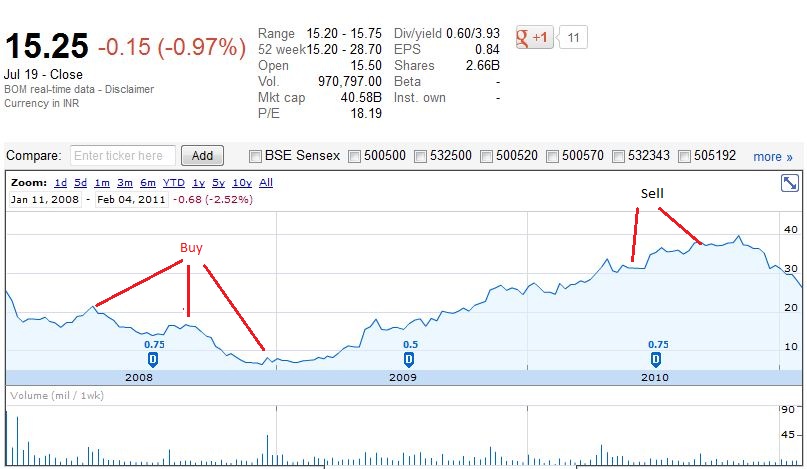
There is a perfect example for this type of an investment – Ashok Leyland.

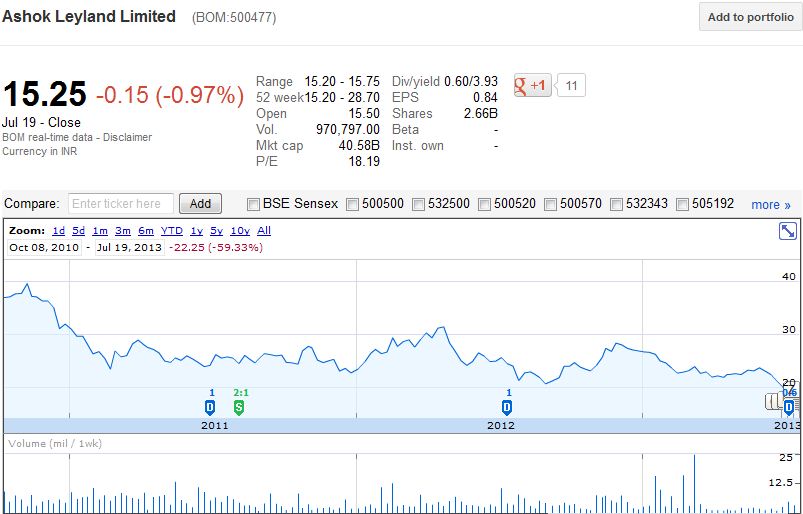
I wrote about the company herein 2008 and kept buying it as the stock crashed during the lehman crisis. My average cost basis was around 11 / share (post split).  I was out of the stock by mid 2010. You can see the price action below

The timing was perfect and as much I would like to think that it was my brilliance, it is usually due to plain dumb luck.

The commercial vehicle business turned in 2010 and has been going downhill since then. The stock price has followed suit

If I had held the stock from 2008-2013, I would have made around 12% per annum , which is not bad but nothing to crow about too.

So the key point with cyclicals is this – Buy and hold does not work (usually) and timing is critical for above average returns

To be continued ……………

—————
Stocks discussed in this post are for educational purpose only and not recommendations to buy or sell. Please contact a certified investment adviser for your investment decisions. Please read disclaimer towards the end of blog.
Its panic time – time to make some money

I

v\:* {behavior:url(#default#VML);} o\:* {behavior:url(#default#VML);} w\:* {behavior:url(#default#VML);} .shape {behavior:url(#default#VML);} Let’s see what all has gone wrong and may get even worse

          Rupee has depreciated to 60/ dollar and may drop further
          The drop in rupee is causing imports to become more expensive, which is keeping the inflation high.
          High inflation is causing the RBI to keep interest rates high, which in turn is depressing growth rates
          High current account deficit is causing the rupee depreciate and can also result in a balance of payment crisis (similar to 1991)
          The government is running huge fiscal deficit which crowds out private investment. In addition, it does not have the same ammunition as 2008 to counter any slowdown
          Corruption and governance issues remain and there is no will to change it in the future.
 
Have I missed anything negative? It is actually a surprise that markets have not dropped further. Actually, let me take that back.
The midcap and small cap index has dropped by 15% and 22% respectively and large caps have not dropped as much, because FIIs have been pumping money (which has now started reversing). So we could have another crisis if the FIIs, were to sell even more in response to the falling rupee.
I think most of you know all this and need not be reminded about it.
Panics are always around
 
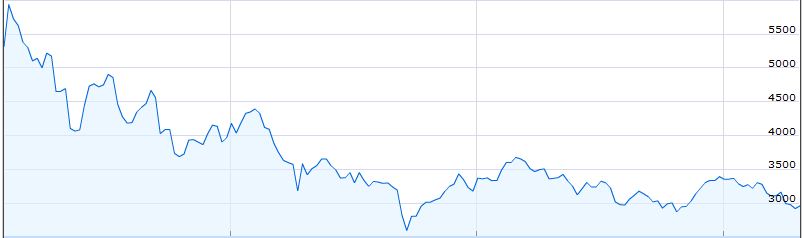
Lets look at a graph

This look like the index from 2008 to 2009 …right ?
No, this is the market drop from Feb 2000 to May 2003. The market dropped 38% during this period, with IT stocks dropping even more.

 My point is that market drops happen from time to time and is the risk of earning high returns. The mistake most investors commit is to extrapolate recent events into the future. An investor looking at the market in 2003 would have missed one of the biggest rallies from 2003 to 2008.

The converse also holds true – something which has done well in the recent past, can go down too.

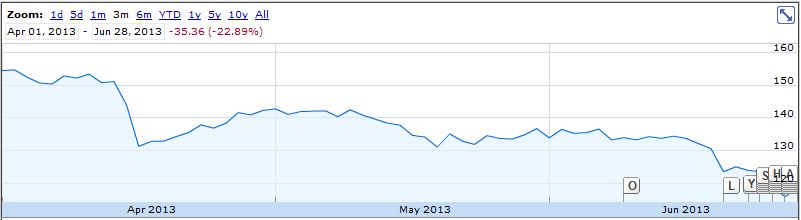
The above graph is not of a stock, but of the favorite investment option of Indians – Gold. Very few would have imaged gold dropping by 20% in 6 months.
 
Panic is a great time to buy
If you have studied history and can keep a cool head, then panics are a great time to buy. The pre-requisite is that one should have done his or her homework in advance, and is ready to act when panic strikes and drives prices down.
 
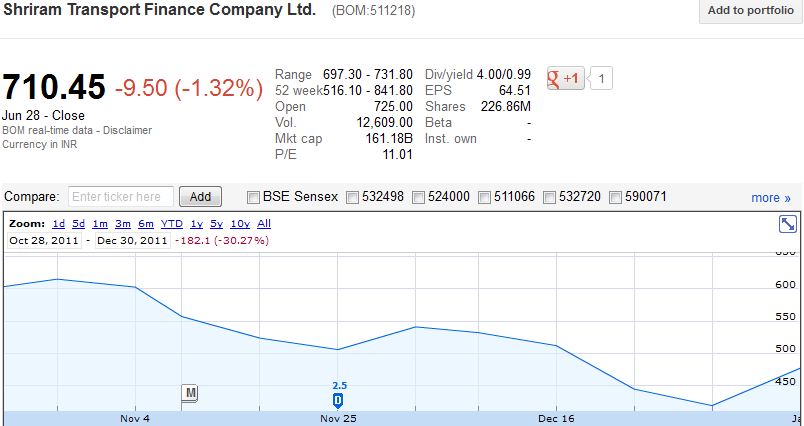
Let me show you a recent mini panic in 2011 – In financials. The market became concerned about the asset quality (rightly so) and knocked down prices of companies by almost 30% in a span of 2 months
A person buying during the panic would be up by around 50% since then.

Where is the panic now ?
I think we are in the panic territory in small caps and almost getting there is mid caps. If FIIs start pulling out, we may see a full blown crash across the market including the large caps.
Do I know if that is going to happen ? No I don’t. I do know that prices are getting cheap and it will soon be shopping time.  I may even buy gold if it drops another 20% !!!!

—————-
 Stocks discussed in this post are for educational purpose only and not recommendations to buy or sell. Please contact a certified investment adviser for your investment decisions. Please read disclaimer towards the end of blog.

Self torture

S

I wrote about two companies in January – Deccan chronicles and Zylog systems (read here)

In case of deccan chronicles, the stock had  dropped more than 90% from its peak and a debt default and other allegations were already in the newspapers.

In case of zylog, my impression from reading the annual reports was summarized as follows

  • poor operating performance resulting in cash flow problems (in addition to commoditization of the core business)
  • Cash flow problems resulting in higher debt which was taken to fund the growth
  • higher debt resulting in promoter pledges to get the funds
  • Point a. causing the stock to drop, resulting in margin calls and forced sale of the pledged stock.
  • The forced sale, causing further steep drop in the stock price

As part of the disclosure, I indicated in the post that I had a very small speculative position in the stock and in the comments section provided the following rationale for it

zulfiqar

i am testing a hypothesis that the management will fix cash flow problems and the business is worth more than the current mcap.however it is a speculative position with a large probability of loss. it is also a very tiny, insignificant position

hi anil 
i would not call such postions a mistake. i do such things actively – on very tiny amounts these position have a large learning value which is worth more than the money lost. one could get the same by just watching it, but when you put real money, the experience is very very different. it helps one in avoiding such mistakes in the larger serious position.

A new update

On June 14th, SEBI barred the promoters (read here) from buying or selling any securities in the stock market

The key points in the news article seem to be the following

Sebi had, suo moto, carried out an examination in the scrip of Zylog Systems in view of surveillance alerts regarding variation in price. Sebi during examination of the scrip prima-facie observed that the company provided misleading information to the stock exchanges wherein it stated that its promoters have been buying and increasing their stake while actually the promoters were net sellers and their shareholding declined due to invocation of pledge by financiers. Similar misleading clarification was also given by the promoter of Zylog Systems, Sudarshan, to the media.

Sebi order said that Zylog Systems disclosed incorrect and false information in the quarterly shareholding pattern for the four quarters in the year 2012 to the stock exchanges by overstating the holding of the promoters and understating the quantum of shares pledged by the promoters.

Sebi also observed various instances of non-adherences to accounting standards and listing agreement in the annual report by Zylog Systems.

In addition to the above, the latest results show that the promoters have pledged close to 95% of their holding in the company (up from 75% in the previous quarter)

What next
As I indicated in the earlier post, I created a small tracking position to follow the company and confirm my thesis that the debt/ cash flow problems are temporary and should get solved.

I am not sure if the thesis will turn out to be correct or not, but the SEBI order changes the whole picture. I am fine with poorly performing businesses and will hold the stock for the long term if the management is competent and working on fixing the issues. However, if there are coporate governance issues, then all bets are off.

Although the position was small, a loss always pinches. In this case, I walked into it with open eyes – a case of self torture 🙂

————————————

Stocks discussed in this post are for educational purpose only and not recommendations to buy or sell. Please contact a certified investment adviser for your investment decisions. Please read disclaimer towards the end of blog.
 

How I think about macro

H

Charlie munger (warren buffett’s partner at Berkshire Hathaway) was recently asked about his views on macro and he said something to the following effect (in my own words)

“If thing are bad now, they will get better in time. If they are fine now, something will go wrong in due course. We don’t make money by predicting the timing.
At Berkshire, we’re trying to swim well against the tide or with it, we just keep swimming.”

If you have not heard or read about Charlie munger, I would suggest that you read up anything you can find about him. He is one the smartest and wisest person you will ever come across.

Ignoring macro ?
It was fashionable among value investors to completely ignore the macro till the crisis of 2008 – they spoke about it as a badge of honor.

The pendulum has swung the other way since then. I see a lot of investors being cautious about macro, to avoid a repeat of 2008.
 
I think macroeconomic thinking can be broken down into two elements

       Understanding  industry dynamics and trying to evaluate the long term economics of the company
       Understanding macroeconomic variables such as inflation, interest rates etc and trying to forecast or guess so as to make investment decisions.

The first element is crucial in understanding the company and its profitability in context of its industry. One needs to be aware of the competitive situation in the industry to be able to figure out the long term outlook for the company.

The second element which is generally reported on by media and guessed by an army of pundits, soothsayers, forecasters and talking heads is a waste of time. Very few, if any can forecast any of these variables with any level of accuracy and no one gets it right in the long run (remember oil was supposed to go to 200$ / barrel in 2008 ?)

The comment by Charlie munger should be seen in context of the second aspect of macroeconomic thinking – there are variables such as interest rates, exchange rate etc which can impact your performance, but as they cannot be predicted , it is far better to concentrate your energy on understanding the company and its industry and learn to live with the other aspects of macroeconomics  (interest rates, inflation, exchange rates etc)

The capital goods industry

Lets look at an example. The capital goods industry is going through one of the worst cylical downturns in the last 10 years. The last time the industy went through such as patch was in the 2001-2003 time frame (I remember those times !).

I don’t think anyone can predict with precision when the cycle will turn  (although a lot of people claim to be able to do so), but one can be sure that the cycle will turn eventually.

If you can understand the economics of this industry and can find some high quality firms at reasonable prices, I am sure the returns over the next 2-3 years will be good. Let me give a tip – Look at a company like BHEL or blue star or thermax and ask these questions

  • Are these companies likely to go out of business soon ? (current valuations seem to say so)
  • Is it likely that these companies will do well once the cycle turns ? (though we don’t know the exact timing ?)
  • Are these well managed companies with competitive advantages ? ( I believe they are)

The typical talking head on TV or broker needs to be right in the next 3 months. As an individual investor, I don’t have to play by the same rules. If I can find a company which will do well in the next 2- 3 years, I can ignore the near term outlook.
—————-
Stocks discussed in this post are for educational purpose only and not recommendations to buy or sell. Please contact a certified investment adviser for your investment decisions. Please read disclaimer towards the end of blog.
Snatching defeat from the jaws of victory

S

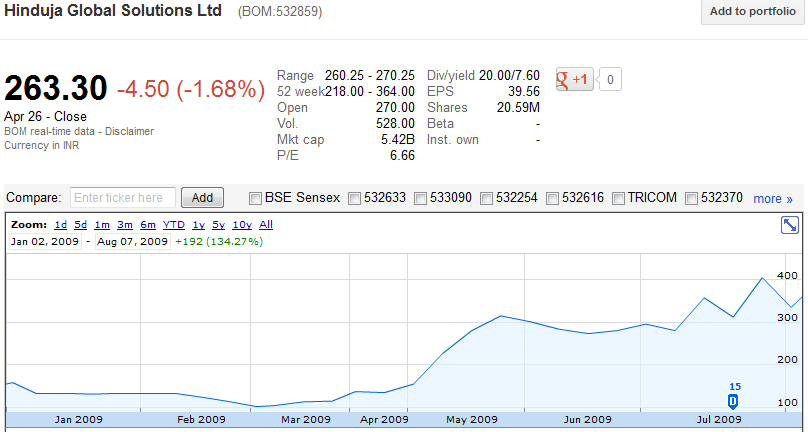
I wrote about hinduja global solutions (Now HGS) in jan 2009 (see here). The company was selling for below cash and thus the operating business was available for free.

As we know, the stock markets recovered by May 2009 and HGS was up 200% in a short span of 4 months.

In case you are wondering, this post is not about how I smartly exited in July and make 200% of capital.

The company performed extremely well in 2010. Net profits were up by 100%, Net margins hit 14% and this was inspite of the company carrying a large amount of cash on the balance sheet. I was feeling pretty smart about it.

The slow slide
 

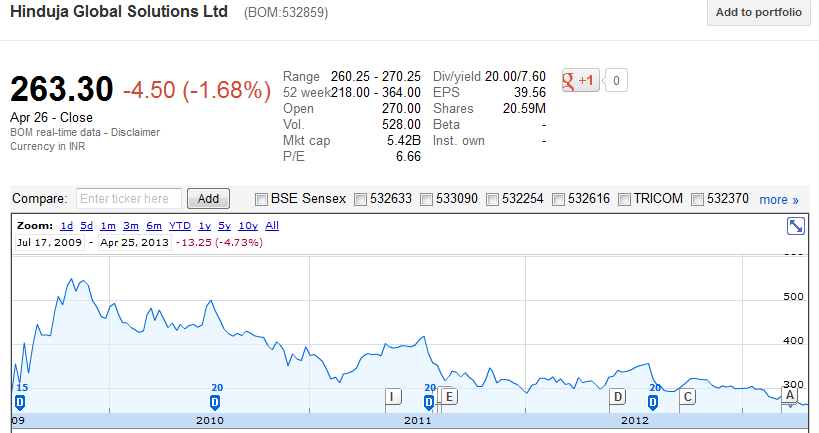
The price action from the peak in 2009 shows only part of the story. The company has increased its sales from around 900 Crs in 2010 to around 1550 Cr in 2012 at a CAGR of 30%+. The net profit  however dropped from 130 Crs to around 106 Crs in 2012 and may drop further to around 80 Crs in the current year.

I kept buying the stock during this period, anchored to the earlier levels of profitability.
The company has thus been able to grow through a combination of organic initiatives and acquisitions, but saw a drop in profitability due to lower margins and lower capital turns. In effect, the growth came through, but the economics of the industry has deteroriated during the same period. The company has gone from above average profitability (20%+ROE) to below average levels in the current year (single digit ROE)

The lessons
There are two key takeaways from the above loss.

The first lesson is that if the initial expectations on the economics of an industry do not play out, one should accept the reality as soon as possible and act on it. The second lesson for me is that I should give a higher weightage to the qualitative aspects of the business and not focus too much on the valuation. In case of HGS, the large amount of cash on the balance sheet (and corresponding low valuation) distracted me from the deteriorating economics of the business – A value trap.

The blind spot problem
I have looked at the various companies in the past and have wondered why others keep buying/ recommending it when it is obvious that the company does not have above average profitability and cannot be a good long term investment.

The thing with blind spot is that the same issues are not visible to yourself, where one may keep rationalizing your own decision for a long time.

It is not easy to accept a mistake, especially a slow one , resulting in the boiling frog problem. Hopefully this lesson will stay with me for a long time and prevent me from making the same mistake again (new ones will however happen)

Searching the debris

S

There are two numbers I want to highlight

-13% and -15%

This is the drop in the CNX midcap and CNX small cap index since the start of the year. If these numbers look troubling, they don’t even represent the vertical drop in some stocks. I wrote about some such stocks in this post and now that seems to have become a daily affair with some stock just dropping like a stone.

I have to be honest about one thing – I have never seen such bungee jumping in the Indian markets. In the good old days, the market took its own sweet time to react to any fundamental or corporate governance issue and as a result an investor had a lot of time to get off the train wreck.

No such luck these days!!
If the company you own comes out with slightly disappointing numbers or if there is whiff of a corporate governance issue, the punishment is brutal.

The good news

It would take real optimist to look for any good in this. I am in that camp.

If  you are looking closely at the carnage, you may have noticed that companies with a weak business model or poor corporate governance are getting punished severely. At the risk of sounding insensitive, I would say that is the way markets should work. A properly functioning market should reward companies with sound business models and good managements and punish the wealth destroyers.

In case you think I am being insensitive to the plight of a lot of small shareholders, let me tell you that I have suffered for my poor decisions in the past and some of my current holdings have got impacted too. The market is not a good place to discover yourself.

Digging through the rubble
 A lot of investors, if there any left, are shell shocked with this sudden turn of events.  The most common advice is to wait for the uncertainty to resolved. The reality is that the future is never certain – it is just that investors sometimes get optimistic and pay for the illusion of certainty.

One can choose to either wait for the fog of uncertainty to clear up or better yet have the courage to start digging through the debris to see if there are some gems lying around.

The first point to keep in mind is to avoid anchoring to the pre-crash prices. A stock is not cheap just because the price has dropped by 90% – look at Deccan chronicle holdings. A large drop in the stock price is a good starting point, but not a sufficient condition for a bargain

The second point to keep in mind is to look closely at the fundamentals of the company. Is the company highly leveraged and with a weak business model? In addition, it is important to avoid companies with corporate governance issues.

The final point is regarding one’s own emotions and conviction. Once you have identified a good idea and believe that the market is being irrational in beating it down, it will require a lot of emotional fortitude to hold onto the stock. One is likely to get a daily dose of negativity via falling stock prices and bad news or reports about the company. It is unlikely that a company with a beaten down price is enjoying great growth and high expectations from the market. One needs to do his or her homework that the current downturn is a passing phase and the stock will give above average returns over the next 2-3 year time frame.
I am currently looking at some of the following companies. This is just a preliminary list and I may or may invest in any idea

  1. BHEL
  2. Infinite computer s ltd
  3. Manapuram finance
  4. FAG bearings
  5. Whirlpool India
  6. Eros international
  7. Tata motors
  8. Canfin homes – thanks to ayush mittal.

I am sure some of you would have rolled your eyes on reading this list. Well, I have never been the one to buy popular stocks anyway. I am usually fishing in areas where you will not find most investors.

A roller coaster ride since 2007 and negative returns since then in comparison to double digit returns in gold and real estate means that if you tell someone that you are investing equities, they think you need to be assigned to a mental institution. It is not easy to be any equity investor these days. However if you look past the gloom, then the current downturn is a decent time to pick good stocks.

—————-
Stocks discussed in this post are for educational purpose only and not recommendations to buy or sell. Please contact a certified investment adviser for your investment decisions. Please read disclaimer towards the end of blog.
Value trade: Infinite computer ltd

V

In an earlier post, I discussed about a new mental construct – value trade. This is basically an investment operation where one buys a super cheap stock in the hope that it will become merely cheap (as my good friend neeraj puts it).
The idea is to buy a stock which is selling at dirt cheap price due to various short term reasons such as selling pressure, unexpected bad results or sheer neglect. The hope is that the market will get over this extreme pessimism (temporary) soon and will price it at slightly more reasonable levels (though still cheap). 
In such cases, I am out as soon as the stock recovers (as I have done with some ideas in the past – Globus spirits).
About
Infinite computers is a 1400 Cr IT services company. The main business segments of the company are application management services, infrastructure management services, Product engineering services and a new division – Mobility solutions.
The application management services involve the usual ADM and other support services. This is the bread and butter of the Indian IT industry. This segment contributed to around 68% of the revenue for the company and is characterized by repeat revenue, moderate levels of margins and high levels of competition
The infrastructure management services contributed around 16% of the revenue and is similar to the application management services in terms of profitability and competitive pressures. These two segments are being commoditized across the industry and the days of fantastic profits are gone.
The product engineering services involves some kind of IP based revenue sharing model. I could not find any revenue data for this segment, but based on the other segments would assume around 14-15% of the total revenue.
The mobility solutions segment is a new segment referred to as Infinite convergence solutions. This is a messaging platform (details here) acquired from Motorola and supports around 100 Mn+ global subscribers.
Financials
The company has grown from around 350 Crs in 2007 to around 1400 Crs for the year 2013 which translates to around 25% CAGR growth.  The net profit for the company has grown from around 3 Crs to around 120-130 Crs for the current year.  The net margins have improved from around 9% to around 11% levels, mainly due to a small reduction in the manpower cost (as % of sales)
The company has been able to deliver an ROE of 20%+ in the last five years. In addition the company been able to maintain receivables at around 25-30% of revenue which seems reasonable for a company of its size.
The company is a debt free company and has around 130 Crs cash on the books (30 % of market cap). The management has been investing capital into the business, has a 30% dividend payout ratio and the rest has been accumulated as cash on the books. In addition, the company also did a small buyback in the last one year.
Positives
The company has a very strong balance sheet and good returns ratio. The management has invested capital sensibly in the past and has a reasonable dividend policy in place. In addition, the top management is a buyer of the stock at the current levels (though one should not read too much into it)
The company has a high level of repeat business, which provides a high level of confidence to the sustainability of the revenues.
Risks
The company has been able to grow the topline and profits since 2007 and now has considerable cash on the books. At the same time, the company was not very profitable from 2005 to 2008 (average 2-4% margins) and had a very low topline growth of around 5% per annum during this period.
The company operates in a highly competitive, global and fragmented industry – IT services. The industry is facing commoditization and is very likely to have lower profitability in the future. The company is focused on the telecom industry which has its own competitive pressures with the additional risk of a very high proportion of revenue from the top 5 clients. This exposes the company to a high level of topline and profit risk, if there is any loss of  business from the top few customers.
Finally, the company is also expanding into the product space which is a high risk, high return kind of a business. The company has invested in excess of 80 Crs on various product related businesses and these intangible assets may incur a write down if these ventures were to prove unsuccessful.
Catalyst
In case of a long term idea, a buy and hold strategy works quite well as the company is growing its intrinsic value. In case of mid cap IT companies, the economics of the industry over the long term is not very clear (atleast to me). As a result, the returns have to come over the next 9-12 months and this is usually driven by a catalyst.
In case of infinite computer solutions, the 2013 profits have been a bit suppressed by the forex losses and once this headwind dies down , we should see a better growth in the net profits. A consistent dividend payout of 30% – growing with the profits should serve as another catalyst.
What can go wrong?  A loss of any of the top 5 customers would hit the topline and profits. A sudden slowdown in north america would impact the company as this region accounts for almost 80% of the revenue. If any of this happens, the stock is likely to drop in the short term
Finally, if the management does an overpriced acquisition or has to write down the intangible assets, the market is not going to like that.
Conclusion
The company sells at a PE of around 4 and an EV/EBDITA of 1.7 (after excluding cash). At these levels, the market believes that the company will soon be out of business. The company does face multiple risks (which company doesn’t), but none of the risks appear to be fatal. In addition, as far as I can tell, the management seems to be doing a good job of managing the business and a fair job of allocating capital.
If one believes that the company is not going out of business, then one does not need any fancy calculations to realize that the stock is cheap.
Why a value trade?
I am not comfortable with the economics of the IT services industry. This industry is commoditizing and the wage arbitrage game is slowly coming to an end. The super high returns on capital are likely to trend down – as has already occurred for several mid cap companies in this space.
At the same time, I cannot resist an undervalued stock which can deliver above average returns in the medium term (9-12 months).
Note: This idea was emailed to me by chaitanyya and it is not an original idea. I have a small starter position and will add or reduce based on the price and performance of the company.  Please do your own due diligence.
Disclaimer : Stocks discussed in this post are for educational purpose only and not recommendations to buy or sell. Please contact a certified investment adviser for your investment decisions. Please read disclaimer towards the end of blog.
Facing the crash

F

The midcap index is down by around 7% since the start of the year and the small cap index is down by 9% during the same period.  That is quite a drop in a span of 45 days and it still does not represent the true carnage which has occurred in a few stocks which have dropped by 20% or more in the span of a few days.

The standard prescription

The standard prescription is to follow the fortunes of your companies like a hawk and to buy and sell the stock based on short term expectations. This approach helps you jump in and out of stocks and be ahead of the market at all times.

This prescription works well for highly cyclical stocks such as cement or steel where one needs to time the buy and sell decision to get above average results. The same approach is a disaster if applied to companies with above average economics (high return on capital with good growth prospects) at the hint of the slightest slowdown

I have personally paid the price for jumping in and out of stocks based on short expectations – such as with asian paints and marico (and more). I purchased these stocks in 2000 and sold them off in bits and pieces from 2006 and onwards.  The opportunity loss in all such cases has far exceeded the actual losses from all my failed stock picks

I won the battle (short term), but lost the war (long term).

How to handle such times
It is easy to preach rationality and follow it during times of rising markets. It is however a different ball game to be rational at a time such as now, when stocks can suddenly drop by 20% or more in a matter of a few days.

One way to prevent knee jerk reactions is to avoid checking your portfolio everyday.  One needs to turn off the financial channels and stop tracking the portfolio on a minute by minute basis. I really doubt the long term returns of one’s portfolio are dependent on any breaking news, which by the way is generally some useless piece of information

In addition to the above, one needs to have an appropriate level of diversification in the portfolio. I  general limit each position to around 5-7% in the portfolio to dampen the volatility. A higher level of concentration and the associated returns are thrilling when the market is rising. However during market swoons such as now, the momentum can suddenly turn and make a lot of individuals nervous. A focused portfolio is of no use, if you exit your positions at such times.

Finally, it is important to analyze the fundamentals of the company and try to look at it with a fresh mind after each quarterly result. It is important to avoid anchoring the thought process to the buy price and the original thesis and one should  look at the company based on the current price and its future prospects

What if I am wrong ?

One certainty about investing is that you will be wrong occasionally. The super investors are wrong less often than the less successful ones, but still make wrong bets.

In my case, if one of my picks crashes or the company comes out with a really bad set of numbers, the first thing I do is to avoid looking at the company for a few days – no I am not joking. The reason I avoid looking at the company is to prevent myself from reacting emotionally and taking a hasty decision. It is quite possible that I may lose 10-15% more on the position, but overtime I have realized that a calmer mind helps me in taking a more rational decision.

Once the panic dies down, I generally try to look at the results and key indicators of the business and try to see what I am missing (which the market sees). In several cases, I may conclude that the market is over-reacting and may decided either to do nothing or even add more to the position. Sometimes though, I have realized belatedly that I have messed up and  that the best course of action is to exit (and feeling like a fool at the same time).

A few months later, I will come back to the mistake again and analyse it further to avoid making the same mistake again (new ones will still happen!)

What next?
It is quite likely that things could get ugly before they get better. I personally have no way of knowing the future and my investment approach is not based on getting the short term right. I prefer to look at the 2-3 year prospects of the company and if the company is moving in the right direction, I would rather just buy and hold the stock (or buy more if the stock gets cheaper).

Subscription

Enter your email address if you would like to be notified when a new post is posted:

I agree to be emailed to confirm my subscription to this list

Recent Posts

Select category to filter posts

Archives