
Blog

Shortest investment book

S

1.    Save atleast 20% of what you earn

2.    Buy a term life insurance policy such that the policy value = 30-50 times annual expenses (add health insurance to this if required)

3.    Park 10-20% of savings annually in liquid deposits (Emergency fund or for down payment on a house)

4.    Invest 60-80 % of savings via SIP in an index fund or a basket of diversified mutual funds like HDFC equity.

The above is enough for 90% of the people to retire comfortably at the end of a 40 year working life. Anything beyond this just commentary !
So there you go – no need to listen to any broker , read this blog or any investing book J.

—————-
Stocks discussed in this post are for educational purpose only and not recommendations to buy or sell. Please contact a certified investment adviser for your investment decisions. Please read disclaimer towards the end of blog.
Patient Wealth creation

P

This is a commonly used, but rarely defined word. I am going to argue in this post that the sole purpose of investing is wealth creation.

What is wealth creation ?

Let’s take a numerical example. Let’s say you have 100 Rs. You can invest it in an FD at around 9-10%. At the end of 5 years, you will have around 161 Rs. We can call this the baseline level of return .

However putting money in a Bank FD is not a riskless transaction. If the inflation during this period turns out to be 11%, then you would have lost 5% of your buying power. On the other if we take the average inflation of the last 20 odd years, then the buying power would have risen by 15% over the same period.

Have you created wealth in the above case ? I would say yes, as you have been able to increase your buying power over the investing period, but not by much (15% at best on average).

Let’s say one were to invest in the stock market (via index funds) for a 5 year period. On average, the market has returned around 15-17% per annum over the last 20+ years. If you back out an inflation assumption of 7%, then the buying power would rise by 61% for the period. Now we are talking of some serious wealth creation !

However the above example has a catch – I spoke about an average return of 15-17%. The reality is that the stock market returns are lumpy and you can have a period of 2003-08 of 30%+ returns and then a period of 2% returns for the next 6 years (2008-2013). So in this case, one is talking of wealth creation with an added level of risk.

The above examples are quite obvious , but ignored by many. We need to concentrate on post tax, post inflation returns to evaluate the wealth creation potential of an investment option. If you have a higher buying power after taxes and inflation, then you have created wealth.

The aspect of time
I arbitrarily considered a time period of 5 years in my example. What is the correct period? 1 month, 1 year or 20 years?

I would argue that the time period for wealth creation should be driven by your personal goals. Are you saving (and creating wealth) for the purpose of buying a house or retirement? If that is the case, then the period should be upwards of 10 years.

Let’s put the above two point together – One needs to make a level of post tax, post inflation returns over the investment horizon (10 years +) such that you can meet your personal goals. Why else would you put your money at risk?

Now there a lot of people who invest for the thrill of it (for 100% return in days !!) or to boast of their investing prowess to their friends and impress the other sex , mostly women – who from my personal experience,   don’t care about such silly things  J ).

It is fine to put your money in the stock market to feel macho about yourself – but let’s not call that investing. Bungee jumping off a cliff is also done for thrills, but no one calls its investing !

Following the logic

If you agree that the purpose of investing is wealth creation over a long period of time, it is important not only to earn high returns, but to also do it consistently over a period of time. There is no point earning 30%+ returns for four years and then losing 50% in the 5th(Which will translate into an 8% annual return)

Why is consistency important ? If you can earn 15% consistently for 20 years, you will have 16 times your starting capital and 40 times if the rate rises to 20% per annum. This is simply the magic of compounding.

Now If you shift your focus from high returns (to feel good or boast about it) to consistent returns (to create maximum wealth), the investing approach changes.

Implication of consistent returns

If you are looking for above average, but consistent returns for the long run what should one look for ? If you are looking at earning a 15-20% return over a 10-20 year period , I would suggest looking for companies which are earning this kind of return on capital now and have the capability to do so for a long period of time.

If you can find a company which has a sustainable competitive advantage (sustainable being the key) or a deep and wide moat, then it is likely to maintain its current high return on capital. If you buy such a company at a reasonable price (around the median PE value for the company), the results are likely to be good over time.

Let’s look at an example here – This is a current holding for me and not a stock tip. The name is Crisil.

You can read the analysis here.
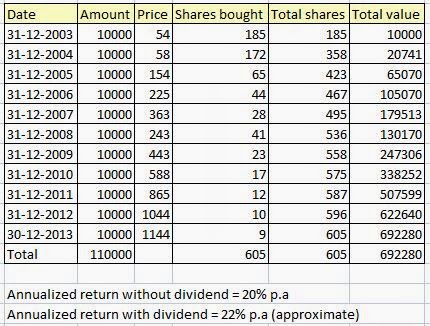
Following is a table of price, and annual return/ CAGR for the last 10 years

As you can see, even if you purchased the company on 31stDecember each year (blindly without worry about valuation), you would have done well.  This result boils down to the following reason

   The company has a wide and deep moat in the ratings industry due to government mandated entry barriers (none can just start a ratings agency),  Buyer power (Companies have to pay to get their debt rated and the cost is usually a small percentage of the debt) and lack of substitutes (even banks insist on company ratings now based on RBI directive).
   The deep and wide moat has enabled the company to maintain a high return on capital of 50%+ for the last 10 years. The company has been able to re-invest a small portion of its profits to fund its growth and has returned the excess capital to shareholders via dividends and buybacks.

A strong competitive position and good management with rational capital allocation approach has resulted in a very good result for the shareholders.

The catch
There always a catch in investing – nothing is as easy as it looks. For starters, this approach requires a huge dose of patience.

How many active investors (me included) would like to select a stock once in a few years and then do absolutely nothing  for a long period of time ? In every other profession, progress is measured by level of activity – except investing, where sometimes doing nothing is much better.

The other catch is that this approach is very boring. You find a few companies like crisil and then spend maybe 1 hr each quarter and a few hours every year end reviewing the progress. If the company is still performing as it always has, you have no further work left. If you are a professional investor, what are you going to do with the rest of your time ??

The last catch is that this approach has a level of survivorship bias. If you select a wrong company or if the competitive advantage is lost during the holding period, then the returns are likely to be poor or even negative.

Returns over entertainment
Although this ‘rip van winkle’ approach makes a lot of sense, I am unlikely to follow it fully. I enjoy the process of investing, looking for new ideas and doing all kinds of experiments. At the same time, a major portion of my portfolio is slowly moving towards such long term ‘wealth creation’ ideas.

In the final analysis, investing should be about wealth creation and achieving your financial goals.

—————-
Stocks discussed in this post are for educational purpose only and not recommendations to buy or sell. Please contact a certified investment adviser for your investment decisions. Please read disclaimer towards the end of blog.
A contingent stock

A

A few disclosures – This is a borrowed idea. I will not use the word steal, as I got it from a friend J

This idea was published by Ayush on his blog (see here) and then he mentioned it to me via an email. I was intrigued by the extremely low valuation (which is not obvious) and some medium to long term triggers.

I started looking at the company in the month of December, and before I could create a full position, the stock price ran up. Inspite of the run up, the company is an interesting, though speculative opportunity.

Another disclaimer – I hold a small position in my personal portfolio, but as it is a speculative idea, I have not added it to my family or the model portfolio.

The company

The name of the Company is Selan exploration and it is an E&P (exploration and production) company. The company has five oilfields – Bakrol, Indrora, Lohar, Ognaj and Karjisan

As part of the NELP policy, the company has the rights to explore and develop these oil fields. The company was among the first private sector players to get the rights to do so and if successful in finding oil and gas reserves, they have to pay a certain level of royalty to the government. In addition, the entire production of the company is taken up by the government or PSU under the production sharing contracts

The E&P business

The basics of exploration and production are actually quite simple to understand – The government grants the license to explore and exploit a specific area which may be rich in hydrocarbons, under a specific contract. The company winning the contract then undertakes exploration of the area using various advanced technologies such as 3D seismic surveys and exploratory drilling to identify the size of the reserves and the best location to drill wells to exploit these reserves.

Once the reserves are delineated (identified), the company applies for the various clearances (such as environmental) which once approved, allows the company to drill production wells. Although the technology is quite advanced and allows a company to identify deposits accurately, it is not a precise science and hence a certain percentage of the wells may turn out to be dry wells (not enough oil in that particular location). These dry wells have to be abandoned and the cost has to be written off (similar to a product which fails in the market).

The productive wells, once online produce oil and gas which is transported via pipelines or other means to oil refineries.

The problems

Let’s start with the problems which have caused the stock price to stagnate over the last few years. That will also give us an idea of the medium and long term triggers for the company.

The company was granted the exploration rights in the 90s and has been able to increase the production from 62000 BOE in 2004 (barrel of oil equivalent) to roughly 2.82 Lac BOE in 2009. I described the process of license, survey, clearances and approvals to get to the final production stage of drilling the production wells and pumping out the oil.

As you see from the process, we have government involvement at each step and anything where the government is involved means lack of clarity and uncertain timelines.

As has happened for multiple sectors in the economy, the clearances for drilling production wells came to a halt in the last four years. Due to the nature of oil exploration and production, the current wells start getting exhausted in time and if you are not drilling new wells, the overall production starts dropping.

In case of Selan exploration, production dropped from 2.8Lac BOE in 2009 to 1.64 Lac BOE in 2013. The revenue dropped from 99 Crs to around 97 Crs in 2013 and the net profit was roughly the same (at around 45Crs)

A mumbo jumbo of terms

Before I get into what is the opportunity here, let’s talk about a few terms for the Oil and gas industry. For starters, barring Selan and Cairn (I), I don’t think the PSUs in this sector are worth considering as investments. These companies are run as piggybanks by the government to subsidize fuel in the country. It is debatable on how good that is for me as a citizen, but I am clear that it is a disaster for a shareholder.

If you want to understand how the industry works (without the chaos of government interventions), you may want to look at US and Canada based companies such as Chesapeake, Devon energy or Exxon Mobil. If you are looking at a pure play E&P Company, there are several small companies such as Novus energy or Jones energy.

Why bring up these non Indian companies? Any US or Canada based company has to declare several key parameters which help an investor to analyze an exploration company. Some of those parameters are

2P reserves (proved and probable reserves)

Operating netback per BOE : revenue minus cost

NPV10: DCF valuation of the reserves (revenue based)

EV/BOED: Enterprise value/ Barrel of oil equivalent in reserves (valuation measure)

Cost curves, EUR, Exploration cost and well IRR (for each field)

Current oil flow rate (BOED) to understand the current revenue levels

You can find the definitions easily by doing a Google search for these terms.

So which of this data is provided by Selan exploration? None!

Are they doing anything illegal? No, because I don’t think there are clear disclosure norms on the above for Oil and gas companies in India (none that I could find). In comparison, Cairn (I) has more disclosures and communication.

The thesis
In absence of this disclosure, why even bother and move on to something else? That is a valid point and hence I have called it a speculative bet as I am making it with minimal information.

What do we know here?

For starters, it seems that the company has 79.2 Million (7.9 Crore) BOE of reserves in two fields alone (Bakrol and Lohar). The company sells at around 1.2 dollar/ BOE (EV/2P) versus 5.5 for cairn (I). Comparable companies in the US/Canada sell at around 8-12 dollar/BOE. Of course the foreign companies are not comparable, due to a very different regulatory environment.

In addition to this valuation gap, we are not even considering the potential reserves in the other fields (which seem to be bigger than the ones in production). So we are talking of a situation where the market is valuing the company based on the current production rate (Which is suppressed due to lack of approvals) and is not giving any credit for its reserves.

The company is able to generate a pre-tax profit of around 70 dollars / BOE versus 10-25 Dollars for the US/ Canada companies. The huge difference is due to the fact that Selan produces mostly oil compared to oil and gas in case of other companies.

So the company is very cheap based on known reserves and is also quite profitable. In addition the company has spent close to 65 Crs in the last three years on exploration expense (remember the surveys to find the oil and gas reserves?). Once it starts getting the approvals, it can start drilling the wells and start pumping out money …sorry oil.

So why is this still speculative or contingent? It is contingent on the company receiving approvals – Which is seems to be getting recently based on the update in the latest quarterly report. These approvals are based on the whims and fancy of our government and one can never be sure what will the scenario be next year.

Why is it speculative – because there is so little disclosure and we are using the reserve numbers from a past annual report? We do not have any clear updates in the latest reports and so it is like driving with a foggy windshield window.

I have taken a small bet on the company to track the company and may buy or sell in the future based on new developments. As always, please do your homework and make your own decisions.

Stocks discussed in this post are for educational purpose only and not recommendations to buy or sell. Please contact a certified investment adviser for your investment decisions. Please read disclaimer towards the end of blog

A 2X in 3 years

A

I wrote earlier about a Darwinian approach to portfolio construction. This approach involves the ranking all the stocks in a descending order and replacing the last position with a better stock/ idea. The key concept behind this idea is to replace the weakest position with a stronger one and thus improve the portfolio quality.

I did not discuss about how to rank the various stocks in the portfolio. I will discuss the business aspect of the ranking in a future post. Let me share some thoughts on how to consider valuation when doing this exercise.

A 2X in 3 years
As the title suggests, I have now started asking a question for each position (at the time of quarterly and annual results) – Does this position have the potential to double in 3 years ?

Note the use of the word  – potential. One can never be sure if the stock would double.

How does one look at the potential ? There are two variable driving the stock price – earnings growth and valuation. Lets say the stock is selling at intrinsic value and the earnings are growing at around 24% per annum. At the risk of over simplifying (and not stating some additional factors), we can expect the stock to increase at roughly the same rate and thus double in 2 years.

If however the stock is selling below fair value, then we may get an additional bump from an increase in the PE ratio. However I would prefer to place a higher wieghtage on the earnings growth than the valuation – which depends more on the whims of the market.

Not a scientific exercise
One can easily find a lot of flaws in the above thought process. You can argue that, no one knows the market situation three years from now. In addition, the company performance may turn out to be much lower than expected, thus negating the entire exercise.

All the above points are true and I could add more. However the point of the entire exercise is to look at the potential of each stock (atleast annually) and assess its attractiveness based on new information. It is easy to fall in love with a position (especially in my case) and hang on to an old thesis, whereas the world around the company has changed completely.

What do to with such cases
Lets say you identify a stock where the potential return is unlikely to be 2X in 3 years. What now ? do you sell and buy another stock ? What if you don’t have another idea ?

Lets bring in the concept of opportunity cost. Lets say you dont have a better idea. Then the alternative is to sell and invest it in a fixed income instrument. Is the opportunity cost around 9% then? .

I don’t think so. I would say the opportunity cost is the average returns you have made over the long term. Lets assume that your portfolio has returned  15% per annum on average in the last 10 years. I would say that this is your opportunity cost and the existing position has to be above this threshold to remain in the portfolio

Why is this your opportunity cost ? The reason is simple – you have been able to make this return in the past on average and if you sell the existing position and hold cash, something will surely come up in time to deliver this kind of return. You may not make this return the next month or next quarter, but can expect to make it over the next few years.

So the question to ask is – does this position meet my opportunity cost threshold? If yes, hold on to it till you can find a better idea – preferably a 2X or 3X in the next few years.
—————
Stocks discussed in this post are for educational purpose only and not recommendations to buy or sell. Please contact a certified investment adviser for your investment decisions. Please read disclaimer towards the end of blog.

Experimental investing reportcard 2013

E

I ran a few ‘experiments’ during the year, some of which I wrote about on the blog. As the year draws to a close, I am preparing the report card and as always it’s a mixed one – Lots of D and F and not a single A J

One point to keep in mind is that I run these experiments with miniscule amounts of money. The emotional pain is no less if the experiment fails, but the damage to the wallet is minimal (as my wife puts it, everyone needs their vices J).

Let’s look at some of these experiments, learnings and plans for next year.

Buying dirt cheap stocks
The main ‘idea’ behind these positions was that the stock was dirt cheap and hence once the pessimism cleared, the price would bounce back

Let’s look at two cases under this category

Business cycle related
The capital goods sector has been hit very hard in the last few years and the news worsened during the year. As I wrote in this post – ‘How I think about macro’, I personally thought the pessimism around this sector was overdone and one could look for some quality firms in the industry to take a position at rock bottom valuations.

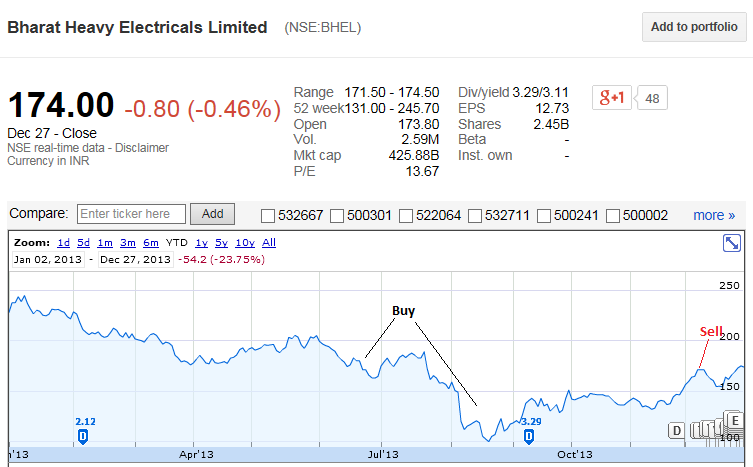
My pick was BHEL as it was selling at a 10 year low in terms of valuation (you can download my calculations from here) and I personally thought that if the company could be profitable even under such trying circumstances, then it was worth a bet.

You can see the price action below

As you can make out, my timing was hardly perfect. I was early and averaged down as the price kept dropping. My average cost worked out to around 120 and my sale price was around 160, resulting in around 35% gain during the period

So what’s the grade ? It’s a B at best for the following reasons

Learnings
– I don’t have timing skills and this episode proved it again. I care about buying at the right price rather than at the right time. However in the above example, it is important to get the timing right too, otherwise one will have to wait for a long time. A number of fellow investors I know are experts at this – but I am not. As a result, this type of investing has rarely worked for me.
Due to the lack of timing skills (and being aware of it), I have been hesitant to create a large position in such opportunities. The result of a small position is that a 33% return, does not move the needle on the portfolio. As a result, buying such kind of stocks, which I do not plan to hold for the long term are just a waste of time (for me)
These kinds of timing opportunities in the end may just be good to keep me entertained, but will not add to my returns in the long run.

Management issue

I wrote about zylog here. I  laid out the argument for this position in the post and the reason for the eventual exit.

What was the net result ? A 70% loss and an F grade.

It is easy to look at this episode with hindsight bias (management was suspect and hence one should not touch the stock).  Around the same time last year, I was looking at some high profile cases of failure (read here) and wanted to test the following hypothesis – is it possible to figure out management fraud from publicly available documents such as annual reports (market grapevine does not count).

I looked at zylog and saw that the stock had dropped to around 20% of its peak price. As I could not find anything suspicious in the documents, I decided to create a tiny position in the company.

The above trade turned out to be a disaster as it soon became known that the management was indulging in insider trading.

Learnings
– The above action by a management would land it in jail in most countries. In India, they are just prohibited from trading in the market. Should we still wonder, why the small investor does not trust the stock market ?. I learnt a powerful lesson from this episode  – if there is some smoke, there is usually a fire.
As a small investor, I am a sitting duck and can be taken for a ride by a management if they wish to do so, without any consequences. The best bet for me is to have zero tolerance for management ethics. If something is fishy, don’t touch the stock, no matter how attractive the idea.

Value trade
I wrote about this short term opportunity here. As I noted in the post, this is a stock which had become cheap for  short term reasons (quarterly earnings miss), though there was no long term issue or any management concerns.

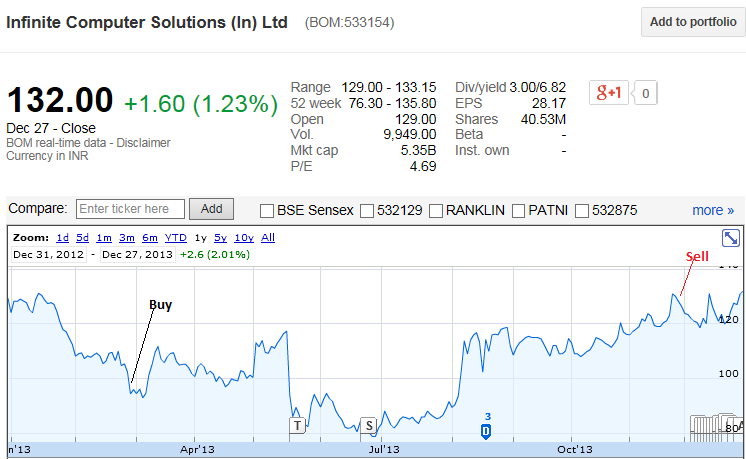
The idea was to buy the stock dirt cheap and sell once the short term pessimism wears off. The price action of this trade is given below
 
So what was the net result – around 40% gain and I would give myself a B+.

This type of investing is more suited to my personal temperament. I am able to analyze that the market is being too pessimistic due to short term factors. If the business is doing fine and there are no management issues, I am able to take a mid size position and make reasonable returns over a one year time frame.

These kinds of opportunities are not risk free (infinite computers has its own issues) and there is always an element of luck in it. However, some of these opportunities can act as placeholders for cash, if I cannot find something better to do.

Not all trading
If you have started reading my blog recently, you may feel that I am into short term trading. That is miles from the actual reality. The above cases, are just experiments on the side, representing not more than 1% of my personal portfolio.

Why do it ? I will put it down to curiosity. I just like to explore different approaches and see how they work out. In the end, most of them turn out to be unsuitable to my temperament. I am not saying that these are not valid approaches (others may do it well), but just that they don’t suit my temperament,

The long term changes
The key change I have been focusing on my core portfolio, is moving towards higher focus or concentration. I have kept a fairly diversified portfolio in the past with majority of positions under 10% of the total portfolio. I have now started increasing the size of some positions where I have a higher level of confidence in them.

Chicken that I am, the move is likely to be very slow and measured.

—————-
Stocks discussed in this post are for educational purpose only and not recommendations to buy or sell. Please contact a certified investment adviser for your investment decisions. Please read disclaimer towards the end of blog.

Patterns of failure

P

Failure is a better teacher than success. This holds true in the case of investing too. I have been looking closely at some of the recent cases such as Arshiya international, gitanjali gems, CEBBCO, Kingfisher airlines, Zylog limited and some older ones such as reliance communications, DLF, SSI, aftek and many more.

These are extreme examples of spectacular drops in stock price of 80% and more. These examples are the exact inverse of multi-baggers and a few of such positions can decimate one’s portfolio. I have mostly been able to avoid such cases in the past (except SSI and zylog, which was self inflicted) and think it is important to avoid such extreme failure to make above average returns

Why analyze such cases? On that count, I am following these comments from Charlie munger on learning from failure

You don’t have to pee on an electric fence to learn not to do it
Tell me where I’m going to die, that is, so I don’t go there

It is not always fraud
I have seen an oversimplification on the cause of failure in the above cases. A lot of investors think it has been caused by management stupidity or greed. The reason for this conclusion is due to some high profile failures such as satyam.

It is easy to say that the management was unethical (Which is true in several cases) and hence the business failed. I think that is intellectual laziness. There are several other companies where the management is a bit suspect, but the company and its stock has not collapsed (though did not perform as well)

Some key factors
On going through all these companies, I am able to see some common threads. These factors may be present in combination in some cases or one of the factors could be dominant in others. In most cases, however it was the combination which sank the ship

1. Low return on asset/ equity due to commodity or highly competitive business (think airlines or telecom)
2. Low free cash flow (after taking into account Working capital needs and obsolescence risk/ business model changes )
3. Growth obsession funded by debt, resulting in high debt equity ratios (2:1 or higher
4. Cyclical industry with 1,2 and 3
5. Growth obsession with expansion into foreign markets (most likely from pricey acquisitions) stemming from management’s grandiose views of building an empire (rather than focusing on value creation)
6. Management failure/ governance issue (with diversion of funds into sister firms in some cases)

The steps to destruction
Let’s look at some kind of chronology of events leading to the eventual collapse in the stock price

1. Company experiences temporary success due to a cyclical high or tailwinds (look at the long term base rate to identify this situation). In some cases, success is from sales perspective and ROE and cash flows are still weak.
2. Management feels bullish and starts adding capacity/ businesses. In a lot of cases this is funded by debt or FCCB type equity.
3. In some cases, management goes abroad and acquires assets at high prices stemming from delusions of empire building (aka ‘Indian name’ in foreign lands)
4. Business encounters a hiccup or a cyclical downturn. The cash flows dry up and management finds it increasingly difficult to service the debt.
5. Management fudges the numbers for some time and tries to keep things afloat (bullish statements, confidence in the business inspite of worsening fundamentals such as negative cash flow, worsening debt service ratios etc)
6. The pack of cards finally collapses when the company defaults on its debt (openly or in private). When the market gets a hint of this, the stock price collapses almost overnight and the outside investor is left holding the bag

What to avoid
If you like the principle of inversion and think high cash flows and low debt is the sign of a healthy company, then one should avoid a company with poor cash flow and high debt irrespective of the story or future prospects (which are always rosy).
It’s quite possible, that you may miss some of the real turnaround cases, but on the balance I think it one would do much better by avoiding such companies

Bull market stocks
A lot of companies with poor cash flows and high debt did quite well during the previous  bull market and a majority of the investors choose to ignore the red flags. Why bother, when you are making money ?
It is during tough market conditions, that the chickens come home to roost, and a lot of investors (me included) get a lesson on risk.

—————-
Stocks discussed in this post are for educational purpose only and not recommendations to buy or sell. Please contact a certified investment adviser for your investment decisions. Please read disclaimer towards the end of blog.

Its all about pschology

I

I think behavorial finance is a very important topic for an investor (and in other walks of life too) and one should spend some time learning about and trying to avoid the common psychological pitfalls. I discussed some of these pitfalls in the previous posts (hereand here).

Some good books/ resources on the topic are listed below

Poor charlie’s almanac
Thinking fast and slow
The psychology of influence
The art of thinking clearly
Seeing what others don’t : The remarkable ways we gain insight

Professor sanjay Bakshi’s website (here) and all his lectures (here). I would encourage everyone to read the lectures multiple times.

Lets explore a few more baises and how one can avoid them

Sunk cost fallacy
This is a tendency of investors to throw good money after bad. Once you make an investment in a stock and the price starts to drop, the general tendency is to average down. If one analyses the company based on current facts and arrive at an objective conclusion that the price drop is unwarranted,  then buying/ averaging down is a good approach. However most investors (including me) remain anchored to the previous conclusions and are also influenced by the sunk cost – money already invested in the stock. As a result, majority of the investors refuse to change their mind and incur heavier losses in the future.

I have been guilty of this fallacy a lot of times and find it difficult to change my mind quickly. At present, the best antidote I have is to acknowledge my weakness, look for disconfirming evidence and act on it, inspite of looking like a fool at that time.

Story bias
Humans are suckers for stories. We understand the world in the form of stories. Our epics and mythology are stories and so are films and other forms of entertainment.

It is however dangerous to get seduced by a story stock or company. Unfortunately you can find investors buying into stories all the time and overpaying for it. The stories change, but the basic theme is always the same. A new or exciting development comes to the attention of a few investors (IT stocks, real estate stocks or consumption stocks). These smart investors have the insight of investing early at attractive valuations. This ‘story’ is soon picked up by the media and now others follow blindly into the story at astronomical valuations. The ‘story’ feeds on itself and everyone looks good as long as the price is rising. At some point investors start realizing that the valuations are too optimistic and the selling begins. The ‘story’ is discredited and investors wonder how they got sucked into it

How does one avoid getting sucked in? There is one word for it – valuations. Never overpay for stocks, no matter what the story. If something is obvious to everyone, then the price reflects it and it is ‘overconfidence and hubris’ on part of most investors to assume that they are smarter than the market.

Base rate neglect
If you ask someone an unpleasant question – are you more likely to die in an airplane crash or heart attack, what is the more likely answer? I can bet in the majority of the cases, it would be the airplane crash (heart attacks are a more common cause). An airplane crash is more vivid and comes on the front page of a newspaper, whereas heart attack deaths are almost never publicized.

Almost everyone tends to neglect the base rate – statistical probability of an event. Investors tend to do the same. Let’s consider some examples – 90% + options expire worthless and various studies have shown that IPOs tend to underperform market over the long run. Inspite of these statistics, investors believe they can do better, mostly because they are not even aware of the low success rates.

How does one take advantage of base rates? One needs to focus on areas where the odds favor you. It is far easier to do well with companies and industries where the underlying business has a high rate of return. In such cases, unless one pays too much, the investor is likely to do well over time.

In summary, know where you have an advantage and work on exploiting it. For example – I know for a fact that I cannot beat a full time trader in the short term and hence I will never invest in a stock or option where the odds are stacked against me.

Over optimism and overconfidence

One needs a level of optimism or confidence to do well in life. At the same time, there is fine line between confidence and over confidence. How do you know you have crossed it?

If you find yourself, attributing all the success to your intelligence and failure to bad luck and other factors, you may be crossing the line. As an investor, if your performance is not above average (after several years) and you still think that there is nothing wrong with your approach and think that it will all work itself out, then you need to dial down your confidence and optimism.

What about me? I have had the reverse problem – I have always been underconfident and that has been harmful too. I have underallocated to equities in the past and created smaller positions in my top ideas. As a result, my opportunity loss has been far higher than my actual losses.

In my case, the actual results have given me the confidence to be more aggressive, though I still finding myself doubting all the time.

No silver bullets
We have reviewed several biases in a series of posts. As you can see, it is easy to understand these biases and even recognize them in yourself. It is however far more difficult to overcome them – I am often aware that I am irrationally committed to an old idea, but still struggle to exit/ sell the stock.

The first step in overcoming these biases is to recognize them and acknowledge that we are often influenced by them. The next step is often to build routines to reduce their impact or negate them completely. Some shortcuts I try to use

– Do not look at the stock price when analyzing a company to avoid getting ‘anchored’ by the stock price
– Never buy a stock which is hitting upper or lower circuits. There is a lot of emotion around the stock/company and it is better to let the dust settle down, before one can analyze the situation calmly and make a balanced decision
– Try to look for at least three reasons which could cause the idea to fail
– Do a probabilistic analysis of the stock, to evaluate the downside. How low can the price drop?
– Avoid IPO, options and current fads
– Never listen to tips – especially from TV. If it is recommended on TV, everyone and his uncle knows about the company and the price already reflects the prospects.
– Analyze the stock from a 2-3 year perspective where I have a strength over the other short term players in the market.
– Don’t tell about your losses to your wife. She will think that you are smarter than you really are J

—————-
Stocks discussed in this post are for educational purpose only and not recommendations to buy or sell. Please contact a certified investment adviser for your investment decisions. Please read disclaimer towards the end of blog.

Becoming rational

B

I personally think that being rational is extremely important in becoming an above average investor. So how does one become more rational?

There is a book called – predictably irrational by dan ariely which talks of the irrational behavior in most of us. The more interesting part of the book however is the ‘predictable’ part. It means that most of us are consistently irrational. The good thing about this predictability is that if one can identify these patterns, then there is a possibility of reducing the irrationality (I don’t think it can be completely eliminated)

The first step in reducing the irrationality is to name and classify the various behaviors which impact us negatively as investors. I started exploring the various biases which affect us in the previous post and will continue with a few more in this post.

Authority bias
You may seen this bias in others (most people think they are themselves immune), when they  purchased a stock based on a recommendation by some TV presenter or commentator. In other cases, the recommendation may be from a broker or some sales person in a bank.

I have personally avoided this bias in the above form by having a simple thumb rule – TV presenters are actors and should be watched for entertainment alone. As far as brokers and sales people are concerned, I refuse to listen to them.
The above comments may imply that I am immune to this bias – but I am not. I follow a few other bloggers and top investors. In the past, if one of them was invested in a stock, I would develop a much more positive view of the stock and even went ahead and invested in the same.

The biggest source of my bias has been from the top thinkers in the field of investing (Warren buffett, Ben graham etc). It is not that their teachings are not worthy of following, but I have followed them blindly without understanding the context.

Case in point – Warren buffett talks of the buy and hold philosophy. A lot of people miss out that they he does not imply buy and forget and certainly not buy and hold bad companies. The pre-requisite condition is that one should buy a good company at an attractive price and then hold it for a long time. I have bought duds and then held it for some time, thus compounding my mistake.

How does one avoid this bias – As in all other biases, it is not easy. I have found one approach which works for me a bit – Never accept blindly what others say (including your idols). I  try to analyze the context of a statement or idea and try to think of a scenario where that idea is not true.

First conclusion bias
This is a very common bias and we know it by another name – First impressions. We tend to form opinions of other people in the first few seconds of meeting them and then any interaction tends to re-inforce the impression. This bias has a lot of implication in job interviews, but that is a separate topic.

In the case of investing, this is closely related to the commitment and consistency bias. As an investor, I have found that when I am looking at a company and its financials, I tend to form a fuzzy view of the company in the first few minutes – such as looks worth of investigation (may even buy) or maybe this company is junk. Once I reach this view (often subconsciously), my subsequent analysis and thought process is influenced by this first conclusion. In addition, if I make a token purchase the commitment and consistency bias kicks in. Once this happens, my decision is kind of locked (even if i think it is not)

How does one avoid it ? For starters, I look at a company and form a view (even if subconscious) and then just drop further analysis. I make a note of the company and then move on to something else – allowing for a cooling period. I will usually come back to it after a few days and then read up on it further – making notes as I go along.

The final decision to buy comes usually after a few weeks and even then the position is a small one. I am not sure if I have been able to reduce the bais, but it prevents me from buying a stock when I am in heat. The downside is that the stock price may run up before I can buy a full position, though in balance I would rather loose the upside occasionally than make a foolish decision.

The next post will the final one on this topic and I will explore a few more biases and discuss how it is important to build routines in your investment process to reduce their impact.

—————-
Stocks discussed in this post are for educational purpose only and not recommendations to buy or sell. Please contact a certified investment adviser for your investment decisions. Please read disclaimer towards the end of blog.

Kill your beloved ideas

K

I have been reading a few behavioral finance books on the various biases which impact us as investors (and in other walks of life too). I have picked up this topic of study for a very specific reason.

I have been analyzing my investment process and am realizing that the weakest link continues to be the various biases which commonly impact us. If I look back at the last 15 years of my investing life, I can safely say that I was fluent in the basics in the first couple of years and could identify good ideas by the fifth year.

The above statement would imply that I was an expert by year 5 and poised to be a good investor. Unfortunately the reality was far from that – you can read my journey till 2008 here. Knowing what to do is different from doing it.

Let me list a few biases and how I was impacted by them. I will also try to explore what one can do to avoid them

Social proof

This is a bias where in one is influenced by other investors and the general mood of the crowd. I wrote about a mistake I committed a long time ago – purchase of SSI and IT mutual funds during the dot com boom.

Although I was new to investing (around 3-4 years), I understood the importance of valuation and of not overpaying for stocks. Inspite of being cautious for the majority of my portfolio, I still went ahead and committed 25% of it to IT related stocks. As I look back, I recall that the main reason was that a few of my friends were investing heavily in this sector (and getting rich). In addition to this, a nice and pretty broker also recommended a few hot mutual funds (such as ICICI technology fund) which were sure to make me rich in a few years.

How could I miss?

I managed to lose 80% of my capital in a short period of six months. This was unmistakable evidence that I had made a spectacularly wrong decision. Ever since then, I have followed a few simple rules to avoid getting influenced by the crowd
– Do not buy hot stocks. If the media is talking a lot about some hot sector or all my friends are getting into it, I will just avoid it. As a result I did not touch the real estate and infrastructure stocks during the 2007-2008 period and spared myself of a lot of agony
– Do not take stock tips from anyone, especially pretty girls J

Anchoring bias

This is a bias wherein one gets fixated on a variable in the decision making process and uses that to make all subsequent decision. This is a difficult bias to recognize and overcome.

I had been following Crompton greaves limited for some time and decided to buy the stock in 2011 after the company reported poor results in the first quarter. The stock dropped quite a bit after that and I started purchasing the stock as it ‘appeared’ cheaper compared to the past results.

In the case of stocks, investor returns are dependent on future performance, but the data to evaluate that comes from past performance. It is an art, more than science, to evaluate the past results and arrive at an appropriate conclusion. In the case of Crompton, I got anchored to the price and the past fundamentals and did not weigh the state of the industry and management issues more heavily.

How should one avoid this bias? Once you have purchased the stock, it is very difficult to avoid the anchor of the purchase price and past performance. The best approach I know of is to be aware of this bias and constantly question your reason for holding a stock.

This is a tendency to be consistent with one’s behavior in the past. It is a good way to behave in life – if you have been a decent and honest person once, you want to continue and be committed to that behavior.

However this behavior can cause a lot of trouble for an investor.  Once you have purchased a stock, there is a tendency to be committed to it and as a result one tends to underweight any negative information about the company.

Look at any stock boards – majority of the investors are talking about the positives of the company. If you are already invested in the company, does it make sense to find any additional information which just confirms your belief? How will that benefit your decision?

I have suffered from the same bias and I can’t think an easy way to avoid it. I have purchased value traps like Cheviot Company and held onto them even though the company continues to deliver mediocre performance and the stock price was stagnant.

The approach I take now is to rank all the companies in my portfolio in a descending order of attractiveness. This forces me evaluate more idea more objectively. Once I have my rank, I compare any new idea with the last idea in the list. If the new idea is better than the last one on the list, it gets replaced.

The title of this post comes from the concept of Darwinian selection – kill the weakest ideas to make way for the stronger one. This also reduces the impact of the commitment and consistent bias.

I plan to cover additional biases such as the authority bias, availability bias and more in the subsequent posts.

—————-
Stocks discussed in this post are for educational purpose only and not recommendations to buy or sell. Please contact a certified investment adviser for your investment decisions. Please read disclaimer towards the end of blog.

Analysis: Supreme industries

A

About

Supreme industries is a leader in the plastics processing industry and processed around 2.45 Lac metric tonnes in 2012. The company processes polymers and resins into various plastic products. The broad verticals for the company are as follows
  • Plastic piping including CPVC pipes
  • Consumer products such as molded furniture
  • Packaging products such as specialty and cross laminated films
  • Industrial products such as Industrial components and Material handling products
  • Construction business wherein the company has developed a corporate park on some excess land in Mumbai
The company has around 22 plants across the country which has helped it in reducing the transportation cost for the products (an important factor for operating margins).
Financials
The company achieved a topline of around 2900 Crs and is expected to close the current year at around 3500 Crs. In addition the company earned a profit of around 240 Crs (8% Net margins) and should be able to achieve a single digit growth during the year. The lower growth in net profits is due to lack of sale of commercial property in the current fiscal.
The company has been able to maintain an ROE in excess of 25% for the last 6 years. The debt equity levels have dropped from around 1.5 to around 0.6 during this. The company has also been able to improve the asset turns from around 2.5 in 2007 to 3.5 in 2012 as a result of an improvement in working capital turns (mainly driven by lower receivables as a percentage of sales).
The company has also improved its net margins from around 4% in 2007 to around 8% in 2012 driven by an improvement in overhead costs and depreciation as % of sales.
Positives
The company operates in a commoditized industry and as a result several products of the company earn low margins. The company is now focused on developing new products (called valued added products) such as CPVC pipes, cross laminated files and composite cylinders which have a higher operating margin (17%) than the other commoditized products such as molded furniture. The company plans to increase the contribution of these value added products to around 35% by FY15 and expects to improve the overall operating margins to around 15-16% levels
The company has a wide distribution and production network and well established brands in the plastics product space. The management has been able to use these assets effectively in entering higher margin products while exiting the commoditized segments at the same time.
The per capita consumption of plastics is around 7 kg versus almost 30-70 Kg in other countries. As a result, the industry is likely to see sustained growth for sometime as the per capita consumption increases with a rise in the income levels. In addition to the demand tailwind, companies like supreme are likely to benefit further as the industry continues to consolidate and the market share shifts to the organized players.
Risks
The company operates in a highly fragmented and commoditized industry. Although the company has been able to maintain the margins and a high return on capital by constantly introducing higher margin products, the moat or competitive advantage is not deep.
Brand name and a wide distribution network provide some level of competitive advantage, but the resulting moat is not wide and deep. As a result the company will have to constantly innovate to keep the return on capital high. The profitability could get hurt if there is a rapid commoditization of the various segments.
Competitive analysis
The plastics industry is a fragmented industry with a large unorganized sector, especially in commoditized products. The company has different competitors in each segment of operations.
In the case of PVC pipes the key players are finolex, chemplast sanmar, Jain irrigation, astral poly etc. In the packaging products there are around 6-7 large players and several un-organized ones. In consumer products nilkamal and Wimplast are the two key players. Finally in the industrial component segment there are a wide range of players ranging from Motherson sumi to Sintex industries.
Most major players earn an ROE of around 13-14%, with high leverage , except for astral poly which has an ROE of around 22% with low levels of debt (due its focus on a high margin and high growth product – CPVC pipes).
Overall the industry does not have high return on capital- due to the commoditized nature of the products. Supreme industries has been able to break away from the pack due to a portfolio approach to products (exit low margin products and move into high margin ones).
Management quality checklist
          Management compensation – compensation is around 5% of net profits. This is on the higher side, though not excessive
          Capital allocation record – The capital allocation record of the company has above quite good in the last 6-7 years. The management has been investing in high return projects and has also used some of the cash flow to reduce the level of debt. The ROE as a result has improved from the 20% levels to 30%+ levels in 2012
          Shareholder communication – adequate. Management provides decent amount of disclosure in the annual reports and also conducts quarterly conference calls to discuss about the performance.
          Accounting practice – appears conservative
          Conflict of interest – none appear to be of concern
          Performance track record – the management has been fairly transparent about its performance goals (growth and return on capital) and has been achieving them consistently in the last few years. In addition the management has been in this business for the last 40+ years and understand it very well.
Valuation
A discounted cash flow with conservative assumption of around 7-8% margins and 15% topline growth (10% volume growth + 5% inflation) gives a fair value in the range of around 530-570 per share. The growth assumption appears to be conservative as the company has delivered a 12% volume growth in the past. The risk is mainly around net margins which could come under pressure if there is faster commoditization in the industry.
The company has sold between a PE of around 8-9 and 18-20 in the past. The current PE of around 15 is at a midpoint and as a result the company does not appear to be overvalued.
Finally the company has shown a higher growth and Return on capital as compared to almost all other players in the industry (except astral poly) and hence has a higher PE (but not much) than others.
In summary the company does not appear overvalued and may be undervalued by around 30-35% from its fair value.
Conclusion
Supreme industries operates in a growth industry (due to increasing demand for plastic products) where the average profitability is quite poor. The company has been able to perform better than the other players by being focused on the newer and higher margin products. The management is as focused on ROC (return on capital) as on growth as compared to several other players who are pursuing growth at low returns.
Inspite of the above average returns and competent management, the company is unlikely to enjoy very high valuations like the FMCG industry as the overall profitability of the industry is low and the pricing power of branded products not very high. Supreme industries appears to be modestly undervalued and the returns are more likely to come from a consistent increase in profits than from revaluation by the market.

—————-
Stocks discussed in this post are for educational purpose only and not recommendations to buy or sell. Please contact a certified investment adviser for your investment decisions. Please read disclaimer towards the end of blog.

Subscription

Enter your email address if you would like to be notified when a new post is posted:

I agree to be emailed to confirm my subscription to this list

Recent Posts

Select category to filter posts

Archives