—————-
Stocks discussed in this post are for educational purpose only and not recommendations to buy or sell. Please contact a certified investment adviser for your investment decisions. Please read disclaimer towards the end of blog.

—————-
Stocks discussed in this post are for educational purpose only and not recommendations to buy or sell. Please contact a certified investment adviser for your investment decisions. Please read disclaimer towards the end of blog.
Starting note: This is a long post and I am going to cover a lot of ground. I have tried to cover a vast topic in a few pages, which is usually the subject of entire books. As a result, I have tried to simplify and generalize in several cases to make a point.
In the previous post, I tried to make the point that it is not enough to say that a company has a moat and then rush to your broker to put in an order. One needs to answer a couple of questions
Do not focus too much on the math
I received a few emails asking me about the calculations on how I arrived at the PE ratios. As I said in my previous post, the math is not important for the point I am making – longer a company earns above its cost of capital, higher is its intrinsic value.
I would suggest that you use the standard DCF model and apply whatever assumptions you like for growth, ROE, free cash flow etc and just play around with the duration of the moat or the period for which the company can earn above the cost of capital. It should be quite obvious that longer the duration, higher is the value of the company.
For the really curious, I have uploaded my calculations here. Prepare to be underwhelmed!
Market implied duration
The other point i would like to make is by turning around the equation – If the company has a high PE ratio, the market is telling you that it expects the company to earn above its cost of capital for a long time.
For illustration, let’s take the example of Page industries (past numbers from money control, future numbers are my guess).
Future expected ROE = 50% (roughly 53% in 2014)
Future growth rate = 30% (40% growth in 2010-2014)
Terminal PE = 15
Current price = 14000 (approximately)
If I put in these numbers into DCF formulae, I get a Moat period of around 10 years.
So the market expects the company to grow its profit by 30% per annum for the next 10 years and maintain its current return on capital. This means that the company will earn a profit of 2000 crs by 2025.
So do I think that page industries will maintain its moat for 10 years or longer and grow at 30%?
I don’t know !
However if I did own the stock or planned to buy it, my next step would be to analyze the competitive strength of the company and see if the moat would survive 10 years and beyond, because if it didn’t I would be in trouble as a long term investor.
Precision not possible
In the previous example I used a fancy formulae and a long list of assumptions to suggest that the market considers page industries to have a competitive advantage period or moat (CAP for short) of 10 years.
Once you put a number to some of these fuzzy concepts, it appears that you have solved the problem and are ready to execute.
Nothing could be farther from the truth.
Anytime someone tries to give you a precise number on intrinsic value of a company, look for the assumptions behind it. As you may have read, the best tool for fiction is the spreadsheet.
The above calculation should be the starting and not the end point of your thinking. I typically do the above kind of analysis to look at what the market is assuming and put it into three broad buckets
2-5 years : Market assumes a short duration moat
5-8 years : Market assumes a medium duration moat
8+ years : Market assumes a long duration moat (bullet proof franchise)
Let’s look at some way to analyze the moat and bucket it in some cases
Measuring the moat
A substantial part of my post has been picked up from this note by Michael Mauboussin. The first version of this note was published in around 2002 and the revised one in 2013 (download from here)
If you are truly interested in learning how to discover and measure moats, I cannot stress this note enough (some important parts in the note have been highlighted by me) . Read it and then re-read it a couple of times. The only point missing from this note is the application of the concepts – Michael mauboussion does not provide any detailed examples of applying the concepts to a real life example.
Model 1: Porter’s five forces analysis
I am not going to write a detailed explanation of this model – you can find this here. I have used this model to analyze IT companies in the past – see here. A few more posts on the same topic can be found hereand here.
Let me try to explain my approach using an example from the past. Lakshmi machine works was an old position for me (I no longer hold it). As part of the analysis, I did the five forces review of the company/ industry which can be downloaded from here
A few key points about the analysis
The above is also visible in the form of a very high return on capital for LMW – The company had a negative working capital for 10+ years and earned 100% + on invested capital at the time of this analysis
As I analyzed the company in 2008, I felt strongly that the company had a medium (5-8) or a long duration moat. It was not important to arrive at a precise number then, as the company was selling at close to cash on books and the business was available for free. Surely a business with a medium term moat was worth more than 0 !
Model 2: Sources of added value
The second mental model i frequently use is the sources of added value – production advantages, customer advantages and government (pages 34-41 of the note)
I have uploaded the analysis for CERA sanitary ware (current holding), I had done in 2011. Look at the rows 14-19 for the details.
A few points to note
Model 3: High pricing power
Another key indicator of competitive advantage is the presence of pricing power. The following comment from warren buffett encapsulates it
“The single most important decision in evaluating a business is pricing power. If you’ve got the power to raise prices without losing business to a competitor, you’ve got a very good business. And if you have to have a prayer session before raising the price 10 percent, then you’ve got a terrible business.”
How do you evaluate this ? Look for clues in the annual report or management responses to questions in conference calls. Does the management talk of margins being impacted severely due to cost pressures ?
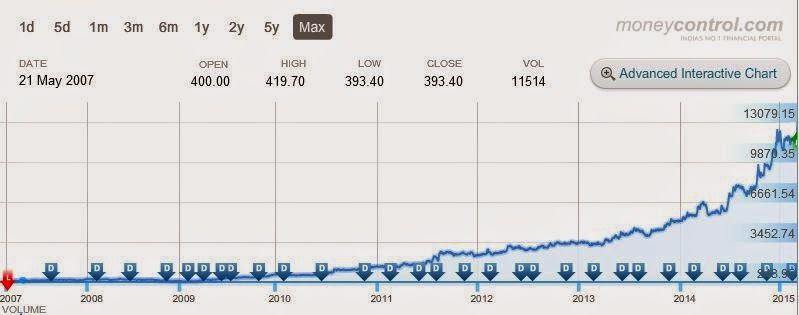
For example – Companies like Page industries or asian paints are generally able to pass through cost increases to customer without losing volumes. When the input costs drop they can either increase their margins or use this excess profit in advertising and promotions and thus strengthen their competitive position. Can steel or cement companies do the same ?
Other miscellaneous models
A brief synthesis
I have laid out various models of evaluating the competitive advantage of a company. Once you go through this exercise, you can arrive at a few broad conclusions
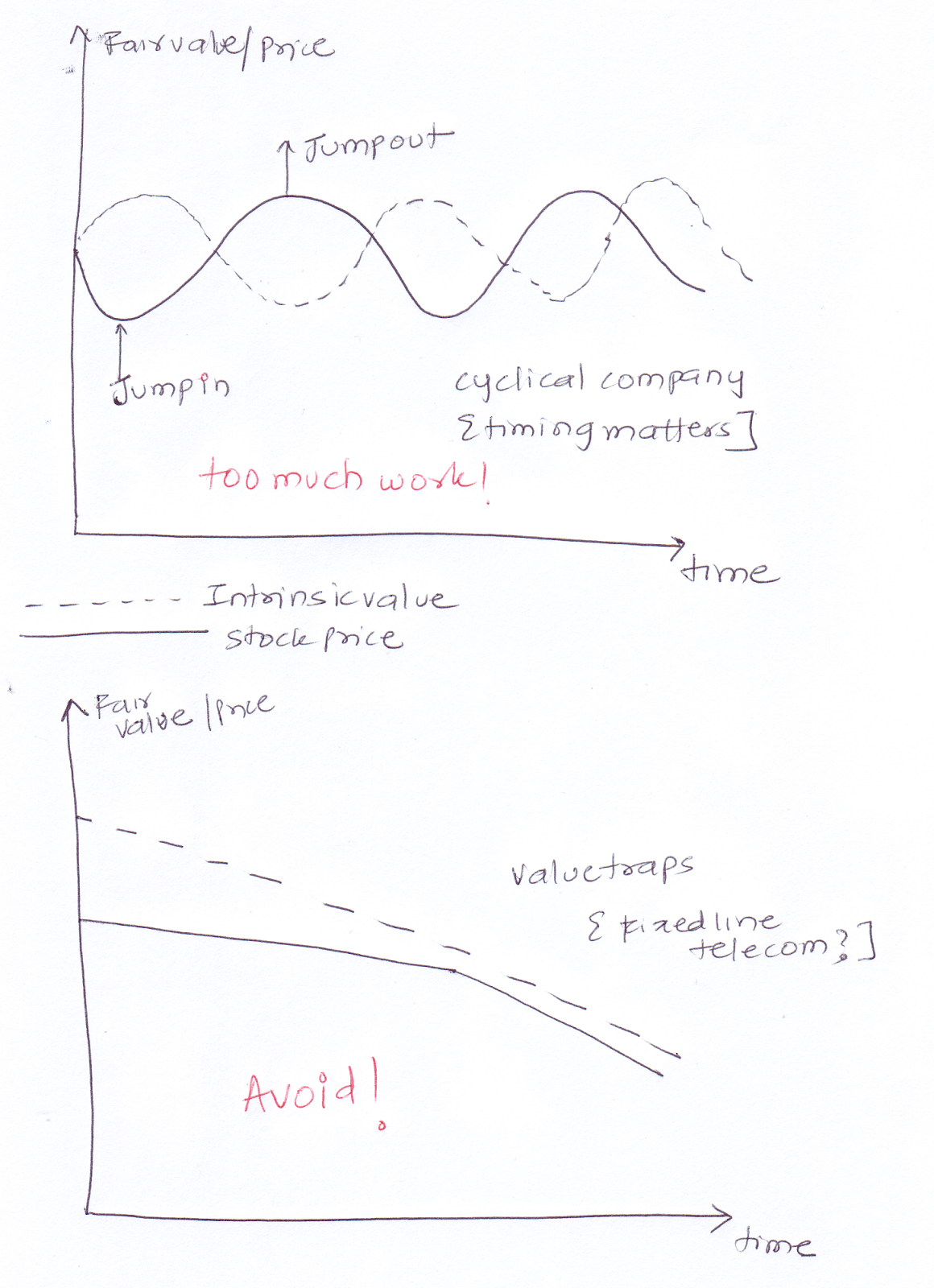
No moat: A majority of the companies do not have a moat. As you go through the above models and are hard pressed to find anything positive, it is an indicator that the company has no competitive advantage. Even if the company has been earning a high return on capital in the recent past, it could be a cyclical or temporary phenomenon. Look at several commodity companies which did well in the 2006-2008 time frame, only to go down after that.
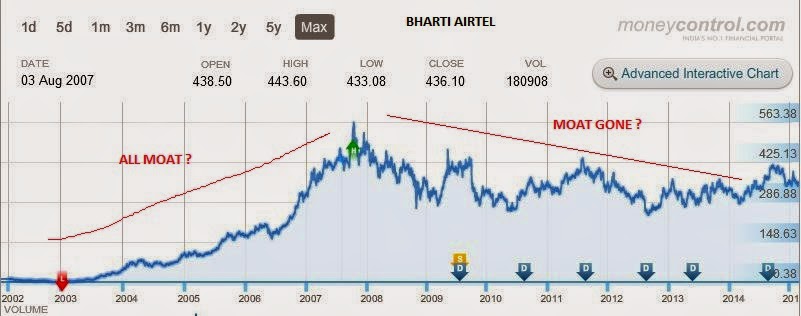
Weak moats : If the moat depends on single a production side advantage such as access to key raw material or government regulation, it’s a weak moat (think mining or telecom companies). The company can lose the advantage at the stroke of a pen, law or whims and fancy of our politicians. In addition the pricing power of such companies is very low. I would categorize such a moat as a weak one and not give it a duration of more than 2-3 years.
Strong, but not quite : If the moat depends on customer advantages such as brands or distribution network, the moat is much stronger. A company with a new brand which is either no.1 or no.2 has a much stronger moat. I tend to give the moat a medium duration (5-8 years). The reason for being cautious at this stage is that the company clearly has a competitive advantage, but the strength has not been tested over multiple business cycle. In addition, in some case the business environment is subject to change and one cannot be too confident of the durability of the moat. The example of LMW or CERA in the past is a good one for this bucket
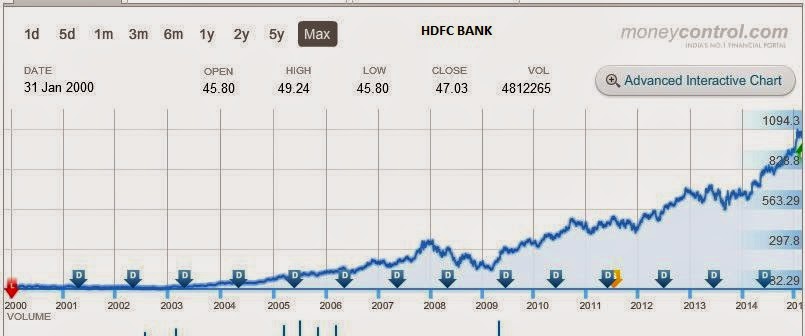
The bullet proof franchise :These are companies with multiple customer and production (scale related) advantages. These companies are able to command high margins, can raise prices and at the same time have a very competitive cost structures due to economies of scale. These companies have demonstrated high returns of capital over 10+ years and continue to do so. In such cases, one can assume that duration of the moat is 10+ years. These cases are actually quite easy to identify – asian paints, nestle, Unilevers, pidilite, HDFC twins and so on.
Moats are not static
A key point to keep in mind is that moats are not static, but changing constantly. In some cases the moat can disappear overnight if it depends on the government regulation (such as mine licenses), but usually the change is slow and imperceptible and hence easy to miss.
If you can identify the key drivers of a company’s moat, then you can track those driver to evaluate if the management is strengthening or weakening the moat. For example, the moat of an FMCG company is driven by its brands and distribution network. As a result, it is important to track if the management is investing in the brand and deepening/ widening the distribution network.
In the case of LMW, I think the moat has slowly shrunk due to the entry of Reiter ltd. Reiter was the technology partner and equity holder in LMW. The two companies have since parted ways and Reiter is now competing aggressively in the same space.
LMW has repeatedly indicated that they are now facing a higher level of competition in India and consequently there has been a slow drop in operating profit margins. In addition one can see an increase in the working capital usage too. I cannot precisely state that the moat duration has shrunk from 10.7 years to 6.3 years, but there is increasing evidence that the moat is under pressure. As a result, I exited the stock a few years back.
Putting it all together
Let’s assume that you have done a lot of work and figured out that company has moderate moat possibly 5-8 years. At this point, you can plug in the required variables into a DCF model and analyze the market implied duration of the moat (the way we did for Page industries)
If the market thinks that the company has no moat or a minimal moat, than you have a probable buy. If however the market implied moat is 10+ years, then the decision would be to avoid buying the stock, not matter how good the company
The above sounds simple in theory, but is far more difficult in practice – I never promised that I will be giving you a neat, fool proof formulae of making a lot of money by doing minimal work 🙂
The moat of a long term investor
If the all of the above sounds too fuzzy and cannot be laid out in a neat formulae, you should actually feel very happy about it. Think about it for a moment – if something is fuzzy and requires a combination of a wide experience, insight and some thinking, it is unlikely to be done successfully by a computer or fresh out of college analysts.
Can a research analyst go and present this fuzzy thinking to his head of research, who wants a precise target price for the next month ?
So any investor who has a long term horizon and is ready to invest the time and effort to do this type of analysis will find very little competition. It is a general rule of business that lower competition leads to higher returns – the same is true for investing too.
If you buys stocks, the way most people buy shoes, TV or fridges – after due research on features, durability (how long the consumer durable will last) and then compare with price, the result will be much better than average
—————-
Stocks discussed in this post are for educational purpose only and not recommendations to buy or sell. Please contact a certified investment adviser for your investment decisions. Please read disclaimer towards the end of blog.
The easiest way to justify a high PE stock is to say that it has a moat or in other words a sustainable competitive advantage. Once these magic words are uttered, no further analysis or thinking is needed. If there is a moat, it does not matter if the stock sells at a PE of 30 or 70. It is all the same.
So what are the key points?
—————-
Stocks discussed in this post are for educational purpose only and not recommendations to buy or sell. Please contact a certified investment adviser for your investment decisions. Please read disclaimer towards the end of blog.
We are all supposed to be perfectly rational, supercomputers that can do a discounted cash flow analysis on every investment idea we come across. If this is not enough, we are also supposed to be able to compare all investment options at the same time, before making a decision.
This is what most ivory tower professors would have us believe (except one ). Ofcourse this does a lot of disservice to a budding investor, who feels stupid when he or she lets emotions creep into the decision process.
I have invested for around 15 years now and in the countless investors I have followed, I have yet to come across anyone who comes close to this mythical investor. For the ordinary investor like me, I find it far more useful to acknowledge my irrationality and learn to work with it. Although there are no universal rules to managing emotions when investing, let me share my experiences as some would definitely be instructive.
Let’s start with a list of some commonly felt emotions and their impact –
Fear
Think back to August – Oct 2013. Rupee dropped close to 71 to a dollar. Current account deficit was around 5% and at the risk of expanding further. The Indian government led by congress was in a state of paralysis. The net effect – The stock market dropped close to 10%. The same story had occurred in 2003, 2008-09 and 2011.
Inspite of the economy and market coming back after a few years in the past, a majority of the commentators and investors decided to stay away from the market. This is even more surprising considering the fact that Mid caps and small caps were selling at 5-6 year lows and some highly profitable and growing companies were available at decent valuations.
My thinking: It is not that I am immune to fear and pessimism. I felt equal depressed about the state of affairs and angry with the government. However, during such times I go by my sense of history (past record of the stock market) and valuations. If the company is doing well and available at decent valuations, I will buy the stock without worrying about when I will be proven right. How does it matter if the stock doubles in one year or the end of year three?
Greed
I don’t have to go far on this one. Look around now – after almost five years, the small investor is now coming back. We have mutual funds advertising the last one year results and people are now getting excited about equity after a 55% rise from the bottom.
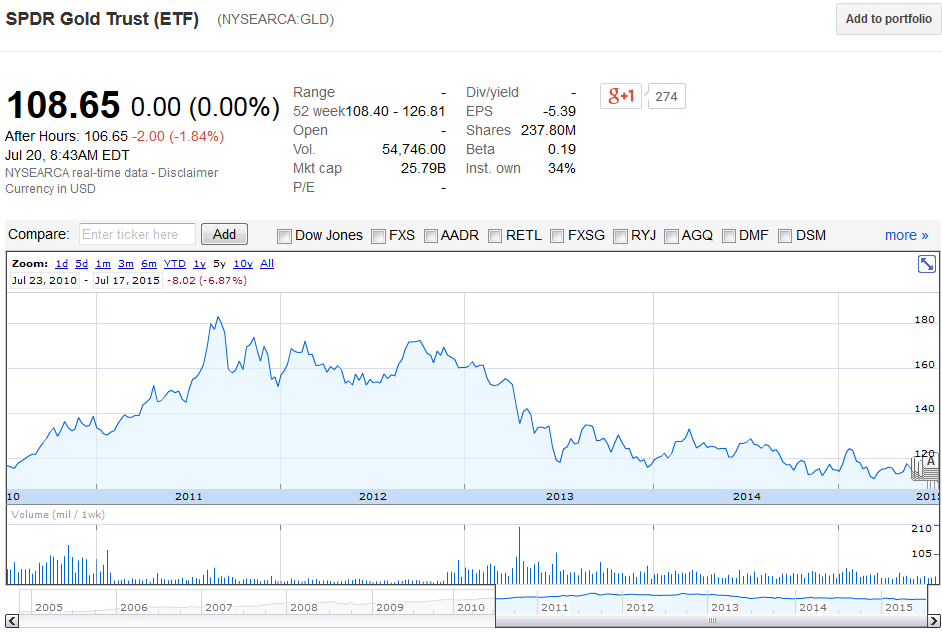
This is a very predictable pattern. Gold increased by 19% CAGR from 2001-2011 and everyone was bullish about gold.
Indians, with a perennial love for gold, found one more reason to buy it and anything associated with gold such as jewelry companies got swept up in the same euphoria.
Gold is down 25% now and so are gold related companies. As far as I know, I am not seeing analysts recommending gold or gold related companies now
So the emotion of greed is obvious – once we see others make money, it is easy to be envious and follow the crowd. The result is predictable too – The last people to join the herd also lose the most money.
My thinking: I have a standard thumb rule. Do not buy something which almost everyone is recommending. If I do buy into something which is the current flavor of the market, I try to move slowly into it so that I don’t lose much if the tide turns. In addition to that, I won’t buy something I don’t understand. For example – I was never able to understand what the true free cash flow for most gold companies is (except titan industries), considering all their profits are generally eaten up by inventory. As a result, I just stayed away from them.
Love and security
Now this is not an emotion, one associates with money and investing. I did not consider it relevant for a long time, but as I think about gold and real estate, I can see the role of these two key emotions
I first realized the importance of love and security as an investment criteria when my mother tried to convince me to buy gold to secure the future of the family. I tried to explain that equities give a better return, but soon realized that there was no way I could convince her. Of course, she decided to take matters in her own hands – she went and bought some gold for the family and said that that was her way of providing security to the family 🙂
The effect of emotional attachment is very high with gold – When it goes up, people justify its purchase based on the price rise. If it goes down, the justification changes to it being undervalued or being a hedge against catastrophe or any other reason you can think of.
If you still don’t agree with me – go to your spouse or any other member of you family and suggest the following: Please hand me your gold, I will sell it and invest it in a higher return instrument. In X number of years from now, you can buy more gold than what you have now. I have tried it and I am scared to use the two words ‘gold and sell’ again in the same sentence 🙂
Flaunting
If you think, love and security alone explains the fascination for gold – think again. I always found it irrational to buy gold or even real estate (beyond your housing need) if all that you are looking for is high returns.
This thinking changed when my family and in-laws felt that I had finally arrived in life when I bought my own flat with a big loan and essentially signed my life to the housing finance company (read EMI!). I never got any praise for buying an asian paints or any other long term compounder , whereas the flat was a concrete evidence (no pun intended) that I was doing something right in life
There is a tangible quality to both gold and real estate. You can see it, feel it and even flaunt it . In the past one could look and touch the stock certificates, but now with demat accounts what are you going to show others?
Imagine this fictious dialogue
Mom to her friend: My son has finally arrived in life! he bought a 1000 sqft flat in XYZ location. We are going to grah pravesh (house warming). Why don’t you join us?
Versus
Mom to friend: My son bought 1000 shares of asian paints. Let me show you his demat account! you know this company has a sustainable ……… will this dialogue ever happen!!
It’s the same with gold. Your wife or mother can wear the gold and in a lot of cases this serves to signal that the family or husband/ son is wealthy. So gold and real estate actually help in feeling secure or in displaying wealth. It is incidental that they earn some return too.
These emotions sometimes creep into stocks too. At the height of a bubble, investors want to invest in the hottest companies so that they can show their friends and colleagues how smart they are.
My thinking: In my own case, I have usually not felt the need to flaunt (or so I believe). At the same time, I try hard to avoid envy, which causes one to do stupid things such as chase the latest investment fad or buy stuff to show off.
There are only a two exceptions to the above rule in my case – The first one is that the emotional value of your own home is high, so it don’t look at it as a financial decision, but something which makes my family feel secure. The second one is that when my wife wants to buy jewelry I look at it as an expense to keep her happy
The driver
Volatility in prices is not an emotion in itself, but a driver of a lot of emotions we have been talking about. When stock prices crash, we can see that investors are overcome by fear, despair and in some cases complete disgust to the point of avoiding equities forever.
On the contrary if prices rise rapidly the reverse happens – we see greed and euphoria. These feelings are common to all investments, but as the volatility is high in stocks compared to other options, these emotions are amplified in the stock market.
I personally think that one of the reasons investors make higher returns in stocks compared to other options on average, is due to the higher volatility which tends to put off a lot of people. Investing in stocks is tough emotionally, no matter how long one does it. You go through periods of sickening drops and exhilarating spikes and it never gets easier, emotionally.
Take your pick
So it comes down to what one is looking for in their investments. If you want to flaunt your wealth or to feel warm and fuzzy, then go for real estate and gold. The returns could be good, if you have specialized skills in these asset classes, but then that is a different ball game.
If you want complete peace of mind – invest in Fixed deposits and sleep well. There is no harm in that!
If you are ready for a few sleepless nights, stomach churning drops in your networth (even if temporary) or sudden euphoric rise, and have nerves of steel to handle all of these emotions, then you will be rewarded with higher returns over the long term. That is equity investing
This brings me to a final anecdote –
I was discussing about expected returns of various types of assets such as real estate and stocks with a friend. I mentioned that one should expect anywhere between 15-18% from the stock market in the long run. To this, my friend replied that he ‘wanted’ nothing less than 20% per annum.
I asked my friend on why he ‘wanted’ these returns? Ofcourse he had no reason for it. It was just something he thought should be the case!
My reply was that like my kids, if you are wishing for something as they wish during Christmas from santaclaus, you should not hold yourself back. Why stop at 20%, why not ask for 100% – maybe your wish will come true!
We are still good friends, but don’t talk about investments any longer :). This is the final emotion a lot of uninformed investors suffer from – Hope
—————-
Stocks discussed in this post are for educational purpose only and not recommendations to buy or sell. Please contact a certified investment adviser for your investment decisions. Please read disclaimer towards the end of blog.
Oil down 50%+, Ruble crashing. Rupee on its way down and maybe the stock market too !
—————-
Stocks discussed in this post are for educational purpose only and not recommendations to buy or sell. Please contact a certified investment adviser for your investment decisions. Please read disclaimer towards the end of blog.
I think the next 2-3 years are not going to be easy, just because we are in a bull market. A few of you who decided to invest when India was supposedly going down the drain, must be feeling good about it. It is fine to feel good about it, but one should not get carried away by it.
More noise
In a bear market, as we had in the last 3-4 years, almost no one spoke about the stock market except as a place to avoid. Unless you turned on one of the financial news channels, it was easy to avoid any talk about it.
The advantage of this comparative silence was that you could think investing without too much distraction. The situation has changed quite a bit in the last few months. We now have friends, colleagues and relatives, all getting excited about the market. If like me, your acquaintances know that you invest in the stock market, I am sure you must get badgered with tips for the top ten hot stocks which will double in 21 days – small caps especially.
In my case you can imagine the disappointment – recommending people to invest in 2013 when no one wanted to, and being cautious now when everyone and his dog thinks we are at the start of a multi-year bull run.
Feeling envy
It is easy to feel envy when you see others do better during such times. The media adds fuel to the fire by publishing the list of stocks which have gone by 50 or 100 times in the last 4-5 years. Ofcourse, they were silent when these stocks were starting the journey.
In addition, you now have friends and other investors boasting how they doubled their money in the last six months, by buying the hottest idea.
One can abandon his or her approach and start chasing such stocks which have worked well for others in the past. From personal experience, I can tell you that this never works out (atleast for me).
Unnecessary churn
As the market touches new high, I think some people get itchy to sell stocks which have given high returns and recycle them into new positions, which ‘appear’ to be cheap.
I am looking for new ideas too, but will not do it for the sake of ‘doing something’, unless I think it will add to the overall returns. If this means doing nothing for long periods of time – so be it.
Let me explain further – I currently have around 19-20 positions in my portfolio. I am constantly looking for new ideas. As I am close to fully invested, I will have to sell an existing idea, incur the brokerage and taxes (if any) and then buy the new position. The implication of this decision is that I expect this new idea which has been analyzed for a few weeks, will do better than an existing company which I have analyzed and followed for more than a year.
There are people who are smart enough to do this consistently – I am not one of them. I do not want to take these decisions lightly. If the time horizon is 2-3 years and more in my case, it is really important that I take a little more time to think through this decision.
Being patient is never easy
I have found bull markets to be far more difficult to handle than other times. For starters, it involves doing nothing for long stretches of time, when stocks are going up and you are missing out on easy money ( that the easy money is lost in the end is a different matter).
Let me ask a few rhetorical questions (which I keep asking myself too) – is it really important to have all the hottest stocks in your portfolio? Is it really necessary or even possible to have the highest possible returns at all times, if a lower rate of return at much lesser risk will meet your goals ? Is this investing or just showing off?
The main challenge we will face in the coming months and years is to keep our heads amidst the euphoria. It is very easy to get carried away and starting buying marginal companies showing profit and stock price momentum – I have done that a bit in the past and it has always come back to bite me.
Let me suggest a few activities to keep you busy while waiting for the right opportunity
– Watch TV soaps, especially the family dramas. They have a lot of twist and turns too (or so I have heard)
– Take up body building or weights. You will have chiseled body if the bull market turns out to be a 10 year one J
– Go for long walks and walk a little more every day. If this a long bull market, you may be walking the whole day
– If you are single, go to parties and have fun. If you have been investing in the past and not partying, shame on you anyway – what a waste of youth!
For those of you who like me, cannot do any of the above – keep faith and hope. This too will pass. The skies will turn dark again, and they will be gloom and doom. You will get your chance then J
—————-
Stocks discussed in this post are for educational purpose only and not recommendations to buy or sell. Please contact a certified investment adviser for your investment decisions. Please read disclaimer towards the end of blog.
How to reject a stock?
You will generally find ten tips to select the next ten bagger, but not many write on how to reject stocks.
The problem of abundance
A typical well diversified portfolio tends to have 15-20 stocks (anything more does not reduce risk any further). Let’s assume that the holding period is 2-3 years per stock. So in effect one needs to find and replace 5-7 stocks per year in the portfolio.
We have around 5000+ companies listed in the stock market and a selection of 10-12 stocks means that you will reject 4990 stocks (if you were able to have a look at all the companies each year). That is around a 99%+ rejection rate. Even if you were to play around with the number of stocks you can analyze each year and the number you end up selecting, I cannot envisage a scenario where you will reject less than 95% of the stocks you review.
Finally a corollary to my point –The main problem is that we are not limited by choice, but by time and effort.
Building the framework
At the risk of oversimplication, I would say a long term investor is looking at high rates of return for a long period of time. Putting it quantitavely, I would say that I am looking at a CAGR of 26% per annum for 3-5 years or longer if possible.
– The company operates in an industry with above average growth rate which means that the industry is growing atleast at 15%+ rates (higher than the GDP).
– The company is able to earn a high rate of return on capital (atleast 15% or higher) for a long period of time (sustainable competitive advantage)
– Company is led by a competent and ethical management
– The company is selling at reasonable valuations
Easier to reject stocks
You must have noted that I have omitted a lot of factors which go into selecting a winning stock and that’s precisely my point. Selecting a profitable stock is a complicated Endeavour and one can write books on it and still not cover all the points needed to identify a profitable idea.
So let’s look at how we can select stocks to lose money
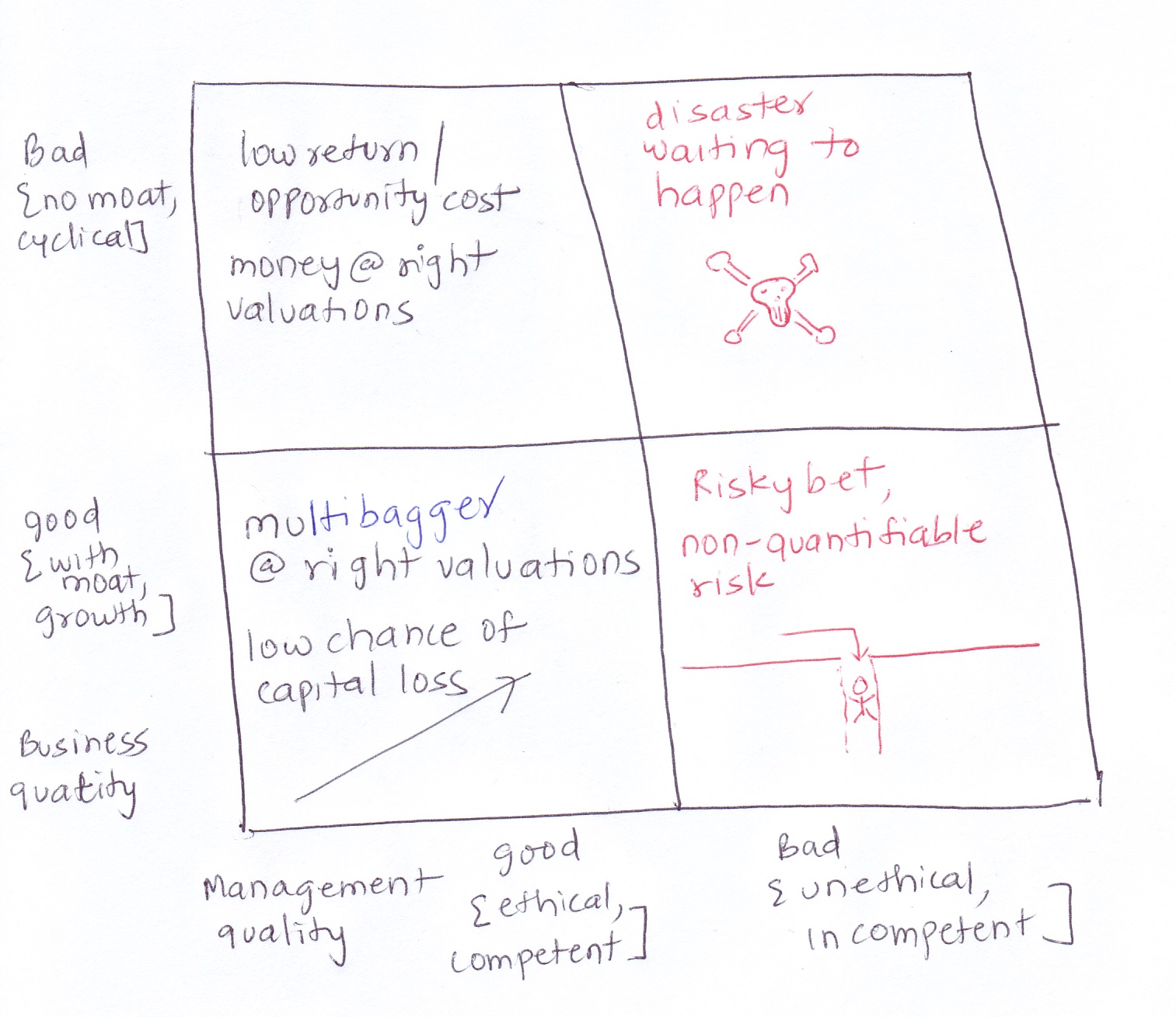
– The company operates in an industry which is in a terminal decline (fixed line telephony) or is highly cyclical, commodity in nature and with very poor return on capital (metals, sugar, airlines etc)
– The industry is subject to a lot of change (regulatory, competitive or technological) which causes several companies to fail or loose money due to sudden change in the competitive scenario (telecom, mining etc)
– The company is managed by an unethical and incompetent management (do you need examples here?? – just look around )
– The stock is purchased at high valuations in a cyclical industry right at the peak of the business cycle. To add insult to injury, the company is managed by an unethical and incompetent management. This combination of factors is guaranteed to loose atleast 50-60% of your capital if not more
Is it comprehensive and works 100% of the time?
Of course, this list is not comprehensive. I can come up with a lot of additional points, but I can say that these broad criteria can be used to eliminate a lot of companies at the first glance.
My counter point is – Do you really want to search for a needle in a haystack when there are often gems lying around? If your idea of fun is to find that nugget of gold in a pile of manure, then welcome to my world. I have engaged in it often and the results are not great compared to the effort put in. In addition if you are not a full time investor, then it makes all the more sense to focus your limited time on good opportunities.
The benefit of my mistakes
The list I have shared is not something I have just dreamed up while sipping coffee. I did a small exercise of listing of my failures for the last 15+ years and found a few common threads among all of them. If I boil it down, it comes down to the four points listed above.
Let me make another bold claim – if you want to lose 90% of your money, buy a highly cyclical and commodity type company at high valuations at the peak of the business cycle and run by an incompetent and crooked management. You will be guaranteed this result. How do I know – I tried it a few times and have never failed to loose my shirt (and other garments!)
—————-
Stocks discussed in this post are for educational purpose only and not recommendations to buy or sell. Please contact a certified investment adviser for your investment decisions. Please read disclaimer towards the end of blog.
Cost is an important, though poorly understood aspect of investing. It is important for the simple reason that costs reduce the overall return one makes from an investment option. It is also poorly managed as people focus too much on explicit costs (cost of brokerage or fees) and ignore the hidden ones (such as opportunity costs).
a. Fixed deposit : cost 0, likely return : 8-9% (pre-tax)
b. Index fund ETF: cost 0.6% to 1%. Likely return : 14-15% (pre-tax)
c. Mutual funds (HDFC equity fund): cost 2%. Likely return : 20-21% (pre-tax)
d. PMS: usually 2% of asset and % of gains. Likely returns: Who knows?
Fixed deposit and index funds are zero or low cost options with the FDs having no volatility, but much lower returns. IF you want to build wealth, an FD is not going to get you there. Index funds are a decent alternative, where the risk of active portfolio management is removed. You don’t have to worry if your portfolio manager is an idiot who will underperform or worse lose money over the long term.
The last option is private vehicles such as PMS (portfolio management schemes). These involve high costs, and in some cases deliver good returns. However they have a mixed record and are generally not a good option for most investors due to a high minimum investment.
Let’s take a hypothetical case
At the end of 3.5 years, you will have following sums with you
Fixed deposit (pre-tax): 4.05 Lacs (pre-tax) and 3.84 Post tax
Index fund (pre-tax and post tax): 4.18 Lacs (net 1% as cost)
Mutual fund (pre-tax and post tax): 4.62 lacs (net 2% management fee )
The explicit costs
In order to make the higher returns, an investor had to contend with all the volatility and noise in the market. In addition to the emotional toll, there was an explicit cost of around 3% for the index fund and around 6% for the mutual fund.
Inspite of these costs, if an investor could stomach the volatility, he or she came out ahead during one of the lousy periods in the stock market.
If you think explicit costs are bad, I would say the hidden costs are even worse.
This difference only increases over time and would be even wider once the market performs close its long term average (15-17%) and interest rates drop.
If you bought 3 lacs of gold in Jan 2011, you would have around 3.78 Lacs of gold now (at pre-tax). I don’t want to discuss taxes as paying taxes on gold is different issue altogether. So gold did barely as well as an FD. Keep in mind that gold over a 20 year or longer period has delivered 9-10% per annum despite the recent runup (excluding transaction and holding costs)
The returns on a specific investment – a stock or a property is not same as the return of an entire investment class. If you want to look at the average returns, look at this table by NHB. The returns vary from -15% for a Kochi to 249% returns for Chennai over a 7 year period. So we are talking of -2% to 15% per annum for different locations. This does not even include taxes, brokerage, and maintenance fee (For property).
Congrats – but then you are missing the final point. The final point is the cost of time and effort – if you are a full time or even a part time investor in RE, you are using knowledge/ skill/ time to dig out such deals and investment in them. As you do this, you are not using your time do XYZ (spend time working, with your kids, play – whatever you can think of)
Compare all costs
IF you truly want to compare multiple investment options, compare all the costs – implicit and explicit
It is foolish to look at some costs and declare a particular option as better. Maybe I value peace of mind and time with family more than returns – in that case an FD is better. My own dad valued these attributes more than returns and spent his spare time with his kids and on his own hobbies (without ever depriving us of anything in life)
In addition to these costs and corresponding returns, I would say there are emotional and bragging benefits to various options which will be the subject of the next post.
I had written a note about Selan exploration here. I will not repeat the analysis as the main thesis laid out earlier, still holds true.
The company is cheap from multiple perspectives – enterprise value per barrel of oil reserves, EV/EBDITA etc. However due to lack of timely clearances for drilling new wells, the production and profits have stagnated for the last few years. As a result, the stock price stagnated for a few years, before the recent run from the 200 levels to around 620 now.
In addition to the above disclosure, there is another very key variable which is showing an upward trend – development of hydrocarbon properties. This is the cost incurred by an oil and gas company to prospect for locations for new wells and then drill the well and complete it. The company has spent close to 80 Crs in the last four years in prospecting for new drilling locations.
We cannot be sure how many of these wells will be successful and when exactly they will come online. At the same time, the typical lead time from start of drilling to production of oil and gas varies between 6-9 months. So we are in effect talking of about 3-6 months of time for the oil production to ramp up.
This is not a core position
This is not a big position as i think it is risky for the reasons already detailed in my earlier post. Let me repeat the key ones
– The management provides the minimum level of commentary on the performance and outlook for the company. There are no interviews, quarterly conference calls etc. In effect short of speaking to the management directly, there are no publicly available sources of information. One is driving through a foggy windshield and being forced to make inferences based on published data
Please do not consider this to be a stock recommendation and do you own homework. Please read the disclaimer if you still have some doubts
—————-
Stocks discussed in this post are for educational purpose only and not recommendations to buy or sell. Please contact a certified investment adviser for your investment decisions. Please read disclaimer towards the end of blog.
What is worse than losing 100% on a stock ? It’s missing a 10 bagger !
What’s worse than missing a 10 bagger ? It missing a 10 bagger which you identified and decided to take no action inspite of knowing about the company. Now you must be thinking – that’s quite dumb ! In a way it is, but as always the story is more nuanced than just being dumb.
Let me give some more hints J ..I wrote about it in July 2010 when it was selling for around 80 Crs market cap. It now sells at around 1400 crores. That’s a 20 bagger excluding dividends during a period where the market has gone nowhere.
Now I can assign this to bad luck and move on. However I have never operated this way – I want to dissect each failure – failure of losing money or failure missing out on a 10+ bagger.
I wrote about this company in July 2010 when it was a micro cap and started a small position in the company. I was comfortable with the financial performance of the company, but was concerned with a corporate governance issue – issue of warrants to the promoter at below market price, when the company did not really need the extra capital.
As the stock price rose, I lost interest in the company and sold my small position as I was not comfortable with the corporate governance issue. In hindsight, I do not fault myself for this decision – it was the right thing to do based on the facts known to me at that point
So where did I really go wrong? As I look back, I can attribute the failure to a label I attached to the company. I was not comfortable with the management and attached the label of ‘poor corporate governance’ to the company.
First conclusion or confirmation bias
The other name for this locking is called the first conclusion bias (read here). Once I had reached a conclusion I refused to change it, inspite of evidence to the contrary. It is only after the evidence became too obvious to ignore that I have revisited my conclusion and realized the flaw in my thinking
If mayor uniquoters was an isolated example, it would have been comforting to ‘label’ it as an aberration and move on. However there are a few more examples (atleast ones which are obvious to me).
Hawkins cooker: This stock was pointed out to me in 2010 when the company was selling at a PE of around 15. The company was and is easy to understand, has great economics and a wonderful management. So if such a company was presented to me on a platter , why did I ignore it ? The single word for that is valuations – The Company was selling at a PE of 15+ which in my mind was expensive.
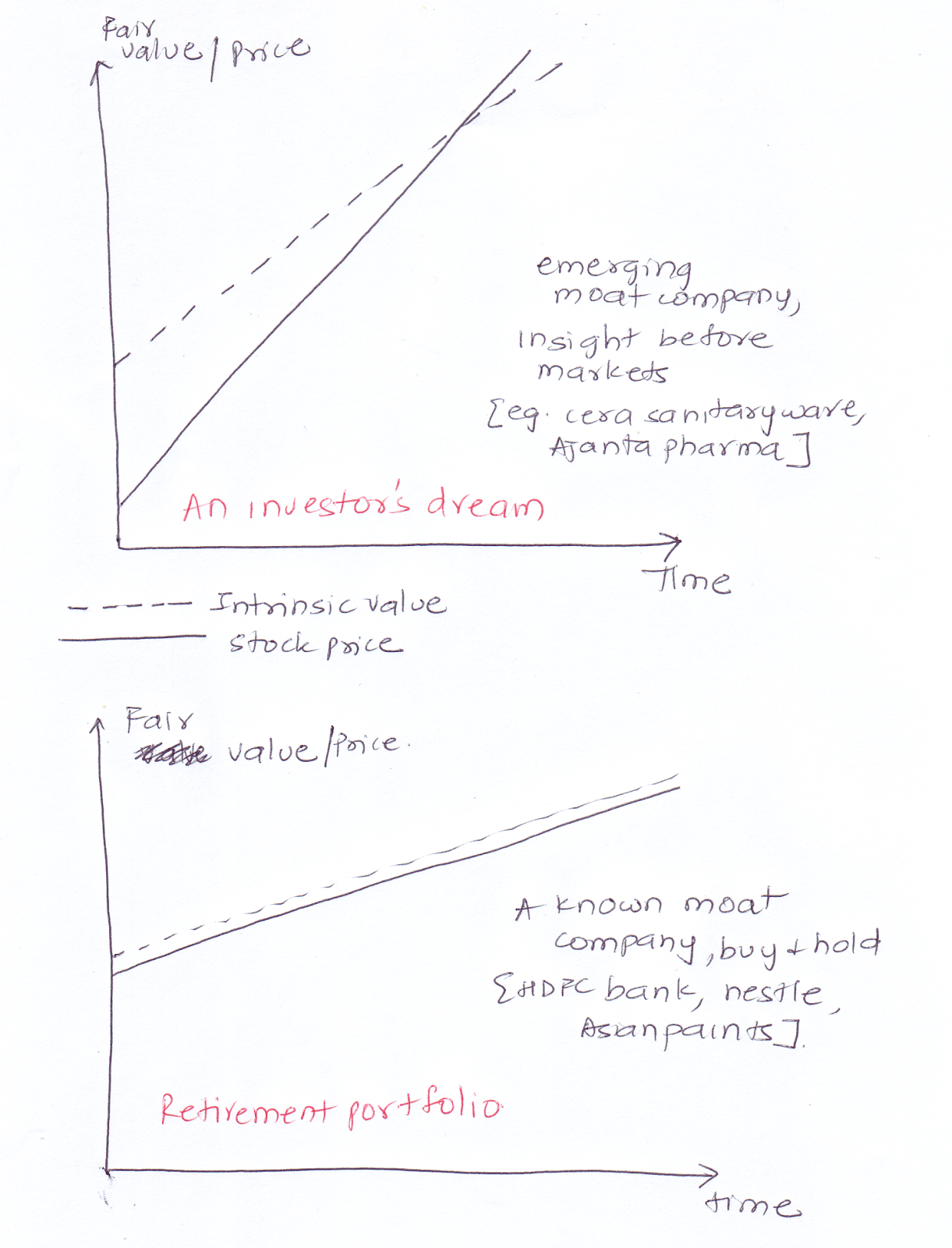
The above thought process holds true in isolation, but it is important to consider the PE ratio in context of business quality. A business with weak economics is a bad stock even if it has a low PE and an exceptional business with a moderately high PE can still be a great stock. I have been aware of this fact, but still had to relearn this important concept all over again
It would be safe to assume that if you are presented ‘data’ which contradicts your assumptions, you will change your prior conclusions ? Atleast not in my case !
Ajanta pharma has been a multi-bagger since it was pointed out to me by a very smart investor – Hitesh. I still have the email in which he shared the idea with me in 2011. At that time, I was not comfortable with pharma companies and thought that I could not judge Ajanta’s future prospects accurately.
I personally follow this site and occasionally post on it too. Ajanta pharma and Mayur uniquoters are two such ideas which were posted on this site and analyzed in a lot detail. I have been following these companies over the last few years and inspite of over whelming evidence did not take the plunge
How to change ?
The first step in fixing a blind spot is recognizing one. Now that I have recognized multiple biases in my case, I have started focusing on the following points in my investment process
– Do not equate a high PE with expensive. Analyze the business in detail and determine if the company can still double in 3 years at current or slightly lower valuations
– Focus on quality before valuations
– Constantly question my own conclusions. I have started doing this after each quarterly result – does the company match the original thesis (positive or negative)? Do I have access to some new non-quantitative information which should prompt me to revise my original thesis ?
Ps: if you guys have some stock tips, do send it my way. I will have a more open mind on it now J
—————-
Stocks discussed in this post are for educational purpose only and not recommendations to buy or sell. Please contact a certified investment adviser for your investment decisions. Please read disclaimer towards the end of blog.