Blog

The staircase chart

T


There is a chart pattern which can either cause dread or euphoria in the hearts of investors.

There may be no formal name for it from technical analysts, so let me call it the stair case chart.This is either a stock hitting the upper or lower circuit continuously for days at end. The pattern looks like a staircase in a particular direction. More than the pattern, the investor psychology during this period is instructive
We had several stocks on the ascending staircase last year. Whenever such an event occurred, it was fascinating to read the comments of investors on social media. Everyone was patting each other on the back, congratulating the management and generally puffed up about their brilliance. The more intellectual types threw terms like moat, great management and large opportunity size to sound rational.
Of course, a rising price tends to obscure all risks and this occurred often in 2017.
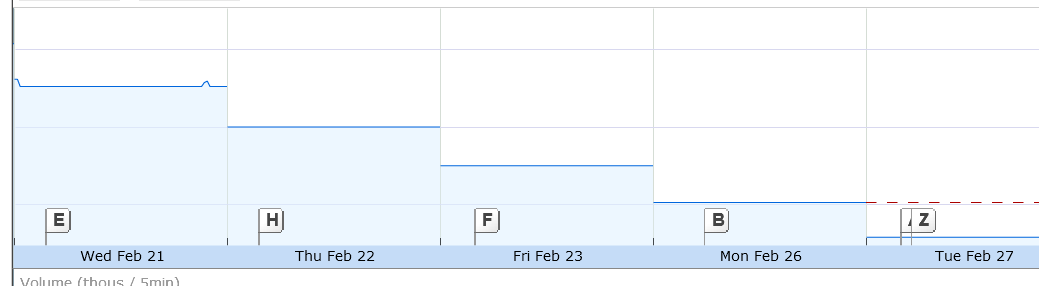
The current year has been the reverse. We are now seeing the dreaded descending staircase chart pattern for a lot of companies. In these cases, the stock price is locked in the lower circuit and a lot of investors who want to get out of the stock, are not able to do so.

It is again fascinating to watch a different set of investors (it’s never the same) now talking of the dishonest management, bear conspiracy and the lack of liquidity.
It is tempting to make fun of others in either of the two scenarios, but I would caution you from doing so. It is not difficult to find yourself in one of these camps in the future. On the contrary, if you invest long enough, one of these patterns will hit you.

I track and study such events to understand the psychology and see what I can learn from it. This is my short summary
        Do not mistake correlation for causation. People invent reasons for quality or lack of it based on the price action. The time to evaluate quality is before the price action starts and not after it. Once the trend begins, it is not easy to avoid the emotional contagion
        You will never know everything there is to know about a company and its management. There are always unknowns and it’s important to stay humble – that is acknowledge your ignorance. Once you do that, you will respect risk and size your positions accordingly.
        Always have an estimate of fair value in mind. When the market goes crazy on the upside, reduce the position size to manage the risk of over concentration.
          Have a downside plan in place. If you invest long enough, one of your position will eventually hit a wall. Know what you will do in advance as it is not possible to react rationally at that time.
        If you have bought into a speculative position, acknowledge that you are riding a tiger. As long you are in control, you are fine. If the table turns, be ready to be eaten (figuratively speaking). Position size and risk management is critical in such cases, so that you live to see another day (in terms of investing)
        Finally keep an open mind. This is of course easier said than done. The most common reaction for almost everyone is to attack someone who is arguing against your view point. In my case, whenever I read an opposing view, I take a deep breath and do nothing at that time, other than make a note of it. This allows me to calm down.


I usually come back to the argument after a few days and try to dig into the points being made against the thesis. In my case, I will note down these points and try to separate facts from opinion. Facts can be easily validated and disposed off. If there are opinions, then the best option is to analyze the reasoning and look for evidence to support it. Even if you don’t find the evidence right away, be on a look out. If you do see the evidence supporting the counter argument, then you know the other person is right.
Investing is all about betting on the future of a company and the best of us will be wrong from time to time. The key is to be on the lookout, acknowledge your mistake as soon as possible and fix it. The ones who make lesser mistakes on average do better than others over time.

—————-
Stocks discussed in this post are for educational purpose only and not recommendations to buy or sell. Please contact a certified investment adviser for your investment decisions. Please read disclaimer towards the end of blog.

Annual letter to subscribers: On risk, Bitcoin and thinking long term

A


The following note was published recently to my subscribers. Any reference to performance or individual companies has been removed to ensure compliance with SEBI regulations.

I hope you find the note useful
What drove the performance
We exited 5 positions and replaced them with four new positions during the year.
It’s a unique year that none of our portfolio positions dropped in value. It is however not surprising considering that various indices were up 40-50% during the year, with almost 100+ stocks increasing by 100% or more. If we just compare the numbers, our performance is nothing to get excited about.
If you just threw darts at the small cap index, you could have done quite well. If, however, you were ready to throw caution to the winds and were open to go down the quality curve, then the gains were even higher. I am not crying sour grapes here. Let me explain why –
At any point of time, I am looking at several companies and track them over time. If I find an idea interesting, I usually create a small starter position to understand the sector and company better.
A lot of such starter positions are up anywhere between 60 to 400% during the year. So, when I say that, if you were adventurous and ready to take on risk, the returns were higher, it is not an academic point. I have seen the same happen in my personal portfolio.
You may ask – why did I not do it in the model portfolio? To that point, let me state something which I have repeated in the past.
The model portfolio mimics our (Kedar and mine) personal portfolios (except for a few small positions) and that of my family and friends. I will never ever take excessive risk just to look good and gain some boasting points.
A year of misses
This was a very frustrating year too. A few new ideas passed through the initial filter and ended up on the tracking list.
Several of the companies on this list seem to be decent bets for the long run, subject to execution by the management. I prefer to start with a small position and increase the size as the management executes as per the plan. If, however the management slips or the business conditions change for the worse, we will exit the position.
In several of these trail positions, the stock price rose rapidly, in anticipation of the improvement. It’s quite possible that the market is able to foresee the improvement much before I can. In that case, we may end up starting the position late with a lower upside, but with much lesser risk.
We need to be patient in all such cases as you never know when opportunity would knock again.
Change in approach: fail fast and small
There has been a subtle change in my approach in the last 1-2 years which I think should be shared with all of you. I have become more open to trials (starting with small positions) and then killing these ideas quickly if they don’t work out.
It is one thing to maintain a buy list, but emotionally very different to actually commit money (even a small amount) to an idea. Once you do that, you are financially and intellectually (and even emotionally) vested into the position. In such cases, it is important to constantly stress test the idea and exit if the thesis does not pan out.
A failure on a small 1-2% position will not hurt our portfolio over the long run. If, however some of these positions work, we can scale into them and make them much larger.  This is the mental model used by venture capital firms and it makes sense to adopt a similar framework (even if the type of companies we target is different) for our portfolio.
What truly drives the long-term returns
I have shared the changes in the intrinsic value of the portfolio with the price changes in the past and would like to reiterate the following points again
a. Businesses and their intrinsic value tends to be less volatile than stock prices
b. Over the long term, stocks prices tend to follow intrinsic value. However, in the short term (1 year or less), these two numbers don’t have to move in lock step.  
c. If the underlying business is increasing in value, it makes sense to have patience as the returns will eventually follow. As an example, if we had gotten frustrated after the measly returns of the last two years and exited in 2016, then we would have missed the gains of 2017
2017 has been a year when the portfolio price has again caught up and run ahead of the value. As a result, we can expect lower performance for the next few years till we can get the fair value up via a combination of new ideas and increase in value of the current holdings.
In the long run, this back and forth will continue, and I don’t plan to play the game of timing to squeeze a few extra points of performance. We will focus on increasing the intrinsic value of the portfolio as much as possible and let the market give us gains as per its own schedule.
Measuring the risk
I had written about risk management in the last letter, which is reproduced below again
I am not trying to make the highest possible returns in the shortest period of time, but above average returns over time with the lowest possible risk, with risk management taking a higher precedence. Risk Adjusted returns are more important than absolute returns.
This focus on “Risk” has led us to cap our top positions at 5-7% at the time of purchase, keep sectoral bets capped at 20% and maintain a cash level of 12-15% over the lifetime of the model portfolio. A more aggressive stance in the form of more concentrated positions or lower cash would have raised our returns (5% per annum by my rough guess), but increased the risk too. I have no regrets of foregoing these returns. I will always prioritize risk over returns and if it means slightly lower returns, so be it.
If we continue to earn above average returns in the future, the magic of compounding with risk management will allow us to reach our destination. I want the journey to be pleasant and would like to sleep well at night. There is no point in dying rich if you have a terrifying time reaching that point.
I have discussed about risk in a subjective manner in the past, without using any ratios or measures. One quantitative measure is drawdown of the portfolio over various time periods.
On an annual basis, we can see that we have lost less than the market during downturns.
However, we do not have enough data points to make this evaluation statistically significant.
In order to have more data points, I have computed the monthly returns of the portfolio and compared it with the large cap index. For the data purists, a monthly period may not be the right duration or they may quibble about using a different index for reference. My response to that – it is better to be roughly right and directionally correct, instead of trying to get it right to the third decimal point.
For the duration of the model portfolio, the average monthly loss for the index has been around -3% (when the index has dropped during the month). In those periods, our portfolio dropped less than the index 63% of the times and our average drop during these ‘bear’ market months has been around -1.1%
The above statistic is quite noisy as I think monthly returns are usually meaningless, but over a long period this statistic can give an indication of the level of risk in the portfolio. In other words, we have had lower drawdowns. We cannot avoid bear markets, but if we lose lesser than the market, we should do quite well in the long run
I am more focused on reducing the risk, than doing better than the market. I have always felt and continue to feel, that the long-term momentum of the Indian economy and the stock market is such that we will do well over time as long as we can reduce the downside risk and avoid doing something stupid.
In case you are curious on how we have done during bull periods (when monthly returns are positive), the model portfolio has returned 5.3% versus the 4% by the index during the same period.
As you can see, that although we have done better than the market on average during the bull markets, our outperformance against the index has been higher during bear markets.
If you are really hoping to do well with me, hope for a bear market now.
Cash is not a macro call
We currently hold around 28% of the portfolio in cash which may appear to be some sort of a macro call. However, let me assure you, it is nothing of that sort. I have never bothered with economics forecasts around GDP, interest rates or any global or geopolitical situations.
My analysis is always bottoms up with a focus on company level factors.
The reason for the high levels of cash is that the price of several of our ideas have far exceeded my estimate of fair value due to which I feel that the long-term returns are likely to be lower compared to the risk of holding those positions. As a result, I have reduced the position size.
At the same time, the speed with which I can find and understand new ideas has been far slower than the rate at which the market has recognized and re-priced them. This is something I cannot fix unless I can buy some extra IQ points to speed up the pace.
The question I am constantly asking
As the markets have risen, I am constantly asking the following question for each position : Will I continue to hold this position if the stock price drops by 50%? If not, why am I holding it now?
The time for risk management is now, when there is euphoria all around and not when everyone is heading for the exits.
If anyone of you, cannot bear a 20-30% drop in your portfolio, it would make sense to do a mental exercise now – how much should I invest in equities so that even if the equity portfolio dropped by 30%, I will not lose sleep.  No one can answer this question, but yourself and the time to do it would be now.
Why do I constantly harp on risk? Is it because I foresee some market crash?
The emphatic answer for that is no! We are not in the business of forecasting which can be left to media personalities. For me and Kedar, Risk is personal and we want to look at it as an integral part of investing. Our monies and that of our families are invested in the same fashion as the model portfolio. We are not managers who will only benefit from the upside, but have no risk on the downside.
We will have quotational losses from time to time, but do not want to be in a situation where our greed or envy of some else’s performance leads to a permanent loss of capital for us, our families and you.
Bitcoin and popcorn
I have been asked by a few subscribers on what I think about Bitcoin. I have a rough idea of the technology that under pins cryptocurrencies – ‘Blockchain’ and think the technology has a lot of potential in reducing transactional costs, improve asset tracking, develop decentralized networks and several other use cases which we cannot imagine as of today.
That said, I do not have a view of Bitcoin as I do not understand it well. There are several other things I don’t understand well enough to be able to make money such as Shortterm trading, technical analysis, Bio tech, Mongolian companies and so on. However, that does not disturb me as there is enough for me to do within the scope of what I do understand.
If we can invest conservatively and earn an above average return in Indian equities, the end result is likely to be very good. Why should we then get all worked up if something is doing well for others and they are becoming rich as a result?
There will always be someone doing better than us in all sorts of stuff. Someone could be running a restaurant or a tech startup which is doing very well. Does that mean we should follow them as a short cut to riches?
I continue to study the technology out of curiosity and watch the drama on the sidelines. I also have some popcorn (unbuttered to avoid cholesterol issues) on the side to enjoy the show.
The Indian bitcoins
When I look at companies which are priced at lofty multiples, I try to break it down to the first principle of investing – The value of an asset is the sum of its discounted cash flow over its lifetime.
A company with a high multiple, is not necessarily expensive if the company can grow its free cash flow for a long period of time. This means the market ‘assumes’ that such a company has a sustainable competitive advantage and a large opportunity space. Please note use of the word ‘assume’. The market is not some “All knowing” entity which can see the future. It is just the aggregation of the combined wisdom (or madness) of its participants.
The market on average and over time gets the valuations right, but not always.
As I look at several companies in the small cap and midcap space now, I am left wondering if investors really understand the implications behind the valuations. A company selling at a PE of 50 will need to deliver a growth of 25% for 10 years to justify the price. In order to make any returns for an investor buying at this price, the actual growth will have to be much higher and longer.
How many companies are able to deliver such growth rates for so long? Let’s look at some numbers from the past
In the last 10 years, we had around 233 companies in the sub 3000 cr market cap space, deliver a growth of 25% or higher. That’s around 6.2 % of the small/ mid cap universe. As the market cap/ size increases, the percentage of companies which can deliver this kind of performance only shrinks.
How many companies in the above space currently sport a PE of 50 higher? around 22% or roughly 675. So, 3 out of 4 companies in this group of ‘favored’ high PE companies are going to disappoint investors in the coming years in terms of growth
In other words, if you could buy all these ‘favored’ companies (greater than a PE of 50), you have a more than a 50% chance that you will lose money. Why would you take such a bet?
All investors in aggregate are taking this bet assuming individually, that their ‘chosen’ companies will not be the ones to disappoint. Of course, every individual thinks he or she is smarter, more handsome or than the crowd (also called illusory superiority).
The odds are against everyone being right. So, it makes sense to be cautious and do your homework well enough.  Some of these companies could turn out to be the bitcoins of our market: assets with promise but without cash flow. In such cases, the end result is likely to be unpleasant.
A long-term partnership
I repeat this every time in the portfolio review and will do so again
– I do not have timing skills and cannot prevent short term quotation losses in the market
– My approach is to analyze and hold a company for the long term (2-3 years). As a result, my goal is to earn above average returns in the long run and try to avoid losses during the same period
– In spite of my best efforts, I will make stupid decisions and lose money from time to time. The pain felt will be equal or more as I invest my own money in exactly the same fashion
    Me and kedar look at our association with you as a long-term partnership. As a result, whenever someone joins us, we are very explicit in letting the person know that they cannot expect quick wins or a stock tip a week or something on those lines.
    
    We want your association with us to span years, if not decades. In our view, financial management is something which lasts a lifetime and hence, as your advisor, we want you all to focus on the long term. We try to instill this focus via multiple actions from our side such as       
      –   Avoiding a short-term focus on performance such as daily, weekly or monthly scorecards
    Buy companies and hold them for the long term as long their prospects remain above average
        Focus on risk and reducing the downside
A lot of subscribers have stayed with us for the long term and hopefully benefited from that. We will continue to maintain this approach irrespective of the latest trends in the market. If that costs us business, so be it. I would rather have some of you disappointed with the short-term result (and consequently leave), than lose money due to chasing the latest trends in the market and then leave (while cursing us).
If you are interested in our advisory services, please email us on enquiry@rccapitalmanagement.com

—————-
Stocks discussed in this post are for educational purpose only and not recommendations to buy or sell. Please contact a certified investment adviser for your investment decisions. Please read disclaimer towards the end of blog.
The Indian bitcoins

T

The following note is from upcoming annual letter to subscribers. I will be publishing the rest of the letter on the blog soon

When I look at companies which are priced a lofty multiples, I try to break it down to the first principle of investing – The value of an asset is the sum of its discounted cash flow over its lifetime.

A company with a high multiple, is not necessarily expensive if the company can grow its free cash flow for a long period of time. This means the market ‘assumes’ that such a company has a sustainable competitive advantage and a large opportunity space. Please note use of the word ‘assume’. The market is not some all knowing entity which can see the future. It is just the aggregation of the combined wisdom (or madness) of its participants.

The market on average and over time gets the valuations right, but not always.

As I look at several companies in the small cap and midcap space now, I am left wondering if investors really understand the implications behind the valuations. A company selling at a PE of 50 will need to deliver a growth of 25% for 10 years to justify the price. In order to make any returns for an investor buying at this price, the actual growth will have to be much higher and longer.

How many companies are able to deliver such growth rates for so long? Let’s look at some numbers from the past

In the last 10 years, we had around 233 companies in the sub 3000 cr market cap space, deliver a growth of 25% or higher. That’s around 6.2 % of the small/ mid cap universe. As the market cap/ size increases, the percentage of companies which can deliver this kind of performance only shrinks.

How many companies in the above space currently sport a PE of 50 higher ? around 22% or roughly 830. So 3 out of 4 companies in this group of ‘favored’ high PE companies are going to disappoint investors in the coming years in terms of growth

In other words, if you could buy all these ‘favored’ companies (greater than a PE of 50), you have a more than a 50% chance that you will lose money. Why would you take such a bet?

All investors in aggregate are taking this bet assuming individually, that their ‘chosen’ companies will not be the ones to disappoint. Ofcourse every individual thinks he or she is smarter, more handsome or than the crowd (also called illusory superiority).

The odds are against everyone being right. So it makes sense to be cautious and do your homework well enough.  Some of these companies could turn out to be the bitcoins of our market: assets with promise but without cash flow. In such cases, the end result is likely to be unpleasant.

—————- 
Stocks discussed in this post are for educational purpose only and not recommendations to buy or sell. Please contact a certified investment adviser for your investment decisions. Please read disclaimer towards the end of blog.
Ignoring the oncoming train

I

I shared the following note with subscribers on how the current trends in solar/wind power and battery technology are likely to cause disruption in the energy markets. The impact of this disruption is already being felt in the capital goods sector, which is an early proxy of the long term trends in an industry. Any management planning to invest with a 20 year horizon will carefully analyze the long trends before committing capital for this duration..

I have kept out the name of the company we hold, for obvious reasons, but the conclusions are valid for any company in the energy sector value chain. In addition, I think these technologies are likely to have a huge impact in the transportation, oil & gas, coal, power storage and other industries too

——————————–
I highlighted the following risk in 2016 for our holding.

Solar energy – I wrote extensively about it in the previous year’s update and the solar energy market continues to develop as expected. It is critical to track this sector as solar is a substitute for other forms of energy (such as coal or Oil) and hence its adoption will have some impact on the demand for the products of the company.

The company continues to focus on process co-gen, waste to energy (including biomass based power generation) and the IPP sector. As I wrote in the previous update, the first two sectors continue to do well as they serve as a complementary power generation system. The IPP segment however is under threat as solar can easily displace this at a lower cost and the company’s performance seems to bear this out.

I have been tracking the renewable and battery/ storage space for the last few years. Let me share some data points before discussing the implications

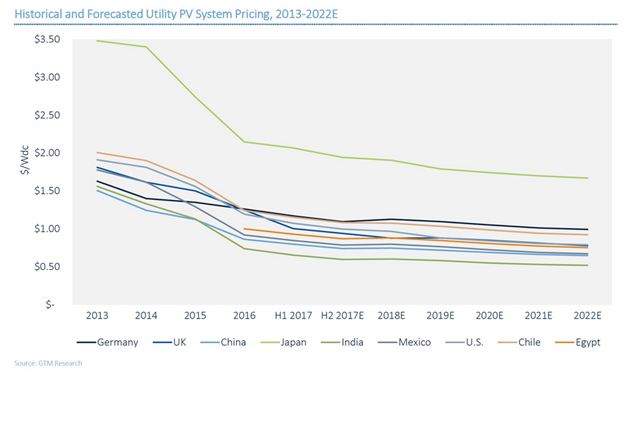
The graph below shows the price trends for the next 5 years. Please keep in mind that the drops in the recent years have been much higher than predicted and there is no reason why the current rate of 15% annual price drop will not continue


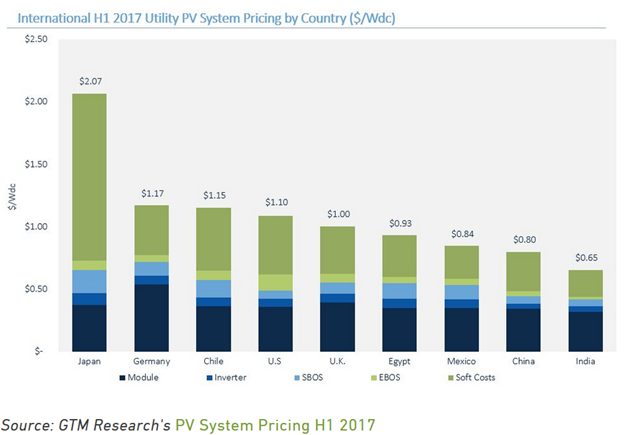
This is a comparative cost across countries


As you can see, India has the lowest costs due to lower soft costs (aka labor costs).

The recent solar auctions in India and several parts of the world are now hitting the 1.3-1.5 Re/KWH levels already and this is expected to drop further. In comparison, the cheapest fossil fuel generated power – Coal, is priced at around 3 Rs/KWH and rising due to transport and other costs

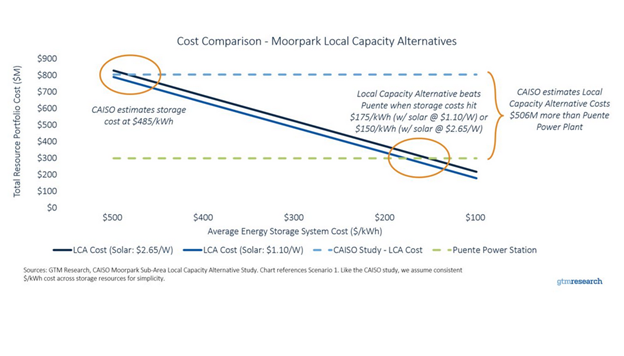
At this point, a lot of naysayers, point out the lack of storage and intermittency of solar and wind power. Let’s look at another data point – Cost of lithium ion storage. This has now hit 200 dollars/ Kwh and continues to drop by around 15% per annum. At the current rate, the cost ofs batteries will drop below 100$/ KWH in 3 years. Why is 100$/KWH important?

This is the point at which solar + Large scale storage start becoming cost competitive with base load or Coal based power. Again, keep in mind that these trends will not stop in 2020, but will keep continuing beyond that due to economies of scale and new research (in other forms of batteries such flow batteries, Lithium air etc)

Is this all hypothetical?
We may assume that all this is theory and the energy markets are yet to be disrupted. That is not true and we already have a few early signs of disruption

a. Gas based Peaker plants (which take care of sudden spike in demand for electricity) are not being built as it is cheaper to use battery storage to take care of such spikes

b. Companies like GE and Siemens have seen a large drop in demand for gas turbines and announced  re-structuring of their power business.


c. What natural gas did to coal, will be repeated again

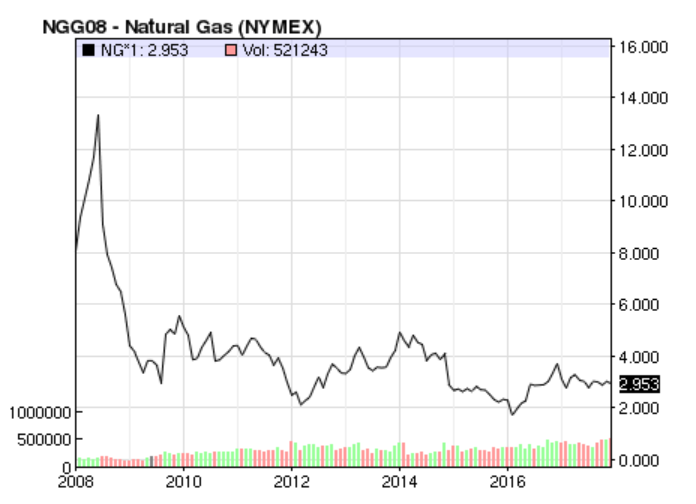
In 2012-14, we had a new technology called fracking reach scale in the US. This technology had been in development for almost a decade and hit an inflection point in 2014. The resulting glut in natural gas led to a sharp drop in the price as can be seen in the chart below.

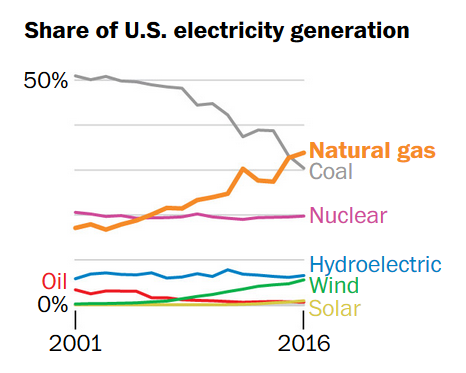
The result of this drop was that, natural gas suddenly became cheaper (and cleaner) than coal and caused a switch in fuel for power generation. This can be seen in the picture below. This in turn led to a drop in the demand and price of coal, leading to large scale bankruptcies in the coal sector in the US

Keep in mind that fracking only works if you already have deposits of gas/ oil in place, but were uneconomical earlier. There is no such limitation for solar or wind energy.

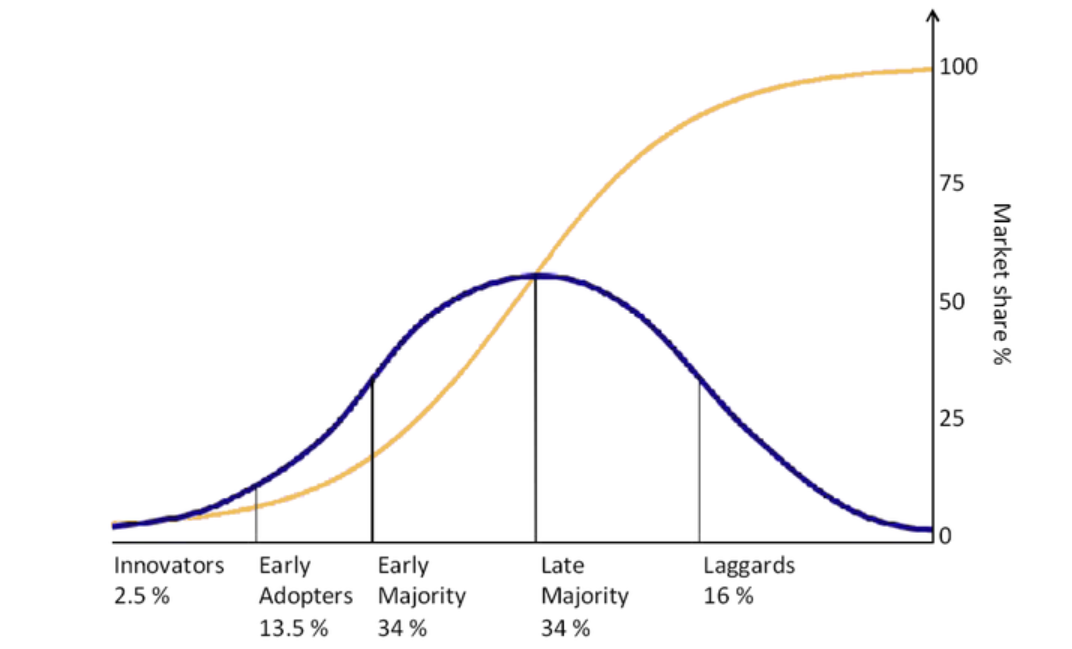
Please ignore the S curve
Lets go back to the first principles in economics – People respond to incentives. Companies, individuals and governments are not going to switch to solar or wind energy because they have suddenly realized that these are green technologies, but the because these technologies are now becoming cheaper than the alternatives (fossil fuel).

We still have a lot of naysayers including some of the think tanks, who keep suggesting that these disruptions are atleast 15-20 years away. If you look at the numbers, for some reason their predictions assume that the price drop in these technologies will change from the current 15%+ to around 3-5% due to which the uptake of these technologies will proceed in a linear fashion.

You can believe these predictions if you are ready to ignore the S-curve model of adoption, which states that these kind of non-linear technologies follow an exponential adoption rate till they hit saturation. 

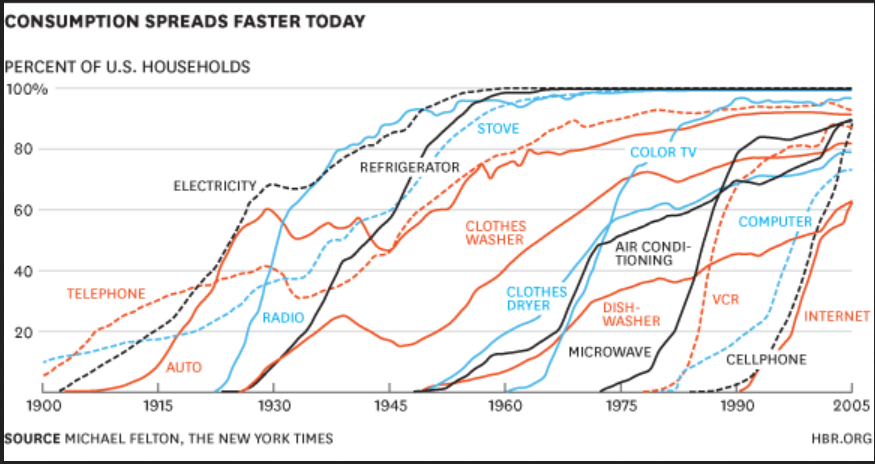
Look at the example of cell phones, internet, Computers and so on which show the adoption rates are only speeding up, not slowing down !

We cannot predict precisely when the inflection will occur. However, it is not difficult to see the disruption ahead. At the current valuations, the market is not discounting the threat of disruption for companies in the capital goods sector, oil & Gas, automotive, power and coal sector.

We can wait till the threat becomes obvious and then exit our positions. I am however not inclined to wait till the last minute before jumping off the track, even though I can dimly see the train coming towards us.    

Over optimizing the portfolio

O

I have often been asked by subscribers – what fixed income option would I recommend for the cash they hold?

My response is that I usually hold my cash in short term FDs or at the most in short term debt funds with high rating and from a well-known fund house.

The main criteria I use in selecting a fund are
           Fund should have a high AUM (> 1000 Crs) for liquidity purpose
           Should be from one of the well know fund house, preferably backed by a bank
           Should have a low expense ratio (as far as possible)
           Should have a 3-5 year operating history or more

You may have noticed that I have made no reference to returns. This is by design as I am looking at high safety of capital and liquidity in this case. The entire point of holding cash or equivalents is that it should be secure and can be accessed at times of market stress without any loss.
Some of you may be unhappy that these options provide ‘only’ 4-5% returns which are quite meager.
Do the math
Let’s do some math. I usually hold somewhere between 10-20% cash in my portfolio. In a crazy bull market such as now, it may go upto 30% level, but on average it hovers around the 15% mark. Let’s assume I get very creative and aggressive with the cash holding and can earn around 10% returns on it. Keep in mind, that the level of risk rises exponentially in case of fixed income instruments. A vehicle giving 10% when the risk free rate is 6%, is not 60% more risky, but carries several orders of magnitude higher risk.
Let’s say, that I still decide to move forward and invest all the cash in such a vehicle. So in effect I have made 4% extra on the 15% cash holding which translates to an extra 0.6% return on the overall portfolio. This additional 0.6% would translate to roughly 7% additional return over a 10 year period.
Is it really worth the risk? Does one really need the extra 0.5- 1% return when rest of the funds are already invested in equities?
There is no free lunch
One of the reasons for holding cash and equivalents is to lower the risk of the portfolio, especially when it is high in the equity market. If you are attempting to get higher returns via fixed income instruments, then you are just changing the label of the investment, but not the level of risk in the portfolio as a whole.
A fixed income label does not change the nature of risk. It is the characteristics of the instrument and its past behavior which defines the same. The worst aspect of investing is to take on higher risks unknowingly and then get shocked when it comes back to bite you.
Please always keep in mind – there are no free lunches in the market. There are absolutely no ‘assured’ high return fixed income options (the term itself would be an oxymoron). If someone tries to sell you one, please run away from the person as fast as you can.
It is not a race
I will never tell anyone of you what to do as you need to make your own decisions. However, let me share what I have been doing for the last 10+ years – I have my funds in safe and relatively secure FDs earning pathetically low rates of returns. This allows me to sleep soundly and have one less thing to worry about. If the equity portion of my portfolio does well, then I don’t need the extra 0.5%. If it does badly, the 0.5% will not save me.

In the end, investing is not a 100 meter dash where the winner gets a gold medal and the fourth place goes home dejected. As a long as I can make a decent return (being 18 %+) over the long run, I would rather exchange a few extra points for much lower risk. The journey would be far more pleasant and I will still reach my financial destination (maybe a year later).

Ps: This does not refer to any investment options such as real estate from a diversification point of view. This is mainly about the desire to optimize the cash portion of the portfolio.

—————-
Stocks discussed in this post are for educational purpose only and not recommendations to buy or sell. Please contact a certified investment adviser for your investment decisions. Please read disclaimer towards the end of blog.
Discounting hope

D

It is widely understood that stock prices are forward looking – they discount the future expectations of cash flow of a company. In bear markets, these expectations are lowered as markets extrapolate recent trends (and assume a recession forever). On the flip side, the reverse happens during bull markets, when investors extrapolate the recent good results into the future and assume that there will be no hiccups along the way.

Finally, we have markets like now, where investors have gone ahead and extrapolated ‘hope’ and discounted that too.
The idea funnel

I maintain a 50+ list of stocks which I track on a regular basis and have created starter positions in a few companies which appear promising. The process i follow is to create a small position (usually 0.5% to 1% of my personal portfolio) and then track the company for a few quarters/ years.

In atleast 50% of the cases or more, I realize over time, that I am not too excited about the prospects of the company and exit the stock immediately. In a few cases, however the company and its stock may still hold promise. In such cases, I start raising the position size in the portfolios I manage.
The above approach allows me to run experiments with lots of ideas and controlled risk.
Discounting infinity and beyond

I am now noticing that some of the positions I hold on a trial basis have started running up based on hope.

Let me take one example to illustrate – Repro India.
Repro India is a printing business with operations in India and Africa. The company performs print jobs for publishers for all kinds of printed materials like books, reports etc. The company has had a chequered past with uneven performance. 
The company was growing till 2012-14 with rising sales in India and Africa. The return on capital of this business was mediocre as the printing business involves high fixed assets, high and sticky receivables with average operating margins in the range of 15-18%.
The export business in Africa went into a nose dive in 2014 due to the drop in oil prices. The company was not able to collects its receivables as these African countries faced currency issues and hence incurred losses. Since then the company has been slowly recovering the receivables and nursing the business back to health. In addition the domestic business continues to be competitive and sub-optimal due to the lack of any competitive advantage
I would normally avoid such a company unless there are some prospects of improvement or change in the future. One such possibility exists for the company. This is the new BOD – books on demand business of the company.
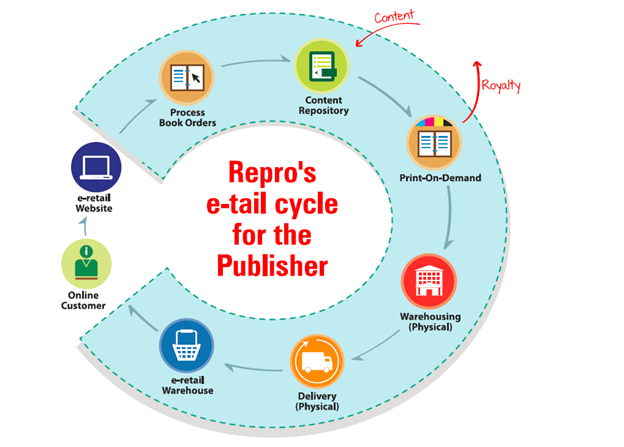
The BOD business is similar to an aggregation model followed by companies such as uber or Airbnb. In the case of repro, the company has a tie up with Ingram (another US based aggregator) and other publishers in India to digitize their titles and carry them on its platform. These titles are then made available through ecommerce sellers such as Amazon or flipkart. When a user like you and me finds this title and purchases it, Repro prints the copy and delivers it you.
The business model is depicted in the picture below (From the company’s annual report).
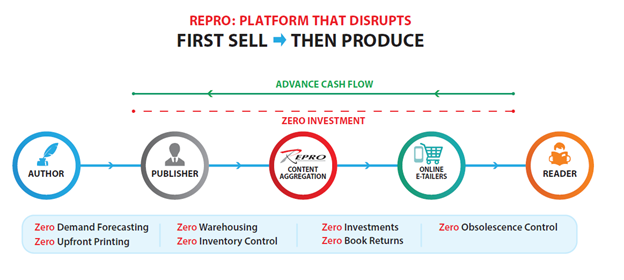
The above business model ensures that there is no inventory or receivables for Repro or the publisher. The payment is received upfront and the product is delivered at a later date. This is a win-win business model for all the value chain participants as it eliminates the need for working capital. As a result, this business model is able to earn a high return on capital with the same or lower margins than regular publishing
Illustration from the company’s annual report

Repro is doing around 40-50 Crs of sales in the BOD segment and growing at around 70-80% per annum. The company has loaded around 1.4 Mn titles on its platform and plans to load another 10 Mn+ titles in the future. This business is at breakeven now. The BOD business has a lot of promise and it’s quite possible that the company will do well. 
However, success in the business is not guaranteed. The company needs to scale its operations and could face competition from other print companies in the future (as the entry barriers are not too high).
The market of course does not care about the uncertainty. There are times, when markets refuse to discount good performance in the present and then there are time like now, when the market is ready to discount the ‘hope’ of good performance in the future. The stock sells at around 100 times the current earnings. As the legacy printing business continues to be mediocre with poor economics, it is likely that the high valuations are mainly due to the exciting prospects of the BOD business
I had created a small position a couple of months back and have been tracking the company. The stock price has risen by around 50%, 60% since then even though the company is just above breakeven on a consolidated level.
I am optimistic about the prospects, but the execution needs to be tracked. I am not willing to pay for hope and so I am a passive observer for now.

—————-
Stocks discussed in this post are for educational purpose only and not recommendations to buy or sell. Please contact a certified investment adviser for your investment decisions. Please read disclaimer towards the end of blog.

The logic of patience

T

Investors hear a constant refrain – be patient, think long term, blah blah blah. Is it similar to the sermons we hear about eating well and exercising more?

Let me share some thoughts on why patience is a critical to earning above average returns. I will try to approach it based on logic and not because the gurus of investing have been preaching it

Let’s walk through a series of logical arguments

1.     The stock market is usually efficient and generally prices most companies correctly based on their near term prospects. So if a company is growing at 30% per annum, earning 25% return on capital and has great long term growth prospects, then the market will value it accordingly.

2.     One can do better than the market only if you have a view about the performance of a company, which differs materially on the upside. If the company performs as the market expects, there will be no impact to the stock price. Only if the company performs better than market expectations, will the stock price will adjust upwards in response to the positive surprise. This is something most investor miss. They are looking for high quality companies with good management. The trick is find those where the market has yet to recognize the quality or improvement in performance (and price it into the stock)

3.     If you combine point 1 and point 2, it follows that some of the ways to do better than the market is if

  • You are able to identify the turning point in a cyclical industry, before the market. As it not usually not possible to time this perfectly, the best option is to be a bit early when there are some green shoots visible and then increase the position as the recovery gathers strength
  • The profits of the company are suppressed due to some short term issues in the industry (weather, demonetization etc.) which will be resolved soon. In such cases, one has to create a position when the outlook is still horrible and hold on to it till the external factors change for the better
  • Some One-off event such as a demerger causes one of the constituents to be mispriced
  • The profit of the company is suppressed as management is investing in the business which is hurting the reported numbers. As the market is still fixated on the reported numbers, one can create a position at an attractive price. However one has to wait for the investment phase to complete and the true profitability surface

If you look at all the above cases, one needs to ignore the near term prospects which are being overly discounted by the market, and focus on the long term. As a result, in such cases you will not see a validation of your thesis as soon as you create a position.

In my experience, one needs to look out at least 2-3 years and make a purchase accordingly. One then has to wait patiently and keep checking if the company continues to deliver as per your expectations

The impact of competition

For those of us who started investing in the late 90s and even around mid-2000, the level of competition in the market was much lower. One could find companies earning 30% return on capital, growing at 15%+ CAGR and selling at 5 times earnings (Marico was one such company). All one had to do was to dig around a bit and put in the money.

The mutual fund industry was nascent at that time and there were very few individual investors. I still recall getting blank stares when I spoke about value investing.

This has changed completely in the last 10 years. We now have an army of smart investors (professional and part-time) who scour the market looking for opportunities. In such as climate, I can bet that you will not find any obvious mispricing which can filtered on a screen.

In such a case, one has to dig deeper and put in more time and effort in understanding the business and its management. Once you get a better understanding than most other investors , you have to buy the stock and wait till the market, hopefully comes around to your point of view.

It would be foolish to assume that the change of opinion will happen as soon as you are done with your purchase. Some of the near term factors which drive the pricing, need to change before the market accepts your view point.

When is patience a liability?

Patience is of course tied with your style of investing and time horizon. If you are a day trader or momentum investor, then time is not on your side. If you time horizon is days, weeks or month then thinking of a multi-year period makes no sense.

The trouble starts when one does not know what kind of an investor you are? A lot of people think they are long term value investors (as somehow that is fashionable these days), but act like day traders – selling and buying over weeks. If you do not get your time horizon and investment approach consistent with each other, then you are in trouble as your will quickly tire of holding the stock and sell just before the inflection

Getting an edge

I had earlier written above three kinds of edge in stock market investing. The information edge is now more or less gone with tools for quantitative analysis and wide dissemination of information by management (look at the number of conference calls hosted by companies!). One has to rely on analytical and behavioral edge to make above average returns.

I personally think that analytical edge too is over rated as it is not possible to consistently have a superior insight with all your positions. Assuming that you are smarter than the rest of the market at all times, is pure hubris. The only sustainable edge left for an investor is the behavioral one and being patient in an age of distraction and immediate gratification is at the core of this edge.

Being patient is therefore not a moral imperative or something you need to do for the good of humanity, but is a logical necessity to do well in the market in the long run as a value investor.
—————-
Stocks discussed in this post are for educational purpose only and not recommendations to buy or sell. Please contact a certified investment adviser for your investment decisions. Please read disclaimer towards the end of blog.
How to lose money consistently

H

Guaranteed approach to losing money –  Look at the last 3-5 year returns and extrapolate mindlessly. Invest when past returns are highest and sell after the market corrects

Starting amount: Rs 100000

1.     Invest infrastructure mutual funds in 2008 (after the boom) based on hard selling by mutual funds
2.     Sell in 2009 with a 40% loss on average
3.     Recuperate from shock for 2 years
4.     Invest in gold mutual fund in 2011/12 after seeing 5 years of boom
5.     Lose 10% of principal in next 3-4 years
6.     Now, invest in mid and small cap funds, after 3 years of boom.

The investor has already managed to lose 50% of principal by now. The above tale may be an exaggeration, but you can check mutual funds with the above kind of performance, with most being launched towards the tail end of the boom. Someone is surely buying these funds at the top of a cycle !

It may not be the same investor in each case, but I can assure there are definitely a few who manage to achieve this ‘feat’ over a lifetime as they never get over their greed and refuse to learn from their losses (it is always someone else’s fault)

If you think, I am mocking such people – that is not the case. I did the same thing when I started out, but the only difference is I swallowed my pride, accepted my mistake and have tried to learn from it.

An oversized ego is always dangerous to the wallet

—————-
Stocks discussed in this post are for educational purpose only and not recommendations to buy or sell. Please contact a certified investment adviser for your investment decisions. Please read disclaimer towards the end of blog.
No pizza today

N

I wrote the following note to my subscribers in response to two questions which are frequently asked by new prospects

a.     Please share your past performance
b.     How many stocks can I buy if I join your advisory today

The note below, seeks to answer the second question

Pizza versus investment advice
If you walk into a store or restaurant, you are handed the item or service as soon as you make the payment. Any delay or refusal to offer the said service is considered a breach of faith or fraud.

The above standard mode of exchange breaks down when we come to investment advice. The job of an investment advisor is to ensure that his or her clients make decisions which helps them in the long run (in achieving their financial goals). This can mean that the most sensible course of action often is do nothing and wait for the right opportunity to invest.

This is however not understood by the vast majority of investors who behave like a customer in a restaurant. A typical investor likes to be handed a menu card of stocks and would like to buy as many as possible even before the ink has dried on the cheque (metaphorically speaking). This expectation works if you order a pizza, but not when you are investing for the long run (5+ years).

The investment industry panders to this behavior and even encourages it. As much as one would like to blame the industry (and they have much to blame), the investor community is equally responsible for it. Stock markets are seen as a place to pat your ego (for recent high returns), indulge your gambling instinct or just entertain yourself.

In all my years, I have found very few who look at the stock market for what it really is – A place to invest your capital for the long term to earn returns above the rate of inflation and thus achieve your long term financial goals.

If you are in for the long haul, it makes sense to invest your hard earned money in the right company at the right price (price being very important). Often this happens, when everyone is running for the exit.

Walking the talk
It is easy to talk, but not easy to do the same thing unless your own money is on the line. My own funds, that of my partner kedar and our families is invested in the same fashion. Nothing focusses you on the risk, when your own money is on the line.

I get turned off when I read about fund managers and analysts who recommend a stock, but do not have skin in the game. It clearly means that they do not believe in what they say.

I made a conscious decision several years back that I will eat my own cooking and as a result, any loss in the portfolio is borne equally by me. In addition to this point, both me and kedar have made it a point to under-promise and hopefully deliver more. As result, inspite of a 100%+ rise in 2014, we decided to go low key as I knew that future results could be subdued for a period of time. I did not want to attract subscribers based on recent performance and disappoint them when I failed to meet their un-realistic expectations.

We continue to follow the same approach today. We will get excited when the market drops and go into hibernation when the market gets euphoric. The hibernation is limited only to activity and not to the effort of finding new ideas. We continue to build the pipeline, but the pizza will be served only when the time is right.

The Hangover from bull markets

T

A lot of people are celebrating these days and patting themselves on the back. We have a parade of investors touting their returns and claiming that 100% CAGR is for chumps. Multi-bagger could soon be a new name for kids 🙂

A bull market feels good and should be the best of times, right? How can one argue with that?

It feels great when your stocks are going up, making you richer by the day. You feel smart, on top of the world and in some moments can even see that retirement on the horizon when you stop working and live on the beach

By my own estimates, I have lived through around 4 major and a couple more minor bull runs. It felt great during those periods as I  felt vindicated for sticking it out during the drops when everyone was rushing to the exits. It is only in hindsight, I have realized that bull market are dangerous in their own way and I was lucky to have survived the full cycle.

Let me explain

A confluence of factors

A typical bull market usually coincides with decent economic numbers when most companies are doing quite well. As a result, most participants become over optimistic and bid up the stocks of these companies. We thus have a confluence of factors – companies performing better than usual and being valued at higher multiples of peak earnings.

In addition to these factors, there are several psychological factors which come into play at this time. Let’s go over some of them

           Social proof: At such times, you see people around you getting rich and more reckless the person, higher the returns. It is not easy on the psyche to watch your friends get rich , whereas you sit around doing nothing.
           Scarcity: During bear markets, waiting helps. As the numbers are bad or getting worse, stock price for most companies stay stagnant at best. As a result, if you like to dig deep into a company, you have all the time in the world. No such luck during bull market. Any company with a half decent results gets bid up. As a result, you can either forgo an opportunity or buy the stock with lesser due diligence
           Confirmation bias: A bull market gives a positive signal and makes you feel that you are doing something right. As a result, there is a tendency to ignore risks and not look for disconfirming evidence
           Authority bias: If you switch on a channel, every other talking head and self-proclaimed guru on  TV is painting the vision of a glorious future where all of us would be rich. This makes you feel as the only idiot who does not get it

In effect there are multiple psychological and other factors, which conspire to get your guard down and ignore the risks

A bad hangover

I can recall the emotional roller coaster in the previous cycle, with the only difference that these cycles used to run over a period of 3-5 years. The years 2001-2003 (which is ancient for most investors) was a grinding and slow bear market.

It was the exact opposite of what we see now. I can remember buying companies selling for 5 times earnings, growing at 15-20% per annum and still going down in price. If you think these were low quality stocks, then that was not the case. I am talking of companies like Marico and pidilite which are the darlings of the quality school of investing now.

A new investor like me just could not understand why the market was behaving in this fashion.

The market started turning in 2003 and from there it took off for the next 5 years. A lot of my personal holdings went up multiple times (no one used the term multi-baggers as often then) and it was great to feel vindicated/ smart.

The problem with feeling smart was that is that you also feel invincible. The net impact of all these emotions is that I made a few picks, which were marginal at best.  These sub-par picks came back to bite me during the next downturn when they performed far worse than the overall markets.

A fight against instincts

The natural instinct for any investor is do the opposite of what should rationally be done.  When the markets are dropping due to poor fundamentals and bad sentiments, the tendency of most investors is to withdraw into a shell and wait for the sky to clear up.

This is usually the wrong action. Unless you believe that the world is going to end (in which case, stocks should not be your worry), it makes sense to buy attractively priced companies as markets usually have a tendency to extrapolate the recent trends into the future.

The same tendency is also visible during bull markets which leads investors to buy at the wrong price. The right action at such times would be to sell or do nothing, if the company is not overpriced. I personally think that one should go one step beyond – use this period to clean up your portfolio. If you hold some companies, which you are not as confident about, sell them down and increase the cash holding. A bull market is a good time to  swallow the bitter pill when the overall portfolio is doing well.

It is never easy

I wrote this a year back after the market dropped by 15% and this still holds true, except the circumstances have changed to a bull market.  Instead of courage to manage the fear, one needs the same courage to manage greed and euphoria.

It requires an equal amount of effort (or even more) to watch everyone around you make easy money, while you stick to your principles and refuse to take part in the madness.

—————-
Stocks discussed in this post are for educational purpose only and not recommendations to buy or sell. Please contact a certified investment adviser for your investment decisions. Please read disclaimer towards the end of blog.
Subscription

Enter your email address if you would like to be notified when a new post is posted:

I agree to be emailed to confirm my subscription to this list

Recent Posts

Select category to filter posts

Archives