Blog

Letting go of easy money

L

I recently received an email and following is my reply


Hello Rohit,
Trust you are doing good.

I have a generic query regarding one of the stocks that has created a lot of buzz recently. Not sure, if you answer such Qs 🙂

Avenue Supermarkets (DMart) – This stock got listed at twice the IPO issue price. And, it is crossing new boundaries every week. There’s lot of positivity about this stock  (like next Infosys etc) and founder Mr Damani (value investor) in market and news.

Its very difficult to resist the temptation to grab this opportunity but not sure if this is the right time. So should we consider this opportunity or just ignore it as temporary heat in the air.

Kindly advise if possible.

hi XXXX
let me share a couple of points on this 🙂
– i never invest in IPO (see here and here )
– i never chase hot trends in the stock markets
– i never buy momentum stocks, especially ones selling at high valuations
– i have never invested in retail companies as this is a very tough business.

i may be wrong here and this could be an exception to all my rules. maybe this stock will keep rising and people will make money. however i am fine with it …i dont need to make money in all opportunities.

so my short answer is – i have no plans of considering or putting a single paise in such opportunities and am fine if others make money. as far as temptation is concerned ..i cant help you there 🙂

i hope i have shared my views clearly …you have to make your own decision. dont hold me responsible if the stock doubles 🙂 …i am fine with letting go of such opportunities

regards
rohit 
—————-

Stocks discussed in this post are for educational purpose only and not recommendations to buy or sell. Please contact a certified investment adviser for your investment decisions. Please read disclaimer towards the end of blog.

Mental capital

M

This is a term I like to use to represent the time, and mental energy devoted to each position in my portfolio. I would also add mental stress to the equation.

I have realized that in a lot of cases the percentage of mental capital allocated to each position does not match with the allocation of financial capital. On the contrary, some of my top position have needed the least amount of mental energy on an ongoing basis and caused the least amount of stress. This has been mainly due to the quality of the business and management.

On the other hand, some of the smaller positions in my portfolio have resulted in a much higher allocation of mental capital and that could be also the reason why I never raised the size of these positions.

Not a mathematical exercise

Unlike the amount of financial capital, one cannot calculate the percentage of mental capital allocated to a position. However there are several pointers one can use to see if a particular company is taking a dis-proportionate amount of your mental energy
           You are regularly surprised by the quarterly results
           The management makes your stomach churn and causes you to worry about the safety of your capital
           The industry is undergoing a substantial amount of change and you have no means of evaluating the economics of the business even for the short to medium term
           You keep coming up with new reasons to hold on to your position, even after your original thesis has been invalidated. The word ‘hope’ keeps coming up in your thinking
           You ‘worry’ about the position for any of the above or other reasons

The killer combination

If the financial and mental capital allocated to a position is too high, then we have a deadly combination. This is kind of an extreme situation can make you act irrationally and in the end be injurious to both your financial and mental health, if the position turns against you.

I have realized over time, unlike financial capital which can compound, mental capital is limited and does not increase much beyond a limit.  It is important to use it smartly both for your financial and mental health and finally for your quality of life.

A certain level of mental capital has to be invested when investing directly in stocks (instead of an index or mutual fund), but in some cases the level can go much beyond the amount of financial capital allocated to it. In such cases, I have usually found that selling down or completely exiting the position has freed up my mind to look for new ideas and devote more time to other stocks in the portfolio.

The tail (portfolio) should never wag the dog (your life).

—————-
Stocks discussed in this post are for educational purpose only and not recommendations to buy or sell. Please contact a certified investment adviser for your investment decisions. Please read disclaimer towards the end of blog.

On outperformance

O

Some excerpts from my annual review to subscribers. Hope you will find it useful

Sources of outperformance

Superior performance versus the indices can usually be broken down into three buckets

a. Informational edge – An investor can outperform the market by having access to superior information such ground level data, ongoing inputs from management etc.

b. Analytical edge – This edge comes from having the same information, but analyzing it in a superior fashion via multiple mental models

c. Behavioral edge – This edge comes from being rational and long term oriented.

I personally think our edge can come mainly from the behavioral and analytical factors. The Indian markets had some level of informational edge, but this edge is slowly reducing with wider availability of information and increasing levels of transparency.

We aim to have an analytical edge by digging deeper and thinking more thoroughly about each idea. However in the end, it also depends on my own IQ levels and mental wiring, which is unlikely to change despite my efforts.

The final edge – behavioral is the most sustainable and at the same the toughest one to maintain. This involves being rational about our decisions and maintaining a long term orientation. If you look at the annual turnover of mutual funds and other investors, most of them are short term oriented with a time horizon of less than one year. In such a world of short term incentives, an ability to be patient and have a long term view can be a source of advantage.

How does patience help?
Take a look at the 5 years history one of our oldest positions – Cera sanitaryware.

The company has performed quite well in terms of profits in the last 5 years and grew its net profit by 30% in FY 15 and 23% in FY16. Compare this with the stock price – The stock dropped from a peak of around 2500 in early 2015 to a low of 1500 in the span of one year, even though sales and profit continued to grow at a healthy pace.

These swings are usually due to short term momentum traders who want to move from company to company to catch the incremental 10%. I am glad that we have such investors in the stock market as it gives us an opportunity to buy from time to time when the price drops below our estimate of fair value.

We will continue to get such kind of opportunities in the future. The key is to be patient and act when an opportunity is presented.

Skin in the game
It is not easy to remain focused on the long term. In my case, I do not feel any pressure to negate this advantage and let me share why.

The reason for holding onto this approach is that this is something which has worked for me over 20 years and for others over a much longer period. If one can identify good quality companies at a reasonable price, then the returns over the long term will track the performance of the business (more on it later in the note). The value approach works over time, even if it does not work all the time

In addition to the above, my own net worth and that of my close friends and family is invested in the same fashion. I will not take the risk of blowing up to show short term results. Nothing focuses your mind, when your own net worth and that of friends and family is invested in the same fashion.

Let’s try to understand the math behind my expectations of the long term returns. This is a repeat for some of you, but is worth reading again.

The math behind the returns

At the time of starting the model portfolio, I stated 3-5% outperformance as a goal and this translated to around 18-21% returns over time. How did I come up with this number and more importantly does it still hold true?

Let’s look at the math and the logic behind it. The outperformance goal ties very closely with my portfolio approach and construction. We typically have around 15-18 stocks in the portfolio, bought at 60-70% discount to intrinsic value on average. Most of the companies we hold have an ROE of around 20-25% and are growing around 18-20% annually. These numbers may vary, but on average they will cluster around the above figures over time.

Let’s explore a specific example based on these numbers. Let’s say a company valued at 100, growing at around 20% is purchased for 70. Let’s assume I am right in my analysis and the stock converges to fair value in year 3. If this happy situation comes to pass, the stock will deliver around 34% per annum return.

Now in year 3, we could sell the stock and buy a new one again and make similar returns. This may occur from time to time in individual cases, but is not feasible at the portfolio level unless the market is in the dumps and stocks are selling at cheap prices. It is unlikely that our positions would be in a bull market and selling at full price, when other stocks are available at a discount.

In such a case,  if the quality of the company is high and we continue to hold on to it, it will deliver a return of around 20% per annum in the future (assuming the stock continues to sell at fair value going forward). If you add 2 % dividend to this 20% annual increase in fair value, the stock could deliver around 22% for the foreseeable future.

The portfolio view
The math, explained for a single stock, works at the portfolio level quite well. As per my rough estimates, the model portfolio has grown at around 22% per annum in intrinsic value. It was selling at around 27% of intrinsic value when we started and is at a 20% discount now. You have to keep in mind that there are just estimates on my part and I cannot provide any mathematical proof for it. However I have found that these two variables have worked quite well in understanding the performance of the portfolio over the long run – discount to intrinsic value and growth of the value itself.

As the intrinsic value has grown over years and the gap closed, we have enjoyed a tailwind and hence the returns have been a bit higher than that of the intrinsic value. The returns are often lumpy as can be seen from the performance.

Where will these returns take us?

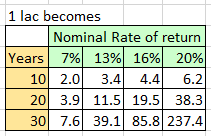
If you talk to some investors, they would scoff at 20% returns. Let look at this table for a moment

I am sure a lot of you have seen the above table. It shows how much 1 lac will become if you allow it to compound at a certain rate of return for 10, 20 and 30 years.

There is something different in the table, from what you would have normally seen. The rate of return numbers seem to be random – 7%, 13% etc., but they are not. Let’s look at what they signify

7 % – This is normally the rate of return one would get from a fixed deposit in the bank
13% – This is the average rate of return from real estate over long periods of time. I would get eye rolls when I quoted this number in the past. The recent and ongoing experience is changing that now.
16% – this is roughly the kind of return you can get from the stock market index over long periods of time
20% – This the level of returns we ‘hope’ to achieve in the long run (3+ years or more)

There are a few key implications of the above table

–        A small edge over average returns adds up to a lot over time
–        The key to creating wealth in the long run is not just super high returns, but to sustain above average returns over a long period of time. It is of no help if you compound at 30% for 20 years and then lose 80% of your capital in the 21styear. The key is to manage the risk too.

If we achieve our stated goal over the long term, the end result will be quite good. There are two risks to this happy end – avoid blowing up (which I am focused on) and early retirement (mine), which you have to hope does not happen either involuntarily (I get hit by a bus) or voluntarily (I head off to the beach).

—————-
Stocks discussed in this post are for educational purpose only and not recommendations to buy or sell. Please contact a certified investment adviser for your investment decisions. Please read disclaimer towards the end of blog


My Q&A on gurufocus

M

I recently responded to an email Q&A from PJ Pahygiannis. We covered some of the following questions and more

– Describe your investing strategy and portfolio organization. What valuation methods do you use? Where do you get your investing ideas from?
– How long will you hold a stock and why? How long does it take to know if you are right or wrong on a stock?
– What are some of your favorite companies, brands, or even CEOs? What do you think are some of the most well run companies? How do you judge the quality of the management?
– What kind of bargains are you finding in this market? Do you have any favorite sectors or avoid certain areas, and why?
– How do you feel about the market today? Do you see it as overvalued? What concerns you the most?

My response has been published on gurufocus.com. You can read the entire Q&A here. I hope you find the Q&A useful
—————-
Stocks discussed in this post are for educational purpose only and not recommendations to buy or sell. Please contact a certified investment adviser for your investment decisions. Please read disclaimer towards the end of blog.

Losing your wallet

L

We had two major events in the last few weeks – The election of Donald Trump as the president of US and the Demonetization of the 500/1000 Re notes

Let’s look at the impact from these two events.

Let me start with the first event, which somehow was in the news for the last few weeks and I felt no need to respond or react. The event was a surprise for many and in a way similar to the Congress win in India in 2004. There was a sense that the market would crash if Donald trump is elected as president. I had no clue about what would happen if this event occurred, but to be frank I could not care less.

You will hear all kinds of reasons why some event will cause a cascade and impact a particular company in question. I personally think this is complete nonsense and one can link any number of remote factors together to make a case.

In investing, the key is to focus on the few critical factors which may impact your investment thesis and ignore the rest. I find it difficult to see why the election of a particular individual in a foreign company will have an impact on most of the companies in India at a micro level. Will consumers buy less soap or stop buying cars or going to movies just because Donald trump is elected in the US?

A final point on this count – Look at what has happened to the US market after the election. After an initial drop, the market is up. So much for predictions from all kind of pundits.

The more important event
The more relevant event for us has been the demonization of the high value currency. I personally think this a watershed event for the country. There are a lot of people looking at the interest rate and tax implications for the country, which I agree is quite good. However the bigger impact is from the signaling effect of this decision.

For starters, it creates a lot of positive emotion for the honest tax payer/ companies as they now feel that they are not idiots for paying their fair share.  This event is a positive boost for them.

The second impact of this decision is that it sends a message that the government is serious about reducing tax evasion and corruption. A combination of GST, JAM trinity and now demonetization could be effective in reducing tax evasion (but not necessarily eliminate it). This would apply to a lot of unorganized sector companies where there is substantial evasion of taxes. These events are creating a level playing field in terms of taxation and will benefit the organized companies in the long run.

Although the long term benefits are huge, the short term is going to be tough. This kind of event has first, second and higher order effects. On the surface real estate, gold, high value durables and other such purchases are likely to get impacted. However if you think further, this drop is likely to cause a ripple effect in other sectors such as lending, construction materials, auto components and so on.

Analyzing the impact on your portfolio
The key point in the analysis of any major event is to evaluate the long term impact to the business model and profitability of the company.

There will definitely be a short term impact of varying degrees to all the companies from a slowdown in the economy. The next 1-2 quarters are going to be ugly for a lot of companies and stock prices have started dropping in response to that. As we approach the end of the year, the selloff could increase as a lot of mutual funds and FIIs try to window dress their portfolio.

I have no such plans for my portfolio. I made an argument in a prior post that we need to be ready for short term volatility and 15% or more drops from time to time. If one cannot handle these swings, then equities are not an appropriate vehicle. I will not sell any stocks where I think the long term prospects continue to be good, even if the near term appears horrible.

An example

Let’s take the example of NBFCs to see how this event would impact some companies

A lot of NBFCs deal with customers who operate on cash due to lack of access to banking services. It is expected that these companies will be impacted as these customers are unable to make timely payments. We are most likely to see a large expansion of NPA in the next 1-2 quarters.

We should however keep in mind that an NPA is not the same as a loss. An NPA means that the borrower has not made a timely payment and as a result, the lender has to mark the loan as non performing, stop accruing the interest income and add provisions (set aside some part of the profits) to account for the higher risk of non-payment.

Even in the event of a loan going bad, the recovery varies from 30-70% based on the nature of the asset and the level of collateral. If the asset is a steel plant, it is quite obvious that it is large, illiquid and will require special skills to operate. In such cases, the recovery for the lender is on the lower side. In the case of other assets such as real estate, there is a large liquid market for the asset where it can be auctioned and hence the level of recovery is usually on the higher side.

Let’s look at a worst case scenario. Let’s say a company has around 1000 crs of assets on its books. Let’s make a very aggressive assumption that 10% of the assets will become NPAs with no hope that the borrower can become current on the loan. We can assume a 50% recovery rate on these NPA. So the eventual loss for the company would be to the tune of 50 crs.

So what does a loss of 50 Crs translate to? A company with 1000 Crs of asset will generally have an equity of around 150-180 crs and would be earning close to 30-40 crs pre-tax, pre-provision profits (profits before accounting for taxes and loan loss provisions). So in an extreme loss scenario, an average NBFC should be able to cover these losses in 1-1.5 years.

Keep in mind that the above loss scenario is quite high in nature. Most of our poorly managed PSU banks have much lower level of losses inspite of much more illiquid assets and lower recovery rates.

Losing your wallet

I had written a post on first principles thinking as applied to investing here. As noted in the post, the intrinsic value of a company is the discounted sum of all its future cash flows. If you think of a company in that fashion, then by how much will you reduce the future value of the NBFC?

To answer the above question, we need to consider a few points. Do we think that the long term prospects of the company have been harmed by the demonetization issue? Will the demand for credit reduce on a permanent basis due to this issue?

I think no matter how pessimistic you may be about the whole demonetization episode and the slow response of the government, it would be hard to argue that this issue will cause a permanent drop in demand for credit in the long run..

If that is the case, then this event is more like a finite loss event. I am not saying that this loss cannot be bigger than what I have discussed earlier, but it is not equivalent to a loss of earning power for the company. The competitive strengths for the company remain the same even after the event.

As an analogy, let’s say you are carrying 5000 Rs (in 100 Re notes J ) and you lose your wallet. It is a loss of 5000 and your net worth went down by that amount. However you future earning power which depends on your skills and other factors did not change due to this event.

This analogy is not perfect and we are making several simplifying assumptions, but this is broadly what is happening to most of the companies. The same is not true if the fundamental business model depends on black money (casino or some real estate developers) or if the business cannot sustain a period of loss (as in the case of several small business operators).

The market reaction has been far more severe with some NBFCs losing almost 30% of their value in the last one month (almost 3-4 times our loss estimate).

Cash + courage = opportunity

We need to be prepared for a very ugly Q3. The demonetization event is likely to be quite disruptive to businesses in the short term, especially in the rural areas where banking services are poorly developed.

The stock market is already reflecting this impact. I am not thrilled about it but it is not shocking for me as such surprises happen from time to time. This is part of equity investing and one cannot make high returns unless one is emotionally prepared for such gyrations.

It will not feel good to keep losing money every day as the market corrects, but I plan to deploy some cash as bargains develop.

—————-
Stocks discussed in this post are for educational purpose only and not recommendations to buy or sell. Please contact a certified investment adviser for your investment decisions. Please read disclaimer towards the end of blog.

My interview on safalniveshak

M


I recently did an interview with Vishal khandelwal at safalniveshak.
We covered several topics such as the process for finding investment ideas, position sizing, concentration versus diversification, facing market turmoil and many more.
You can find the interview here
You can read an earlier interview with vishal here.
—————- 
Stocks discussed in this post are for educational purpose only and not recommendations to buy or sell. Please contact a certified investment adviser for your investment decisions. Please read disclaimer towards the end of blog.

Temperament cannot be bought or taught

T

I wrote this note to all of my subscribers. Hope you will find it useful too

A lot of new subscribers have joined us and so I am writing a short note to talk on several topics such as how to build your portfolio, our investment philosophy, ongoing crises etc. For those of you, who have been with me for a long time, this may seem like an un-necessary repetition. However I think it is important for new subscribers to know what they are getting into with me and for the old subscribers to be reminded of it.

Let me state this again – My approach is to buy good quality companies at a reasonable price. There is nothing magical or new about this. Every other value investor professes to do this and I am no different. There is no secret sauceand I make it a point to share my thought process and analysis as much as feasible.

I am not looking for quick flips based on interest rate changes, slightly better monsoon, modi’s reaction to Pakistan or some astrology sign. There could be others who practice this type of investing and it may work for them. I have no interest in doing the same.

I have practiced a value based philosophy for the last 15+ years and it has served me well. I have no plans of changing a sound and logical approach for something else in the future. As long as I continue to do follow it rationally and with discipline, I think the long term results will be good even with occasional spells of under-performance.

Building your portfolio

One the first comments I get from a new subscriber after joining is this – I had a look at the model portfolio and I cannot buy more than 2-3 positions for now. I have a stock response for that – please be patient and give it some time. I have usually seen that most new subscribers are able match the model portfolio over a span of 2-3 years as some stocks drop below the buy level and new positions are added.

How true has this statement been?

If you look at the price action of our 17 odd positions for the last two years – you will find that at least 14 hit the buy point and even went lower for a few days or more. So in effect, it’s quite possible to be 80% matched to the model portfolio for those who joined the subscription in the middle of 2014. I do not have the statistics of how many have done that, but my point is that over a 1-2 year time frame, one will get enough opportunities to buy and build your portfolio. One needs to have the patience to do that and not get swayed by short term events.

Recurring crises

We started the model portfolio in Jan 2011. We have had several actual and imagined events such as Grexit (did not happen), Chinese hard landing (cannot say if that has occurred), Brexit (did happen), oil crash (occurred in 2014) and mismanagement of the Indian economy by the previous government.

These are the big events which come to mind. If you pick up a newspaper, there is a lot more to worry about from day to day. Now imagine if we had remained in cash or got frightened out of our positions due to some real or imaginary risk and compare that to what we have achieved in those years. Does it make sense to take actions based on unknown guesses about the future or concentrate on individual companies and make informed decisions?

Now someone could counter this logic by pointing the risk of 2008/09 collapse when mid and small caps crashed by 60%. What if one of these events had snowballed into a similar crisis?

Let me answer that concern via two arguments

           For starters, one cannot invest based on the low probability, high impact macro events. One can diversify against black swan risks at an individual company level, but not at the country level. To give an extreme and silly example – how will you protect yourself from the risk of an asteroid crashing into a major city in India and causing a major economic crisis? Can one really diversify against such an extreme risk?
           My second argument is that one needs to invest based on the higher probability risks (such as inflation) and insure against the low probability, but extreme ones. In other words, invest to beat inflation or secure your retirement and buy life/ health insurance to hedge the other extreme kind of risks. Finally there are some kind of risks, where one can only hope and pray that they don’t occur and we can do nothing about it.

Having the right temperament

If a 10-15% drop in the portfolio is going to scare you (as it may have in Feb of this year) and cause you to lose sleep, then equities are not for you. I can share my analysis and thought process, but cannot fix your temperament. You will have to bring a steady and calm mind of your own to the table.

If you think you cannot bear to see your portfolio drop by 15% or more from time to time, now is a good time to exit. I don’t think there is anything to be ashamed of in recognizing your risk tolerance and acting according to it. My own family was never into equities as they were never comfortable with the volatility of the stock market. I started investing for them a few years back after they felt confident that I will not blow up their savings (or maybe it was just their love for me …I don’t know)

Looking for trends
Some of you may have noticed that the model portfolio generally does not have a specific theme or view. One will often hear from investors that they have positioned their portfolio to benefit from better monsoon or revival in capex or some such factor.

The benefit of identifying a broad trend and then investing to it has a lot of upside. However I have generally not followed this form of top down, trend based investing as I have found it difficult to identify a truly long term trend and then find a reasonably priced idea to leverage this trend.

One needs to keep in mind that a good monsoon or lower inflation is not a long term trend, but only specific events which play out for a small period of time. A long term trend would be something like demand for housing/ housing loans which leads to a growth of 2-3X of the average GDP growth rate.

We have three positions which seem to play to this theme. However if you read the original thesis of these ideas, I was looking far more closely at the  company specific factors and only vaguely realized that there were some tailwinds for the sector. It is after holding these stocks for 2+ years that we can now make a story of a theme or trend for these ideas, but this was never the case when we started these positions.

Why am I discussing this point now? I think there is a lot of value in identifying such trends early and investing based on it, provided one does not overpay for it. As a result, I have now started looking at some of the current ideas from a trend point of view. We will however not know if the trend was real or a mirage, till a few years pass.
—————-
Stocks discussed in this post are for educational purpose only and not recommendations to buy or sell. Please contact a certified investment adviser for your investment decisions. Please read disclaimer towards the end of blog.

Mislead by the PE ratio

M

A commonly used thumb rule in investing is that a company selling below a PE of 10 is likely to be cheap and one above 30 is likely to be expensive. I have been guilty of using this rule, often subconsciously and have paid a heavy price for it.

The advantage of writing a blog for 10+ years is that I don’t have to go anywhere to find examples of mistakes. I can always find one I have committed and written about it.

To see the example of a PE driven investment gone wrong, read the analysis of Facor alloys here. In a year’s time, I realized that I had made a mistake and exited this position with a 12% loss – you can read my analysis here.  If I had held on to the position, I would have lost close to 85% of my investment, even as the stock continued to sell at a very low valuation (current PE being 3)

Reasoning from first principles
[youtube=https://www.youtube.com/watch?v=NV3sBlRgzTI&w=320&h=266]

In the above video, elon musk talks about reasoning from first principles. Why should one do that?

Reasoning from first principles leads one to understand the fundamentals factors driving the issue in question. So how do we apply this concept to investing?

I wrote the following on it


Quite simply, the one absolute and immutable fact of investing is that the value of an asset is the sum of the discounted free cash flow, it will generate over its life time. The above statement does not mean that an asset cannot sell above or below this value from time to time, but anyone holding an asset over its life time, cannot make more than the cash flows its generates over this period.

Lets break the above point down into its key components
           Free cash flow
           Lifetime
           Discounted

You can find multiple definitions of cash flow, but the one which I like to use is the cash you can receive from the asset, without impairing its long term earning capacity. Lets apply this to a simpler example than a company – A house or a flat where it is easier to analyze the cash flows.

Free cash flow – Can be estimated as follows : Gross rent – taxes – maintenance expense – other overheads

Maintenance expense usually involves repairing the house, cleaning it after the tenant vacates it and any other expense incurred to keep it in a rentable conditions. Other overheads can be society & broker charges to let out a house etc. So after paying out all these costs, the cash left behind would be the recurring free cash flow to an owner.

Lifetime –  This is the period an asset can be expected to generate a cash flow. In case of a flat or house one can take as it as 30 years, before one has to permanently replace it with a new construction. In an extreme condition you can stretch it to 50 years, however try letting out a very old house and you may realize that the rentals are much below the market rates.

Discount – The definition of discounting can be found here. Usually this depends on the riskiness of an asset.

So how would you value the house or flat now?
The gross rental yields these days are usually around 2-3%. At these yields , one is in effect paying 50 times pre-tax free cash flow. This of course assumes 100% occupancy and no taxes.

Over the long term these rentals usually follow the inflation rate. So over the life of a flat or a house, you will earn back around 60% of the cost in the form of rental. The value of land underlying a house or a flat has been known to appreciate at the nominal GDP rate (GDP growth + inflation rate).

If you put all these cash flows together and discount it at around 10%, the final DCF value comes to about 1.5X purchase price. In other words, the asset is generating an IRR of 12%.

Is this cheap or expensive? It depends on what you believe the price of land will be 30 years from now and if 12% is good enough for the risk and effort of managing a rental property.

The problem with PE ratios
As you can see from the above example, the PE ratio is dependent on several variables which we had to estimate upfront. In the case of some assets such as a rental property, it may be possible to estimate it with a certain level of confidence.

This is however not always the case

Let say, for the sake of example, that the house turns out to be on an old burial ground where there are ghosts and so one want to rent or buy that land J . What happens then? Well the entire investment goes to zero.

On the other hand, lets assume that the government announces a large IT park close to the property and the rental go up by 5X. Irrespective of the actual increase in the property price, the cash flow based valuation definitely goes up as the rentals have increased drastically. This is what has occurred in several cities across the country in the last 10 years.

So the initial PE turns out to be cheap or expensive depending on the subsequent cash flows and terminal value of the asset

PE ratio in equities is even more misleading

In the case of companies, the problem we face is that the cash flows are quite difficult to estimate, there is no fixed duration and the terminal value in the real long run for any business is usually 0.

In the example of Facor alloys, the PE appeared to be low based on the recent cash flow (as of 2010) which had been in excess of 30 Crs. As a result, if one assumed that these cash flows would persist, the company appeared cheap at  3-4 times cash flow.

The above assumption turned out to be wrong. The cash flows were at a peak due to a cyclical high in demand from the steel industry. In addition to a crash in the demand, the management diverted the cash flows to another sister firm which demonstrated poor corporate governance.

In effect, the expected cash flow and duration turned out to be wrong. In such a scenario, the PE ratio was simply misleading.

As a counter example, consider the case of CRISIL(a past holding) which has always appeared expensive based on the usual measures of valuation. However the company has delivered above average returns as it has generated the expected cash flows without much variability in a fairly predictable fashion. The competitive position continues to improve and the company is likely to keep growing with a high return on invested capital for the foreseeable future.

Understand the business

The only way to evaluate if a company is over or underpriced is to be able to predict its cash flow. The higher the valuation, the longer the prediction period.

So if a company is selling for 2 times earning and you are fairly confident that the current cash flow will persist for 5 years, then you have a bargain. On the other hand if you are looking at a commodity company whose cash flows depend on the price of a volatile commodity, then making any prediction is usually a waste of time. You may be able to look at some long price charts of the underlying commodity and get lucky from time to time, but good luck with trying to make it keystone of your investing strategy.

On the flip side, if you are looking at a company selling for 100 times earnings, one needs to have a high degree of confidence on the expected cash flow for 20+ years and beyond. Anyone claiming such clairvoyance is worth of worship !!

The sweet spot is usually when the valuations appear reasonable (in 15-25 range) and one can make a reasonable estimate of the cash flow based on an in-depth understanding of the company, its industry and the competitive situation.

In summary, the best way to approach an investment candidate is to filter out the extreme cases and then dig into the business as much as possible. This should help one make a reasonable estimate of the cash flows and its duration. Once you have a reasonable fix on these key inputs, doing a valuation and comparing it with the market price is the easy part.

Homework: Is coal india Ltd a value stock?

It is selling for 10 times earnings net of cash for sure. Personally I think the PE ratio here is meaningless. One is making a bet that Coal will continue to be a dominant fuel for us for the next 10-20 years in face of dropping cost of solar and other energy sources such as Natural gas. In addition there is also the headwind of climate change regulations and drop in prices globally. In short I don’t know enough to predict the cash flow and hence the idea is a pass for me. If you plan to buy or hold it, you need to answer the above questions with a high degree of confidence.

—————-
Stocks discussed in this post are for educational purpose only and not recommendations to buy or sell. Please contact a certified investment adviser for your investment decisions. Please read disclaimer towards the end of blog.

A rational frenzy

A

The following note was recently sent out to the subscribers. I hope you will find it useful.

A few of you may have noticed the frenzy around the NBFC and especially the MFI (micro finance institutions) space. The buying frenzy is not entirely irrational.

The Indian household debt at around 9-10% of GDP is among the lowest in the world and there is a huge pent up demand in the retail / MSME segment. The introduction of adhaar, regulatory changes and several new technology tools is now allowing the NBFC segment to reach new customers at a much lower cost and achieve rapid growth.

We are now seeing growth in excess of 40% in this space. This is further aided by the fact that PSU banks and to a certain extent some private sector banks, are not capable or interested in serving these customers.

So we have a confluence of factors coming into play here – A new regulatory and technology platform which allows companies to reach out to a large set of under-served customers at a time when the dominant players in the ecosystem, namely banks, are not in a position to take advantage of these opportunities.

We are seeing this playout in the entire financial services space – Home loans, NBFC, Auto finance and even structured finance. This is likely to continue for the next 2-3 years.

Tread with caution
There is however a dark side to this whole opportunity – A growth of 30%+ may lead to poor lending practices and weak credit underwriting in several cases. This may be truer in the case of newer institutions which lack the experience and management bandwidth to manage this growth (and later collect the bad debts).

We may not see the impact of these practices for the next 2-3 years, but if poor decisions are being made, the chickens will eventually come home to roost. We have seen that in the past in the sub-prime mortgage crisis in the US and the bad debt problems of the PSU banks now.

The time to be cautious is now and not when poor lending practices lead to a blow up in the future. In other words – tread with caution and be sure what you are buying.

What are we doing ?
We are already around 20% of our model portfolio in financials via four companies. These companies operate in different segments of the financial ecosystem and I believe that the management of each of these companies is competent and has seen multiple cycles in their respective businesses. At the same time, if the frenzy continues and our concentration in this business segment continues to grow, I will start reducing the position size.

For now, we are not there yet and hence I am not taking any action.

—————-
Stocks discussed in this post are for educational purpose only and not recommendations to buy or sell. Please contact a certified investment adviser for your investment decisions. Please read disclaimer towards the end of blog.
A statistical analysis of failures

A

I have often written about experiments and failures in the past (see here, hereand here). These posts have usually involved a failed experiment or idea and my conclusions or learnings from it. It has been a case of inductive reasoning (going from the specific case to general principles).

I recently initiated an exercise where I collated all the investments I have made since 2010/11 and analyzed the success rate of my picks. I have defined failure as a stock position which delivered less than 13% CAGR over the last 5-6 years.

Why 13% and not an actual loss? There are a few reasons behind it

   13% is roughly the level of returns one can expect from an index and hence I have set that as the threshold
   It allows me to capture value traps as failures. These are stocks where the stock price has stagnated or trailed the index as I waited for valuations to revert to the long term averages.

The analysis was quite eye opening and although I had some vague idea of what to expect, the actual results were still surprising.

Surprisingly low hit rate


I have bought/ sold or held around 35 position in the last 6 years. Of these, I have lost money in 7 and consider 16 (or 45%) as failures (<13% category also includes the < 0% cases)

If you look at the above result, the conclusion could be that the overall portfolio has performed horribly. I am not going to share the actual results as that is not the purpose of the post and anyway I can claim anything in absence of independent verification. Let me just share that the portfolio has done substantially better than the common indices (substantial being 10% above the NSE 50 returns)

A common myth is that high returns need a 90%+ success rate (if not 100%).

The reason behind the myth

So why does almost everyone believe that one needs a perfect hit rate to achieve good returns? This myth is quite common as one can see from comments in the media, where people are surprised when some well-known investor has a losing position.

I think it speaks to the ignorance of the following points

   A losing position has a downside of 100% at the most, but a winning position can go up much more than that and cover for several such losses. Let’s say you have a portfolio of three stocks and two go to 0, but the third stock is a 5 bagger. Even in such an extreme example, the investor has increased his portfolio by 50% with equal weightage in all the three positions.
  Let’s take the previous example again and instead of equal weightage, let’s say the two failed position were only 10% of the portfolio, whereas the winning position was 90%. In such a happy scenario, the overall portfolio is up 4.5X.

In effect investors under-estimate the impact of upside from a winning position and the relative weightage of these winners. A portfolio is not like a true or false exam where every question gets the same marks. If you get something right, the weightage and extent of gain on that position matters a lot

So the next time, you read an article where some famous investor lost money on a position and chalk it to them being over-rated, keep in mind that the losing position could be a tiny starter position. A lot of investors sometimes start with a small position and then build it as their conviction grows.

The learnings

The main reason for this exercise was not to generate some statistics and leave it at that. I wanted to dig further and find some common patterns of failure. This is what I found

Blind extrapolation
The number no.1 failure for me has been when I assumed that the past performance of a company or sector would continue and hence the recent slowdown or poor performance is just a blip.

For example, I invested in a few capital good companies in 2010/11, assuming that the recent slowdown was just a blip. These companies appeared very cheap from historical standards and that motivated me to invest in some of them. I did not realize at the time, that the country was coming off a major capex boom and it usually takes 5+ years for the cycle to turn.

I have since then tried to dig deeper into industry dynamics and understand the duration of the business cycle of a company in more depth.

The forever cheap or value traps
These positions are a legacy of my graham style investing. These companies appeared very cheap by all quantitative measures. I would attribute the failure of these positions to the following reasons

These companies were earning low returns on capital as the management had very poor capital allocation skills. To add insult to the injury, some of these companies refused to increase the dividend payout and just kept piling cash on the balance sheet. In all such cases, the market took a very dim view of the future of the company. Unlike the developed markets, India does not have an activist investor base and hence these companies end up going nowhere.
  I forgot to ask a very basic question: Why will the market re-value this company? What needs to change to cause this revaluation? In most of these cases, the company performance was not going to change substantially for a variety of reasons, and hence there was no reason for the market to change its opinion.

The turn which never happened

There have been a few positions where my expectation was the company will start growing again or will improve its return on invested capital (or both). In all such cases, the expected turn never happened and the company just kept plodding along with me incurring an opportunity loss during this time.

The problem with these kind of situations is that you don’t lose money due to which one is lulled into complacency. One fine day, after having waited for a few years, I realized belatedly that I was waiting for something which was unlikely to ever happen.

I have now changed my process to identify the key lead indicators for a company which need to change to confirm that the management is moving in the right direction. For example, is the management introducing new products, expanding distribution or trying something else to revive the topline? If the annual report and other communication continues to be vague on these points, it is best to exit and move on

Doing too much

There is another pattern I have noticed which is not obvious from the table. I have had a higher number of failures after a successful phase. I think this is most likely due to over confidence on my part which led to a higher number of new ideas in the portfolio with much lesser due diligence on each of them. The end result of this sloppy work was a much higher failure rate.

The changes

It is not sufficient to just analyze failure. One need to make changes to the process in order to prevent the same error from occurring again

Some changes in my process/ thinking has been

–  It is difficult to invest in commodity/ cyclical stocks (atleast for me). I should tread cautiously and have a very strong reasoning behind such an investment (being cheap is not enough).
–  Identify the reasons on why a company will be re-valued by the market. Also have a time frame attached to it (endless hope is not a strategy)
–  Be your own critic. Confirm if the original thesis holds true? If not, exit. It is better to be proven wrong as quickly as possible.
–  Growth is not all important, but absence of it can lead to a value trap.
–  The most dangerous phase is right after a successful stretch. Resist the urge to extend your lucky streak by making investments into half-baked ideas. Take a break or vacation!

If there is one lesson from the above analysis you should take, it is that one does not need to have a very high hit rate to get decent returns. As long as one holds on to companies which are doing well and culls the poor performers rationally, the overall results will be quite good.

—————-
Stocks discussed in this post are for educational purpose only and not recommendations to buy or sell. Please contact a certified investment adviser for your investment decisions. Please read disclaimer towards the end of blog.

Subscription

Enter your email address if you would like to be notified when a new post is posted:

I agree to be emailed to confirm my subscription to this list

Recent Posts

Select category to filter posts

Archives