Read this article on how VOIP is impacting the telecom companies (or could impact). The article focuses on the number of users switching to VOIP and that the traditional companies could see a fall of upto 25 % revenue in the next few years.
I think VOIP could be the disruptive technology often referred to by Clayton M. Christensen in his book ‘the innovator’s dilemma’ . This technology although just below the required performance levels of the regular telecom market is fast improving and moving into the rapid adoption phase. Now with microsoft, skype and google behind it , it should not be long before more rapid adoption happens.
all of the above should be great for the consumer, but what will happen to the telecom industry …i would guess that their entire business model could get disrupted in the next few years …what does this mean for companies like VSNL, bharti or reliance infocomm ?
some of them could face pain but would evolve with the new technology like reliance or bharti ..but i would not be too optimisitic for VSNL, MTNL and some others
i would be wary of investing in the telecom sector for a long term basis
Kothari products ltd – A Net cash graham situation

I was running my screen in the year 2003 and came across kothari products. This was a company with 240 crs cash and equivalent (net of debt) on the balance sheet with a market cap of 80 crs ( i think they had 40 mn outstanding shares @ 170 rs / share). They currently have almost 300 crs (around 600 rs per share )
They were fairly profitable (although the profits were down). The market had beaten down the price due to legislation issues (The maharashtra government had banned Pan masala / gutka – their main products). The company was still profitable, although the profits had come down due to drop in sales. Its free cash flow is same as its net profit because Gutka and other tobacco products require little capex for plant and machinery or working capital. The main asset is the brand (in this case pan parag ). So their profits were pure cash for the owners
I bought the share at an price of Rs 160 – 170 a share and sold around 260 per share. The reason I sold was lack of information from the company ( their website is poorly updated in terms of financial results). In addition, I was not sure what the promoters were planning to do with the cash ( the promoters hold almost 70 % of the company).
So what’s the point of the whole thing …Its not that it was a profitable investment. Rather, although I made money on the whole thing, I did not have a very comfortable feeling with the investment. If I compare it with the other purchases I have done such as asian paints, or a concor which are good businesses with good management, this one made me uncomfortable as there was no transparency from the company. In the end I decided to get out rather than face an unpleasant surprise from the management.
My investment philosophy is closer to that of buffet where I end up buying good to great companies at fair prices and get a good night’s sleep. The above was an experiment in a graham style investment. It was profitable and based on a sound approach. But somehow requires more diversification and purchase in not so great enterprises.
Do you have a similar experience? please feel free to share with me
A great talk on value investing from Prof. Bakshi
I visit prof. bakshi’s blog regularly. He just posted a talk he gave on valueinvesting at the oxford bookstore in 2002. Great presenation with examples which have done well in the last 3 years. One can learn a lot on valueinvesting (and more in an indian context) from him and his posts.
Watchout investors !!
A new website from SEBI and ministry of company affairs which lists any non complaince or any voilation of guidelines or rules by people associated with any public listed companies. Great step towards transparency and investor eductation !!
watchoutinvestors.com is a national web-based registry covering entities including companies and intermediaries and, wherever available the persons associated with such entities, who have been indicted for an economic default and/or for non-compliance of laws/guidelines and/or who are no longer in the specified activity. This information which is presently disorganized, difficult-to-use and is spread across a large number of sources i.e. websites, databases, publications, notifications and orders of the government and of other organizations, agencies, courts of law, tribunals and commissions, has been aggregated, indexed, standardised ,reformatted and re-presented in a form and manner that can be accessed in a user friendly manner.
Blogging for dollar – A new business model for individuals ?
Came across this blog from darren. He seems to have made 100000 usd via blogging in the last 1 year. Seems to be an interesting business model. Can this become a full time source of income ? i dont think so ( and darren suggests the same).
But i think blogs can be become a powerful tool for small time entreprenuers and a creative outlet for a lot of people. In addition a lot of companies can use blogs for internal and external communication (with customers ). Microsoft seems to be doing so.
We may see some companies use blogs in addition to their website to get closer to their customer (experience marketing ?)
It would interesting to see how this medium develop. But it would be safe to say a handful will achieve prominence ( the ones which will pass the tipping point ??) , whereas the rest would remain a labor of love (or pain if you are in it for the money only )
there is an interesting post i read on mark cuban’s blog on a similar topic – podcasting
Good articles on value investing
Mr Sanjay bakshi is a visiting professor at Management Development Institute, Gurgaon, India. He has a blog – http://www.fundoo_professor.blogspot.com/ and a website http://www.sanjbak.com/ .
He is also the CEO of Tactica Capital Management, an investment boutique. There some very good articles on his website which really worth reading
Reading a book on Bill miller
I have been reading a book on bill miller from janet lowe
A few things which I learnt
– It is critical to develop a multi-disciplinary model to evaluate companies. This is getting more important as new companies would have more intangible assets than tangible ones and would depend on network effects / customer lock-in etc to create value (like e-bay). even old economy companies will have some component of new economy companies (think about the website of most retailers )
– Importance of understanding business models of these new economy companies and avoiding slotting them into incorrect categories. Bill miller gives an example of amazon.com which is looked at as a retailer and as a result the market has got it wrong several times. According to miller, business model of amazon is closer to dell than walmart (although amazon is using the same wallmart strategy , but online – keep the gross margins constant and pass the benefits to the consumer to build scale )
– The market typically makes an error in evaluating a new business model and is slow to recognize it (but eventually it does). So an investor like miller who has the foresight , can beat the market on these companies (examples given were for dell and amazon )
– Concepts such as network effects, customer lock-in and increasing returns have been discussed briefly in the book with some example.
– Some example of companies which have both new and old economy models
– The book brings out bill miller’s capability to think independently and stand against the crowd ( there is an incident narrated in the book , where it seems in the baron’s panel , one of member asked if bill was drunk when he bought amazon in 2001 – eventually bill was vindicated on his decision
One the most important points which I learnt from the book was to develop an open mind on the new concepts which are coming up and the way they are being used by value investors like bill miller. The growth v/s value tag seems to be immaterial for any company as long as one can assess the intrinsic value of a company and buy it at a discount. Although I may find it difficult to apply these concepts directly, I think these new concepts would help me analyzing and appreciating the new business models which are developing
If the market is falling ..why am i smiling ?
for the same reason, when the price of a computer, telecom charges, or any other stuff which i need to buy falls !!
It allows me to buy more of it ….
The above way of thinking is ofcourse not original …kind of learnt it from warren buffett. But having internalised it, it makes a lot of sense
so every day when the market falls , i smile and hope that the stocks which i am wanting to buy and have not been able to, would be available soon at a good price
Is it worth investing in the Oil sector


The goverment by controlling the prices is driving the sector to bankruptcy. Trying all kinds of permutations to keep the companies from going bankrupt (see article below). If the oil companies cannot charge market rate (shareholders subsidizing the customer ???!!) , then how is the sector going to make money.
I am still not able to get it (maybe i am missing something ). If the government ( the majority shareholder ) controls the pricing (and profit) of the oil companies at the expense of the minority shareholder with no concern other than the political impact, what is the value of these companies ? how does one value such companies where the future cash flow in addition to being dependent on a volatile oil market is also dependent on a whimsical majority shareholder which has a non economic agenda ! . This sector would start looking like indian railways if the oil prices remain high (which looks likely), that is chronically sick
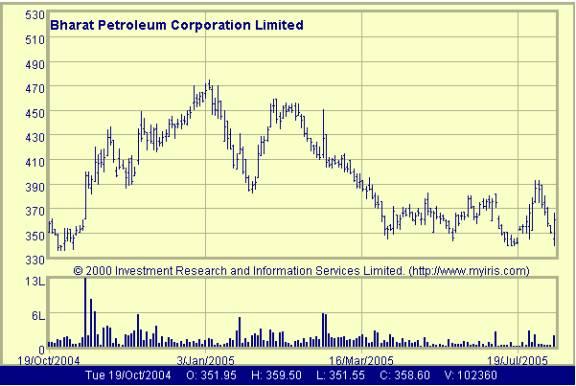
typically oil companies make good profits through forward contracts, hedging etc during rising oil prices (more so if they are vertically integrated). But the indian oil companies are actually down when the overall market is up ( see chart )
To provide cushion for under-recoveries — Standalone refineries may be merged with oil marketing cos — From hindu business line
Our Bureau
New Delhi , Aug. 17
THE Ministry of Petroleum & Natural Gas is weighing the option of merging pure refining companies with oil marketing companies (OMCs) to enable the latter to cushion the impact of high global crude oil prices on their bottomline.
Due to the freeze by the Government on raising retail prices despite the rise in raw material cost, the fuel retailing business is seen as becoming economically unviable, resulting in OMCs such as Indian Oil Corporation, Bharat Petroleum Corporation, Hindustan Petroleum Corporation and IBP suffering losses.
However, standalone refiners in Chennai, Kochi and Mangalore are making profits as they get the international price for the fuel they produce.
Asked whether the Petroleum Ministry was contemplating such a move, the Petroleum Secretary, Mr S.C. Tripathi, told Business Line that, “various options are being considered. In view of the high crude oil price scenario, some serious structural changes could be made in the downstream sector.”
About the suggestion made by the Committee on Synergy in Energy to oil companies asking them to consolidate their businesses, the Secretary said, “we are keeping that also in view.”
Explaining the rationale behind such a consideration, a Petroleum Ministry official said standalone refiners were currently earning huge margins, while the OMCs were taking a hit. The merger could help in sharing refining margins with OMCs. “But this is a long-term view and may take some time,” he said.
Meanwhile, the bleeding OMCs have been seeking a revision in the prices of the four petroleum products – kerosene, LPG, petrol and diesel.
The companies have incurred a cash loss of Rs 1,516 crore in July. They have sought Rs 5.29 per litre increase in petrol and Rs 4.54 a litre hike in diesel prices. Indications are that the Government is unlikely to consider the price revision before the end of the current session of Parliament.
Also, negotiations were on with the Finance Ministry to consider an excise duty cut, senior officials said.
The Government may consider a hike between Rs 1 and 2 per litre each combined with excise duty reduction on petrol from 8 per cent plus Rs 13 a litre to 8 per cent plus Rs 12 a litre and that on diesel from 8 per cent plus Rs 3.25 a litre to 8 per cent plus Rs 2.25 per litre.

Hotel stocks – some number
Pulled out these number from the equityresearchindia website. Pretty depressing economics ….guess one can make money on one can catch the inflexion point when the economy is turning and the hotel industry is poised to do well …
2005 2004 2003 2002 2001 2000 1999
A) Return on Equity (i x ii) 9.20% 4.40% 3.20% 4.40% 8.90% 9.50% 11.90%
i) Return on Total Assets
4.70% 2.10% 1.60% 2.40% 5.20% 5.90% 7.90%
ii) Total Assets To Total Equity
2 2.1 2 1.8 1.7 1.6 1.5
B) Return on Total Assets (iii x iv) 4.70% 2.10% 1.60% 2.40% 5.20% 5.90% 7.90%
iii) Net Profit Margin
11.10% 6.60% 5.60% 8.20% 13.90% 15.40% 17.20%
iv) Total Assets Turnover
0.4 0.3 0.3 0.3 0.4 0.4 0.5
C) Total Assets Turnover (v / vi) 0.4 0.3 0.3 0.3 0.4 0.4 0.5
v) Total Income (Rs. Cr.)
3103 2452 2052 1924 2241 2012 2078
vi) Average Total Assets (Rs. Cr.)
7374 7597 7023 6577 5959 5260 4495