
Blog

PSU mining stocks: More than meets the eye!

P
At first blush, mining stocks are a value investor’s dream. A company with a mandated monopoly, earning around 50%+ net margins and almost 400%+ return on capital should be an ideal opportunity. On top of that if this business sells for 7-8 times cash flow, it is like hitting the jackpot!
Is the stock market nuts to ignore such companies?
Let’s look at the numbers
Let’s look at some of the Government owned mining companies. I will look at two examples in this post – NMDC limited and GMDC (Gujarat mineral development corporation).
NMDC is the largest iron ore producer in India, with an annual production of around 26MMT per annum. The company earned around 12680 Crs in 2011, mainly through the production and sale of iron ore. The company made a net profit of around 50% and earned a return on capital of around 400 % (after excluding the excess cash).
The net profit has grown from around 2300 Crs to almost 6500 crs in the last five years, mainly due to the rise in iron ore prices (as volumes have grown only by around 10% during the same period). The company has around 17000 Crs of excess cash and can easily meet capex requirement from the interest income alone.
The company is also selling at around 6-7 times free cash flow (excluding the cash)
GMDC is one of the largest lignite producer based in Gujarat. The company earned around 375 Crs on a topline of around 1400 crs in 2011. The company made around 25% net margins and around 25% return on capital (excluding excess cash). The company has grown the topline and profits at around 18% p.a in the last 10 years.
As you can see, the numbers look good and are likely to be maintained as iron and Lignite/coal continues to be in high demand (With imports being far more expensive)
Why is the market discounting these companies?
There is more to these companies than meets the eye. The numbers look good for a specific reason – These are government mandated quasi monopolies, which have preferential access to these mineral resources. A private company cannot get license to a mine (other than for captive purposes).
In addition, even if a company were to get a license, it would take a lot of effort and money for the company to get all the clearances to operate the mine. These factors add up to a meaningful competitive advantage.
The flip side of this advantage is that these companies are run by the government as it sees fit and not necessarily for the benefit of the shareholder (or maybe the general public too – which is a different issue completely)
The impact of government control
There are several obvious and non obvious impacts of government ownership . For starters, these companies are not in the business of maximizing shareholder value. These companies exist to serve a specific objective, as decided by the government.
For example, NMDC’s objective seems to be to expand the mining operations to meet domestic and international demand. It has managed to make a lot of money in the process, but the excess capital has not been returned to shareholders. You may argue that this is true in case of a lot of companies. However in all such cases, where the management (private or public) uses the capital inefficiently, the stock market takes a dim view and does not give the company a high valuation
In case of NMDC, the company has now decided to invest in a 3 MTPA steel plant at the cost of around 15000 Crs. You can call this as forward integration, but I see this as a high return business investing in low to average return business – not exactly a value enhancing decision.
In case of GMDC, the company is now expanding into power generation. Power generation in India, is a very tough business with poor free cash flow. In case of the GMDC, look at page 56 of the annual report –  The mining segment made almost 570 Crs on 60 Crs of asset (1000% !),  whereas the power segment made around 57 crs on 1300 (less than 5%).
I hope you can see the pattern here – We have a very profitable business in mining (due to the government policies) and the big profits from this business are being invested into some very mediocre businesses (again due to the government)
Isolated cases ?
The above example may be seem to be a case of related diversification. The problem with such related diversification is that the bureaucrat making these decisions, is doing it with some non financial objective in mind (nation building !!) and does not care about the return on capital
In addition to all these lofty goals, there are smaller cases of waste of capital too. NMDC recently acquired sponge iron limited for around 80 Crs. This is a  30000 TPA producer  of sponge iron with a sale of around 65 Crs and loss of around 10-15 Crs per annum. In comparison , Tata sponge iron has a capacity of 300000 TPA , made a profit of around 100 Crs and sells for around 300 Crs (net of excess cash).
GMDC has several such cases of cross holdings in other PSUs, guest houses and what not!
The above cases are small, but indicative of the way these companies are being run.
Should one avoid these companies?
I am not indicating that these companies are to be avoided at all costs just because they are controlled by the government. On the contrary, there are several PSUs which are run much better , where economics and not politics is the driving factor.
In the case of mining companies one should not get infatuated by the huge cash profits being made by the company, but also look how these cash flows will be utilized. One can expect  to receive decent dividends over time in case of some of these companies, but the intrinsic value of these companies is unlikely to grow rapidly (more likely at around 10% per annum).
The bladder theory is very much at work in these companies – When  management  and more so the government has too much cash, there is a high tendency to piss it away.
What do you guys think? please share your thoughts in the comments
Stocks discussed in this post are for educational purpose only and not recommendations to buy or sell. Please read disclaimer towards the end of blog.
Analysis: Globus spirits

A
Globus spirit is a 500 Cr spirits company with four divisions. IMIL (India made India liquor) accounts for 50% of the revenue of the company. The company enjoys a dominant market share in this segment in the states of Haryana, Rajasthan and Delhi.
Franchise IMFL (bottling operations for other companies) is the second largest segment with a revenue share of around 20%.  The company has bottling ties up with companies such as Jagajit industries, ABD etc. This segment allows the company to utilize its manufacturing facility fully and thus earn additional return on its fixed assets
The bulk alcohol and IMFL are the other two segments with revenue share of around 10-12%. IMFL is premium alcohol business with brands such as Country club and Hannibal rum. The bulk alcohol business sells ENA to other companies including the fuel companies and is a lower return, commodity business
Financials
The company has grown its sales from around 68 Crs in 2005 to around 700 Crs by 2012. This translates into a CAGR of around 40%. The net profits have grown during the same period at around 50% per annum, starting from a low base of 5 Crs in 2006. The company has been able to improve its net margins from 6% level to around 8-10% in 2012.
The company has been able to achieve an ROE of around 18% on average with a low debt equity ratio of under 0.3. The company has been adding to its capacity, which has gone up from 28.8 Million liters to around 84.4 Mn liters in the current year. This capacity addition has resulted in the fixed turns dropping from around 5 to around 1.8 in 2011, as the entire capacity is not being utilized yet.
Positives
The company is a consumer products company where the demand for the product is on the rise. In addition, the company has a fairly high market share in the IMIL segment which is a rapidly growing segment with lesser competition. This segment, though price sensitive, is not completely a commodity business.  The company has an established distribution network in the states of Haryana, Rajasthan and Delhi which can leveraged for future launches.
The company has now started expanding in the IMFL segment too with launch of several new brands and is also planning to expand into new states. This segment is however competitive and will require substantial investment in building the brand and distribution network.
Finally the company has added substantial capacity in the last few years which is being used for the franchise bottling (bottling other brands) or for bulk alcohol sale. The company can easily reduce the bulk and franchise bottling sales as the sale of its brands increase (which generate higher margins)
Risks
This industry is worse than the sugar, tobacco and possibly real estate in terms of regulations. The government considers alcohol as an evil and over time has had a love hate relationship with the industry. The love part with the industry is due to the high level of taxes (highest after sales tax) and the amount of black money which can be generated via the grant of licenses for manufacturing and distribution. Needles to say, the industry is quite murky in its operations.
In addition to the regulatory risks, the industry has very poor corporate governance standards (think UB group). As a result, it is not easy to trust the published numbers in this sector.
At the company level, Globus is comparatively a new player and hence faces the uphill task of building a distribution network and brands from scratch which is quite an expensive proposition. In addition there is quite a bit of competition, especially in the premium and super premium segment.
Competitor analysis
The industry is dominated by united breweries and united spirits, both owned by the UB group. These two companies account for more than 50% of the entire industry. Inspite of such a dominance, the group has a net margin in the range of 4-5% and measly 10-12% ROE with high debt levels.
 I am not able to understand why the profitability is so poor, inspite of the dominance. The comparable company for United spirits is Diageo, which makes close to 15% margins and has 40% ROE. Clearly alcoholic beverages are a very profitable business globally. Anyway i am not interested in these two companies, due to their corporate governance.
The other player in the industry – Radico khaitan has similar net margins, but a much lower debt equity ratio (0.7) and an average ROE of around 12%.  The fourth largest player which is listed, is tilaknagar industries. The company has a margin in the region of 7-8% and  a similar ROE of 12%. The company had a much higher debt in the past, but has been able to reduce it in 2011 by raising some equity.
You may notice that I have hardly discussed about the brands of the above companies. There are two reasons for it. The first reason is that strong and well known brands are often a necessary, but not a sufficient condition for high returns on capital. Clearly in the case of the above companies, brands such as kingfisher or Bagpiper  though well know, have not added to the profitability. As an investor, I am more concerned about the profitability of the business
The second reason is that I don’t drink now (used to in the past) and hence am not abreast of the latest brands. At the same I don’t think that is a disadvantage to me as an investor, as I also have never used  a textile machine (LMW) or tiller (VST industries) to be able a informed decision on these companies
In conclusion, one would expect the industry to have remarkable economics in a product which is addictive and has brand loyalty, but unfortunately the numbers are even worse than the cement or steel industry (where atleast the leaders are quite profitable)
Valuation
The valuation in the case of globus is more of a subjective exercise. The company sells at around 6 times earnings and appears cheap by quantitative measures. The  company is cheap only if you believe that the company’s expansion into IMIL and IMFL segment will be successful and the company will do better than the industry (which has lousy economics for varied reasons). If the company can maintain the current margins and continue growing at 20% rate, then it is cheap.
The margins could dip due to higher expenditure in marketing and distribution and the asset turn could drop due to additional capacities for the franchise bottling and bulk alcohol. If the returns trend towards the industry averages, then the company appears to be fairly valued (which is what the market is assuming)
Conclusion
As you can see, I do not have a specific view point on the company.  Although the company operates in an industry with very poor profitability, it has been able to deliver above average performance with low amounts of debt. I am not completely sure if the company will be able to sustain this performance as it is usually quite difficult for companies to rise above the industry economics.
I plan to analyze the performance of the company and track it for sometime before I become more comfortable with it. In the meantime the price could always run up, which is a risk I can live with.
Stocks discussed in this post are for educational purpose only and not recommendations to buy or sell. Please read disclaimer towards the end of blog.

The value of a buy list

T
update 23/03

I have rarely received as  many comments and complaints about the customer service and the overall business model of a company as mahindra holidays.
 
I picked two companies randomly from my list to illustrate the investment process of maintaining a list. The purpose of the list is to track stocks after they pass an initial filter and dig deeper when the price is right.

The first pass analysis in case of Mahindra holidays, clearly failed in my case and has highlighted (to me) the danger of superficial analysis. I am glad that i learnt an inexpensive lesson and any damage was mainly to my pride and not to my wallet.

If you were thinking of purchasing any of these stocks based on this post, i hope it has highlighted the risk of buying something based on someone else’s analysis.

Thanks all for your comments !
—————————————————–
I am usually looking for new ideas on a regular basis. It is not difficult to find a good company, but the challenge is in getting a good price. High quality companies with competitive advantage and good management usually sell at or above fair value, unless these is an industry specific issue or a macro scare which causes the price to drop below the fair value.

As one cannot know in advance (at least I cannot) when the market will throw up bargains, I tend to analyze a company and then park it in my buy list. I use this list to track the price to fair value and to evaluate the fundamentals of the company on a regular basis.
Let me give two examples to illustrate how I track these companies. The notes below are my rough notes and thoughts.
Mahindra holidays
Intrinsic value : 410
Company description: The Company is the no.1 vacation service company with 70% market share. Company has 125K time share customers. In addition company also has travel and is now catering to corporate customers too.
Reason for buying:
1. Company has an ROE in excess of 25%, 0 debt and net margins of 20%+
2.Company has grown topline at 30%+ and profit @ 50%+. Likely to grow at 20%+ levels in future
3. Company has been in biz for 15 yrs, has a well know brand, extensive distribution/ sales network and also 35+ properties
4. Company is adding new properties and adding new products too.
5. Good growth is likely as domestic tourism is growing rapidly and company has captured only a small piece
Reasons for not buying:
1. Valuations are high @ 20 times earnings
2. Company slowed down in 2011 to improve process and business (need to dig into it). Also customer churn not clear – could be high (10%?)
Current thoughts (as of 4th Jan)
Not creating a position mainly due to valuations
Suprajit engineering
Company description : The company is the no. 1 mfg of automotive and non- automotive cables. It has the highest market share in the domestic market.
Reason for buying
1. The company has maintained an ROE above 20% for the least 10+ years.
2. The company has compounded topline and bottom-line by 20% in the last 10 years (although the growth has been in spurts)
3. Company is sole supplier to companies such as Hero Honda, Bajaj and also supplies to companies such as maruti suzuki, GM, BMW and other global companies
4. Competitive advantage from scale, good customer relationship and smart management.
Reason for not buying
Company has had periods of low and high growth. Auto business is slowing down and we could see slowdown in growth and margins in the next few quarters. Should evaluate in the next 2-3 months
Current thoughts (of 17-June)
Check Q2 results and then take decision. Risk is the company would continue to do well and the price may run away (less likely as auto smaller auto companies do not get high valuations).This is unlikely to be a PE re-rating idea and more a EPS expansion idea
Why do this ?
I started maintaining this list in the last 2-3 years.  There are multiple reasons for it.
The first reason is that I don’t have a very good memory and cannot remember the analysis of a company after some time. I could always delude myself, but think that accepting my limitations is a much better alternative. Once I have analyzed a company, I keep rough notes in this buy list and can refer to it regularly. This helps me in tracking multiple companies and allows me to benefit from my past work.
The second reason for keeping these notes is that the price may not be right at the time of analyzing the company. As a result, if I keep a note of the company, I am able to act quickly when the price drops below my target range. A lot of times such a window opens up for a short period  and it makes sense to act quickly at that time. For ex: financials and banks in Dec 2011. It is difficult for me to analyze a company in depth in a short period of time and all the work done in the past is very useful at such times.
The final reason is that this list is a repository which  will keep building with time as I analyze more and more companies. This should help me in tracking companies and acting on them quickly at the right time. It’s like my personal gold mine 🙂

Stocks discussed in this post are for educational purpose only and not recommendation to buy or sell. Please read disclaimer towards the end of blog

The Dilemma

T
I have several dilemmas in life – such as should I eat jalebis and other good stuff or go to the gym? Sleep late or go to office? But as these dilemmas are of no concern to others, I will leave them for my own thoughts
The investing related dilemma I have always faced and more so during a market crash is this – Should I invest in the high quality companies whose price has dropped a bit or the low quality cyclicals where the price has collapsed completely. I have tried both and will try to present how my thinking has changed and where it stands today.
Let’s look at two specific examples – one of a high quality and other an average company. The high quality company is one of my long term holdings – CRISIL and the other company is Denso India, which I have long exited.
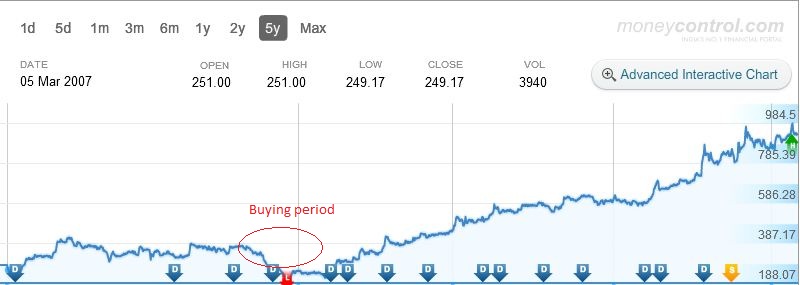
The chart below is of crisil
I wrote about  this company earlier in 2009 and have held the stock since then. As you can see the company and the stock has not disappointed and have done far better than what I expected at that time.
I have had an eye on crisil for quite some time and finally took the plunge in 2009. It is easy see that the company has an enormous competitive advantage due to government mandated status of a certified credit rating agency and brand. In addition the company requires minimal capital to grow (mainly office space and some computers). The company is thus like a toll bridge which does not require any capital expense.
The second example is of denso India. I wrote about the company here. The company was a cash bargain (stock price below cash on hand).
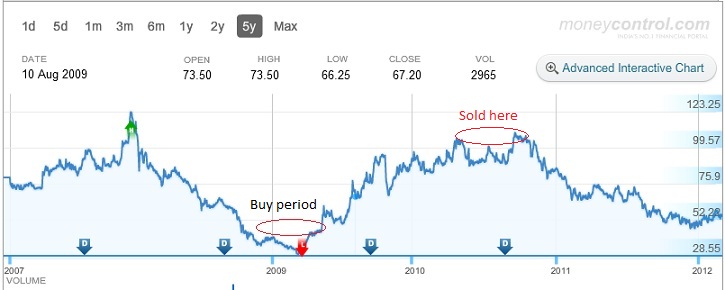
This is the chart for denso India
I was able to buy at an average price of around 40 and exited at around 85-90 bucks. In hindsight, it turned out to be good operation. However as you can see from the chart, the stock has been sliding since then as the performance of the company went south in 2011.
Where’s the dilemma?
Some of you may be thinking – what is the dilemma here? You made money in both, so both options are great. Case closed.
I don’t think that one should reach that conclusion here. In the case of crisil, the company has been able to increase its intrinsic value at a good pace and the stock price has followed suit. I had to make a one time decision to buy the stock and since then have just sat on that decision.
The case of Denso india is more complicated. The company appeared to be a complete bargain in 2009 and in comparison to crisil was much cheaper. At the same time, the company did not have much of competitive advantage. The trick was to buy the company when it was dirt cheap and get off the bandwagon when it was merely cheap.
This is a more complicated operation than it appears on the surface. One had to time the buy pretty well. If you had bought too early, say in mid 2008, the eventual gains would have been around 30-40%. In addition the sell decision also had to be timed correctly. If you sold in 2011, the gains would have been paltry. I  was unusually lucky in this case.
Thus in the short term,  gains are much higher in Denso type stocks. However one has to make more decisions and then also find a new idea to re-invest the capital. In the case of companies such as Crisil, once you have made a buy decision, you can just wait and watch the magic of compounding take effect
So what is a good option?
If you have tendency to constantly ‘do’ something and want some action, then denso type stocks are a good option. If however, you can live with a few percentage point lower returns with the benefit of much lower effort and headache, then Crisil type of stocks should be your target.
In my case, I do have this tendency to constantly do something. As a result, I am always looking for the next new and shiny stock for my personal portfolio to get that extra return. At the same time I manage my family’s portfolio too. In that portfolio,  I have made the decision to buy high quality , fairly priced stocks and let them compound. The returns could be a bit less, but the risk is much lower and the heartburn almost non-existent.
Following is my partial list of high quality ‘wish list’ stocks
HDFC bank, Titan industries, ITC, Marico, Hero motorcorp, HDFC limited and nestle india.
Time  for some jalebis now . Gym can wait J

My personal ten commandments

M
I have a few thumb rules in investing which have helped me a lot of over time. These are not some universal  ten commandments but they have kept me out of trouble, especially the tenth one !
Thou shall not buy a stock on a broker or a TV channel’s advice
Thou shall not trade
Thou shall avoid predicting or investing based on short term forecasts or outlook
Thou shall not chase momentum stocks
Thou shall not invest in an IPO.
Thou shall not use leverage
Thou shall learn to live within means so as to have investible funds
Thou shall not buy gold, commodities or any kind of fancy and complicated instruments
Thou shall not chase returns – if it is too good to be true, it is a trap
Thou shall say ‘Yes Dear’ when asked by wife if she looks good in a dress  – most important rule to have  a happy married life J .
You can choose to ignore the first nine rules based on your personal style of investing, but if you ignore the tenth rule – do so at your own peril !!!

Raising portfolio quality

R
A bear market is a time for lots of activity for me. A 25%+ drop in 2011, with a near collapse towards the end of the year, threw up a lot of opportunities. During such times, the problem for me is that my portfolio soon starts resembling a zoo – it has a stock of each variety.
How do I end up in such a place?
I personally ignore short term forecasts and start buying a company (usually too soon) if the valuations are attractive and the long term prospects are good. The problem with this approach is that there is no grand strategy behind it. As a result I often end up with too many stocks in my portfolio
I have gone through such a phase several times in the past (in 2005, 2008 etc) and have had to prune my portfolio after that. This time around, I made a decision to limit myself to around 22-25 stocks and any further addition would require me to sell something – keeping the total number the same.
Now, one may argue that even 20-22 stocks are too many and one should have a more focused portfolio. Let me assure you that once I gain more experience and hopefully some wisdom, I will scale back the number to 15 or less. Till then this level of diversification is an insurance against my ignorance or stupidity.
So why limit yourself?
A different way of looking at this issue is to question the need to limit oneself to any fixed number of stocks. If you can find enough good and cheap stocks, why not load up on all of them?
I have followed this approach to a small extent in the past and have realized that this results in mental laziness. Once I buy a stock, the endowment effect kicks in and then I am reluctant to change my opinion on the stock even if the company is performing below average.
In all such cases, I have finally come to senses and have sold the stock usually at a small loss. The real loss however is the opportunity cost of deploying this capital in some other high quality idea.
What is the difficulty in exiting?
It would seem very easy to exit such stocks on a purely rational basis.  You look at the original thesis of the purchase (for example – the company will grow at X %) and compare it with what has happened since your purchase. If the company is performing below expectations and will continue to do so, then you sell the stock and move the capital to a better idea.
If only life was this easy ……
The emotional part
I find the emotional part of selling a stock, which has not done well to be a painful exercise. For starters, one has to admit that one has been wrong or unlucky (usually wrong) and in hindsight should not have bought the stock.
The next problem is to find another idea to replace the one being sold, which in turn will hopefully not be dud.
The worst of both worlds is to see the old stock soar in value after the sale (yes, I have had this one too – VST industries) while the new pick stagnates.
Selling to raise the quality
There are times when if you are fully invested, the only way to invest in a new idea is to sell an existing one. I have created an artificial constraint by limiting myself to 20-25 stocks. This constraint has now forced me to rank my stocks in an order and to look for the weakest ideas in the portfolio.  How do you do the ranking? Well that’s another post, and stock price is not the only criteria.
The weakest idea now gets compared to the new idea and if the new idea is much better, then it replaces the weaker one. You can call it the survival of the fittest – each stock has to earn its position and cannot just stay put in the portfolio. There are no holy cows!!
So which of my ideas are facing the axe? Some minor ones have already been axed. I have been reviewing the Q3 results and have a few more on the chopping block now (this one is a good candidate)
Selling the mediocre ideas to buy a more attractive stock is always painful for me, but over time I have found that my overall performance has benefitted by swallowing my pride and biting the bullet.

Stocks discussed in this post are for educational purpose only and not recommendations to buy or sell. Please read disclaimer at the bottom of blog.

A bet on china : MOIL

A
This title must have made you wonder – now what leap of logic is this guy having here ?
Let me walk through the logic to prove to you that I have not lost my marbles (not yet !)
An IPO and frenzy
MOIL came out with an IPO in late 2010 and there was quite a bit of frenzy around it. I think the IPO got oversubscribed by 25 times which shows the level of investor enthusiasm. In my case, I have a personal rule – I never invest in an IPO ( I have written the reason here). As 80% of the IPOs are overpriced and quite a few are junk anyway, I would rather miss a few good chances than be stuck with a lot of duds.
I was asked about MOIL then by a lot of readers on the blog, and due to the above reason I did not look closely at the company.
So why now ? The simple reason is that the stock has dropped quite a bit since then and investor sentiment is a bit negative now. Any time a stock drops or almost everyone gets negative on something, you will find me fishing in that area.
Why the drop ?
MOIL is a mining company and derives almost 80-90% topline and profit from manganese ore. Manganese is a key input in steel making and hence the demand and price for manganese depends on the demand outlook for steel.
MOIL has very high operating leverage. The PBT/ sales ratio has fluctuated between 48% in 2007 to as high as 78% in 2009. The profitability in case of MOIL is highly correlated to manganese prices and due to low levels of operating costs (minimal raw material and manpower cost) in proportion to the sales, any rise in manganese price flows directly to the net profit.
In times of high demand and lower supplies of manganese, the international price for the same has gone up by 30-40% and driven up the profitability for the company. The company was coming off such a peak at the time of the IPO.
In a commodity business, high prices result in capacity addition which in turn drives down the price of the commodity. In case of manganese, South Africa and Australia are big producers  and have increased supply in the recent past. India imports manganese ore as the domestic supply is inadequate for the steel making and for making Ferro alloys (which are exported). As a result, the price of manganese in India is dependent on the international price.
The international prices for Manganese has dropped from their peak levels and so has the profit level for MOIL. Hence the drop in the stock price
So where does china come in ?
I hope you have followed my logic till now – manganese is used in steel making, South Africa and Australia are big producers, India imports manganese and hence manganese prices in india are dependent on international prices, which have dropped in the recent months
So what drives international prices for manganese ? China !
 China account for 50%+ of steel demand globally and is largest consumer of manganese. If china grows, demand and price for manganese goes up. If china slows down or has a hard landing (as some are suspecting), then steel and manganese demand will drop and so will the prices
Sooooo…the profitability in case of MOIL is tied closely to what happens in china
Should you buy MOIL?
If you have a view on what will happen in china in the next 1-2 years, then you may be able to make a decision. In my case, I cannot predict what will happen to the Chinese economy, Indian economy and Indian cricket team (maybe Indian cricket team !) and so I will stay away.
At the same time in the longer run as the company adds more mining capacity and acquires new mines (using the 2000 Crs cash on the book), it will become more valuable. At a certain price, the market may discount a further drop in manganese price and more . I will definitely start looking at the company more closely when everyone thinks it is the worst possible stock.

Stocks discussed in this post are for educational purpose only and not recommendations to buy or sell. Please read disclaimer at the bottom of blog.

The advantages of part time investing

T
Does the professional investor, FII or the institutional investor have a big advantage over the small, part time investor?
Fact 1: The professional investor has access to in-depth research on a large number of companies. They also have access to the management and other industry professionals which allows them to cover an industry in depth and finally they do this on a full time basis. How can you beat that?
Fact 2: Very few mutual funds and institutional investors are able to beat the market over the long term (5+ years). In case of developed market such as the US where the performance numbers are more readily available (including those of hedge funds), only a handful can beat the market by a few  % points.
How does one explain these two contradictory facts?
There are several reasons for this contradiction and I will explore some to highlight how a small investor like you and me can still score over the big boys.
The over emphasis on industry knowledge
The number one advantage cited is that the professional has access to in-depth analysis of an industry and can thus make better decisions. I think this advantage is overrated.
As an individual investor, if one really wants to learn about an industry, a good starting point is to read the annual reports of the top 3-4 companies in the industry. In addition there is a wealth of information available on the internet which one can Google to explore an industry in depth.
In the pre-internet days, the professional investor had substantial advantage over the part time investor but now a lot of information is available at the click of a button.
The other point cited by those trying to sell you funds and other such products is they have access to the latest data on the industry. I don’t think this is a big advantage to a long term investor. If your time horizon is 3-4 years, then getting the monthly sales figures before everyone else is hardly of any advantage unless you want to trade on that information.
Professional behavior
The other advantage of the professional investors is assumed to be their experience and ability to act more rationally than the small investor. I have not seen any evidence which shows that the professionals are more rational than the rest of the market.
Several fund managers and FIIs have portfolio turnovers in excess of 100%, which means that these professionals have an average holding period of less than 1 year. In addition if you look at the FII behavior, they demonstrate the classic herd behavior – exit the market when everyone is doing so and re-enter when the market starts picking up or has already risen substantially.
The net effect of constant turnover and herd behavior is higher cost (transaction costs) and lower returns over the long term.
As an individual investor, I do not have the pressure to follow others or excessively churn my portfolio. I can afford to hold a stock for 5 years, if the long term outlook for the company is bright even if the short term price performance is expected to be terrible
The institutional pressures
The point which is never highlighted by brokers and professionals is the problem of institutional pressures. Professional managers live by the quarter – though they ask their customers (investors) to think long term.
Any fund manager who under performs the market for a few quarters is at the risk of losing his or her job as the fund management company faces the risk of losing the assets due to redemptions. In addition, even if the fund manager is rational and long term oriented, they cannot afford to take unpopular decisions such as buying capital goods or financial stocks now as any underperformance due to such stocks will result in a career suicide.
This institutional pressure more or less forces the fund manager to buy the popular stocks and mimic the index  with minor variations in the long run.
The small investor like you and me has none of these compulsions. In my case, other than the risk of looking foolish (sometimes publicly or worse in front of my wife) in the short term, I don’t face the risk of losing my job or ruining my career due to any unconventional decisions. This is a big advantage over the big boys
Is there any disadvantage?
The key assumption in my arguments till now is that the small investor is willing and able to devote a reasonable amount of time in researching companies and following up on them. There is no short cut for that.
Can you think of any time in college where you did not attend any classes or even study a new subject on your own and still managed to do very well in the final exam (without cheating of course )?
I personally think that if you are interested in investing and willing to devote 5-6 hours a week consistently on it for a long time, there is no disadvantage of information or insight versus the professional.   On the contrary as a small investor, one does not face the institutional pressure and thus has an advantage over the professional.

One stock, three viewpoints

O
Confirmation bias is the tendency to look for confirming evidence to support an idea. As an investor, one of the risks is that once you like or fall in love with an idea, it is easy to ignore all the negatives and risks associated with the company.  In order to avoid this trap, I typically compare notes with my friends and fellow investors Ninad kunder and Neeraj marathe ( and a few more ).
We are all value investors who share the same philosophy and similar thought process. You would assume that if we look at an idea, we would come up with similar conclusions and more or less agree with each other thus re-enforcing the confirmation bias. 
The reality is much different. I have routinely found that we look at the same facts and arrive at very different conclusions. I consider this difference of opinion as a good thing as it helps me in avoiding confirmation bias when I bounce my idea with other investors.
Let’s look at a live example. In the last 2-3 months I have been analyzing one such company – NESCO. Both ninad and Neeraj have been looking at the same company independently and have arrived at their own conclusions.  I am posting my analysis of nesco below. You can read ninad kunder’s analysis here and neeraj marathe’s analysis here . We have decided to do a joint post to highlight the difference in our conclusions inspite of looking at the same company at the same time.
Moral of the story : Share you analysis with other smart investors who share your philosophy but are not your clones 🙂
About
NESCO is a real estate and capital goods company. The company has a parcel of land in Mumbai on which it has developed an exhibition centre (BEC- Bombay exhibition centre) and an IT park. In addition the company has a capital goods business – Indabrator group which has plants in Gujarat.
The company was originally a capital good company, but started incurring losses in the late 90s. The company res-structured its operations and moved the plants to Gujarat. In addition the company has a large piece of land in goregaon, Mumbai where it has developed one of the largest convention centres in India and is now developing an IT park on the same land
Financials
The revenue of the company increased from 16 crs in 2001 to around 145 Crs in 2011. This revenue growth although good, does not highlight the change in the quality of the revenue.
The company had a net margin of around 3% in 2001 and was equal parts a capital goods and Services Company (convention centre). Since then the capital good segment has more or less stagnated and the service segment has expanded with expansion in the convention centre and addition of buildings in the IT Park. The company earned a net margin of 48% in 2011.
The profits of the company, especially from the services business is entirely free cash and has been used to pay off debt. The company now has almost 200 Crs cash which is around 20% of the company’s market cap. The ROE of the company is now 35% and if one excludes the surplus cash, it is in excess of 100%.
The company is able to earn such high margins as the services business (convention centre and IT Park) involve upfront investment and very low operating expenses. In addition the company’s business is now working capital negative due to minimal inventory (only in capital goods business) and low accounts receivables (due to customer advances for the services business).
Positives
The financial positives are listed in the previous section. The company is able to earn such high margins and high ROE due to the competitive advantage of the business. The company has been able to develop one of the largest convention centres in Mumbai which is not easy to develop considering the cost of land. In addition the company is developing additional buildings in the IT Park with the surplus cash (without incurring any debt).
The company thus enjoys a form of local monopoly (large piece of land at negligible cost on the books) and has used this advantage to develop an increasing stream of income. The company plans to re-invest the surplus cash into new buildings in the IT Park (building IV) which are high IRR projects.
The company has also re-structured its capital good business in the last 5-6 years and although this business is not generating attractive returns, it is not a big drain on the company.
Risks
The company has a large number of advantages and a steady cash flow. The business risk comes from a slowdown in the economy, which could impact the utilization of the convention centre and lower tenancy in the IT parks.
I personally feel the above risks are low and would be temporary in nature (will not impact the long term cash flow of the company).
The bigger risk is the re-investment risk. The company has developed 30-40% of the land and will continue developing the rest using the cash flow from the existing properties. In a period of 4-5 years, the company will be done with the development and could be generating 150-200 Crs of free cash flow with no clear avenues for re-investment in the business. At that point of time, the risk is that the management may re-invest the cash in all kinds of poor businesses.
Management quality checklist
Management compensation: The management compensation is around 3% of net profits which seems reasonable.
Capital allocation record: The management has allocated capital intelligently for the last 10 years and may do so for the next 3-4 years. It remains to be seen what will happen after that.
Shareholder communication: Management provides the mandated disclosure through its annual reports and details of the business are available on the website. The communication is adequate, though not extensive.
Accounting practice: The company has followed a bit of aggressive accounting in the past . During the period of 2000-2005, the company was re-structuring the capital goods business and also had accumulated losses. The company capitalized the VRS expenses and other costs and wrote them off till 2006 as it became profitable. The company has however followed conservative accounting since then.
Conflict of interest: None as yet
Performance track record: Above average in the last 10 years. The company has re-structured the capital goods business and expanded the real estate business which is a very high IRR business.
Valuation
The company is currently valued at around 800 Crs and has around 200 Crs on it balance sheet (which is likely to be used partly for IT Park IV). Net of cash the company sells for around 600 crs which is around 7-8 times the expected earnings for 2012. This valuation is low for a company which has an ROE in excess of 100% and can grow at 20%+ for the next 4-5 years with small amounts of added capital.
The above valuation appears low from a cash flow standpoint and the company can be conservatively be valued at 1600-1700 crs (twice the current market cap).
Another view point can be based on the assets of the company. The company has around 70 acres which itself can be valued at a minimum of 2000 crs (if not more). This does not include the value of the BEC business or the IT Park, which enhance the value of the land bank.
Conclusion
The company possess close to a local monopoly due to a large piece of land in a prime location. The management has re-structured its capital goods business and shifted focus to the real estate (exhibition and IT Park) business which has high profitability. The company is developing new projects (at high IRR) which should increase its profitability in the near future. In view the above the company appears to be undervalued as of writing this note.

Stocks discussed in this post are for educational purpose only and not recommendations to buy or sell. Please read disclaimer at the bottom of blog.

Subscription

Enter your email address if you would like to be notified when a new post is posted:

I agree to be emailed to confirm my subscription to this list

Recent Posts

Select category to filter posts

Archives